







Complete Guide to setting up search filters in WooCommerce (2022)

Anyone who's ever shopped online knows that search filters are essential to narrowing down your search based on specific criteria. A WooCommerce search filters plugin is the answer.

Search filters are among the most effective tools your customers can use when browsing through the product catalog in your WooCommerce store. They provide a quick and logical way for customers to find the products they're looking for. This tutorial will focus on WooCommerce filtering, but we also wrote a more general WordPress filtering guide.

Keep reading to learn how to enable WooCommerce search filters using two awesome plugins, and then how to add professional-level filters to your store.

What are search filters?

In most cases, search filters give customers a new way to narrow down their product searches. This can be done based on additional criteria other than the search term itself.

For example, imagine someone entering "shoes" 👟 into the search box and then filtering the results based on size ↕️ or color 🟥🟩. This will likely help them get a better match for what they need than typing "shoes" alone.

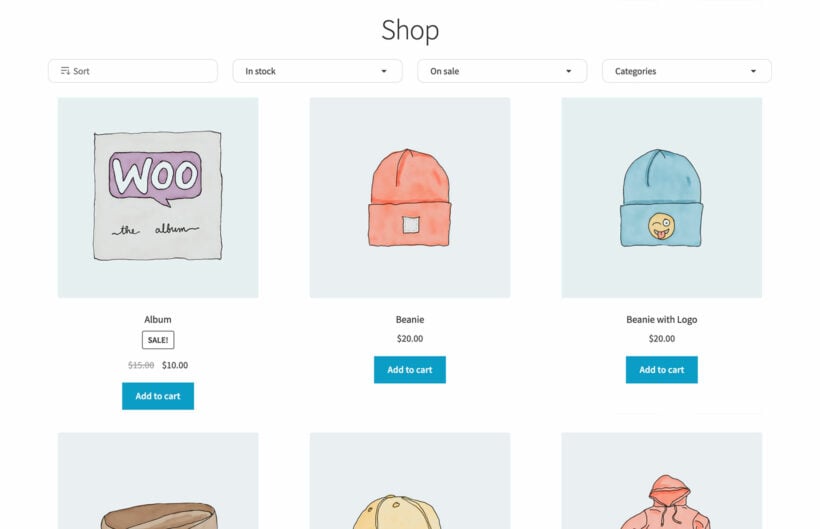
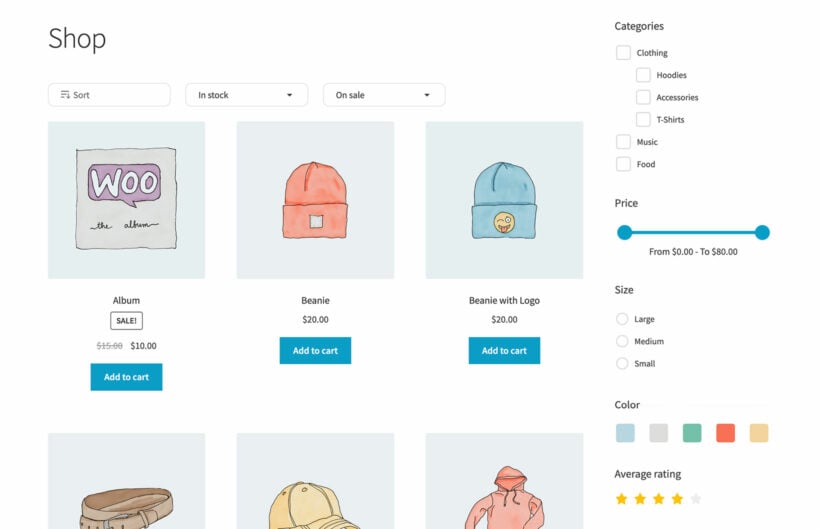
In practical terms, search filters appear as additional boxes/lists/buttons alongside the standard listings of products. For instance, it can be something like this:
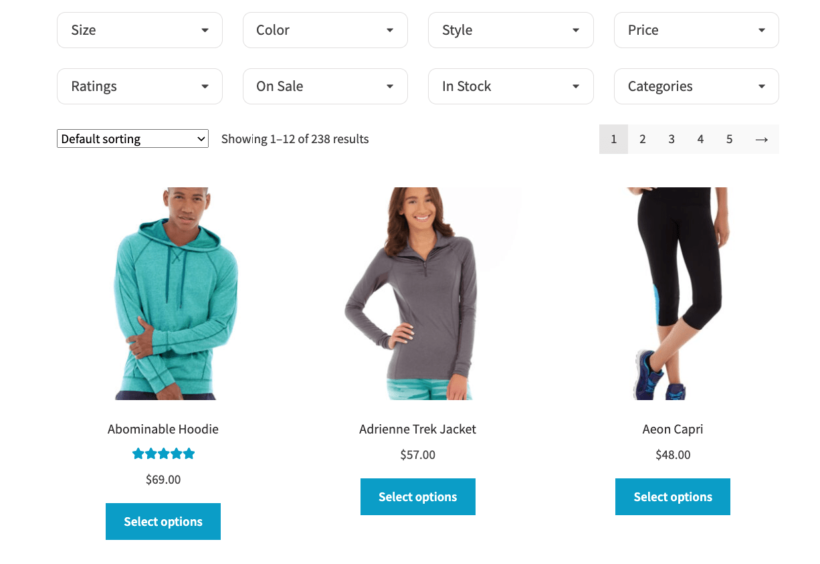
WooCommerce search filter dropdowns above a grid of products

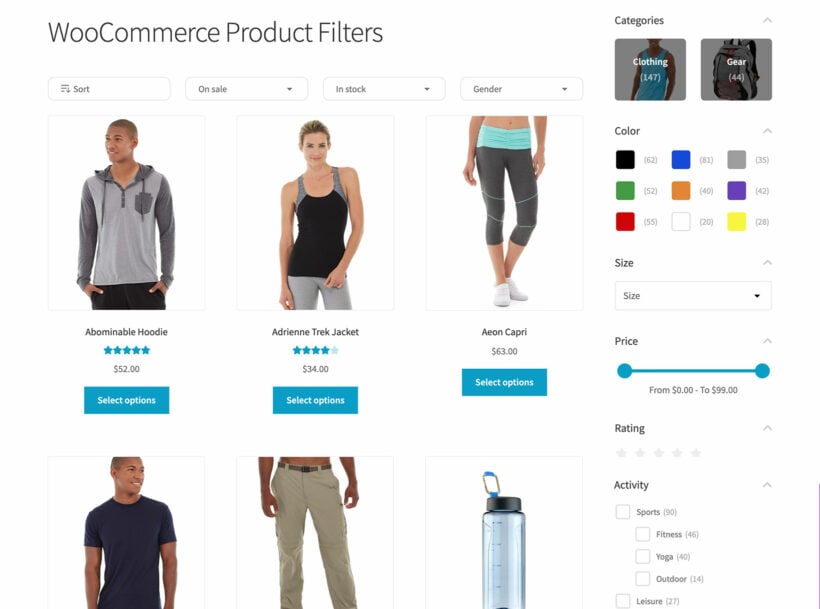
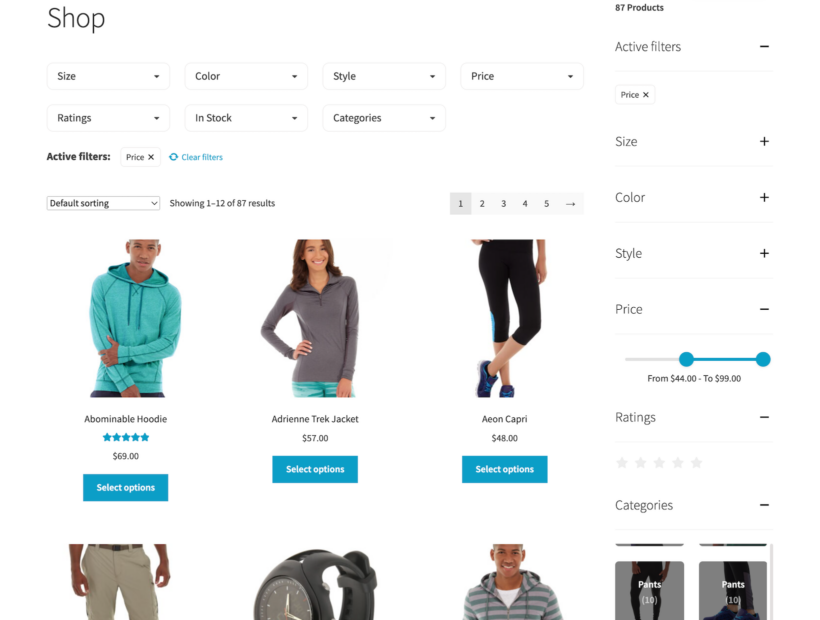
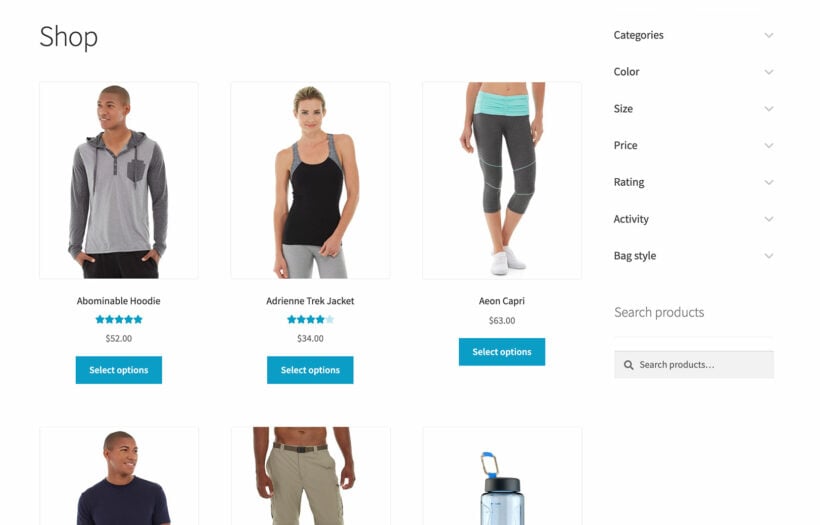
Some stores also like to put their search filters in the sidebar, like so:
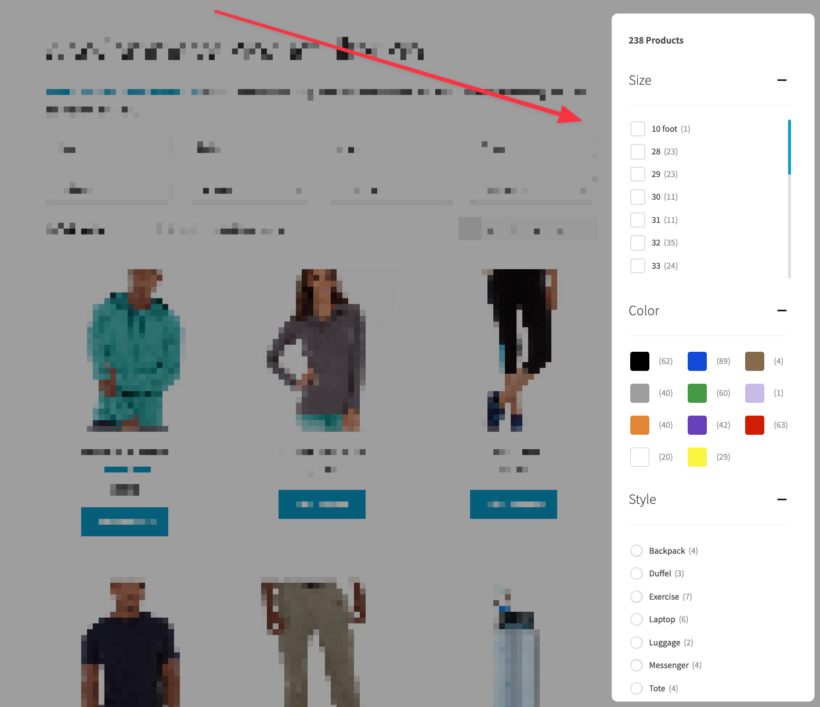
WooCommerce search filters in the sidebar

What makes search filters effective?

Search filters help store owners solve a user experience problem that's hard to tackle using other tools. They let your customers find products based on parameters that cannot be matched using standard text-based search.

For example, imagine someone who's looking for "black shoes cheaper than $100". If they type that into the store's search box, they'll find nothing. However, if the store owner provides a good filtering mechanism, then the customer can type "shoes" into the search box and set filters to "black" and "cheaper than $100", Or even better, you can eliminate any chance of mispelling or customer error, and let customers select "shoes" from a pre-defined list of categories.

This is especially useful in stores with tens or hundreds of products in the catalog. And even more so if those products are generally similar, but differ in a handful of key parameters, such as color, size, etc.

At the same time, search filters are very easy to use and intuitive. Years of shopping on Amazon have taught us all how to use filters efficiently.

Okay, so how to get search filters in WooCommerce? Are there any filters in WooCommerce by default?

No, there are not. Or at least, not effective ones that solve the problems that we described above.

To add professional-level WooCommerce search filters, you'll need to install a plugin.

The best WooCommerce search filter plugins

We want to show you two excellent search plugins, which you can either use alone or together to add search filters to WooCommerce.

WooCommerce Product Filters


This plugin allows you to create any number of WooCommerce search filters and then add them to your product listings or product search pages.

You can place the search filters either in the center part - above the list of products - or in the sidebar as a widget.

What the WooCommerce Product Filters search filters look like
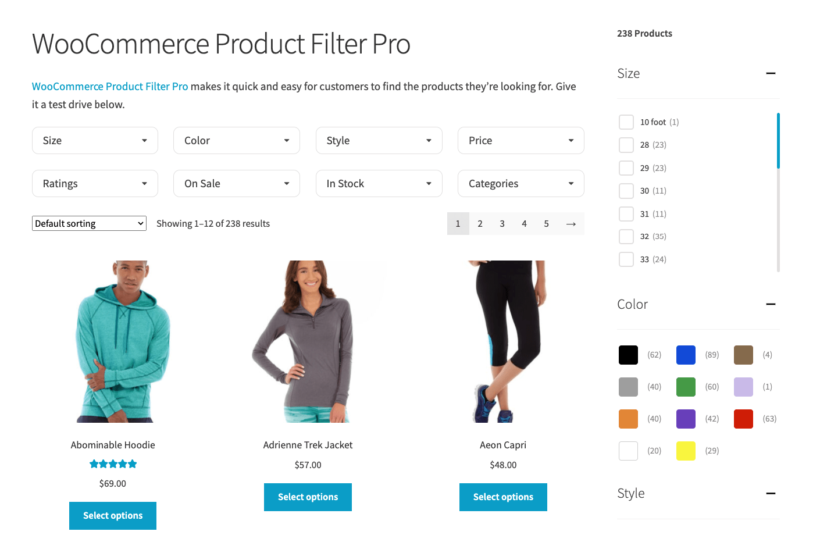
WooCommerce search filters for size, color and price above a product grid

When it comes to what types of filters can be created, it's basically anything you can imagine. Just to name a few possibilities, you can create filters based on:

  • Product categories
  • Product attributes
  • Colors (using color swatch filters for better customer experience)
  • Tags
  • Custom taxonomies
  • Price (of course)
  • User ratings
  • Whether the product is in stock or on sale

Then, the filters themselves can be shown as drop-downs, checkboxes, radio buttons, sliders, labels, or even images. You can pick how you want to display each filter based on its nature and how you think the filter works best for the customer.

Plus, you can use WooCommerce Product Filters together with the search box that comes with WooCommerce itself - and place your filters on any page you wish.
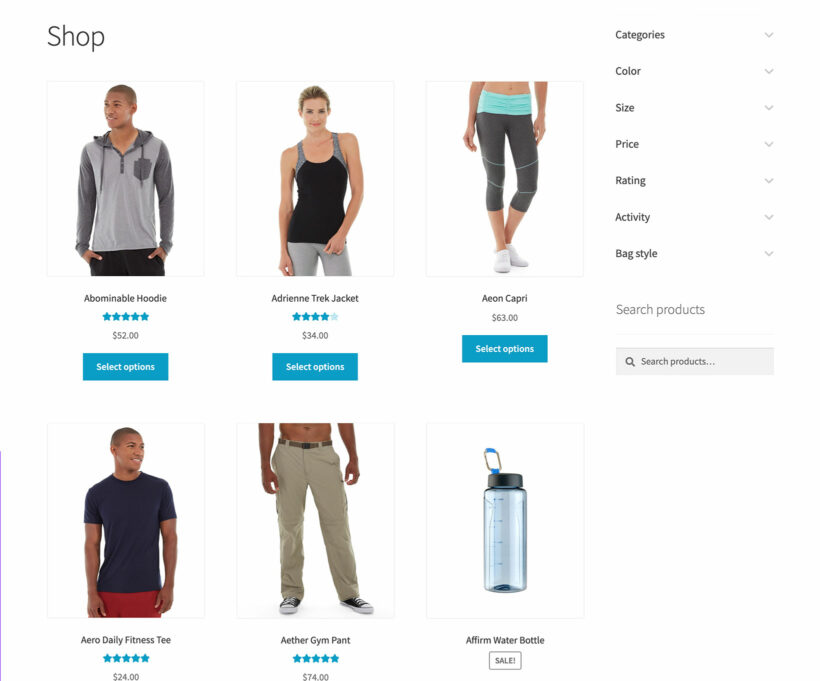
WooCommerce shop with collapsed sidebar filter toggles and a search box below the filters
A store with WooCommerce search filters and the Product Search widget underneath

How to set up WooCommerce Product Filters

First, get WooCommerce Product Filters. Next, upload it to your WordPress admin via Plugins → Add New → Upload Plugin, and click on Activate when the upload finishes.

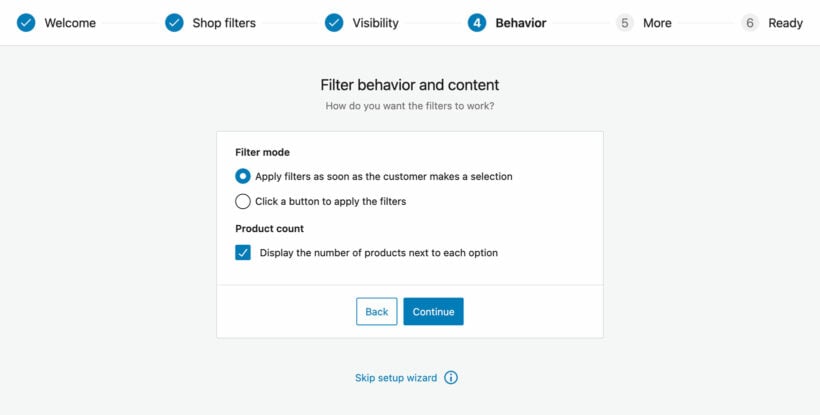
The setup wizard will open, promoting you to enter your plugin license key. You can also choose the main settings for your WooCommerce search filters. Here are just some of the things you can set:

  • Set if the plugin should do its magic instantly or wait for the user to click a confirmation button.
  • Decide whether to show filters on page load or hide them by default and only reveal once the user requests the filters by clicking a button. You get different settings for mobile and desktop.
  • Let users toggle each WooCommerce search filter open and closed to save space.
  • Change the text for buttons such as 'Apply Search Filters' and 'Clear Filters'.

With this done, the plugin is fully operational.

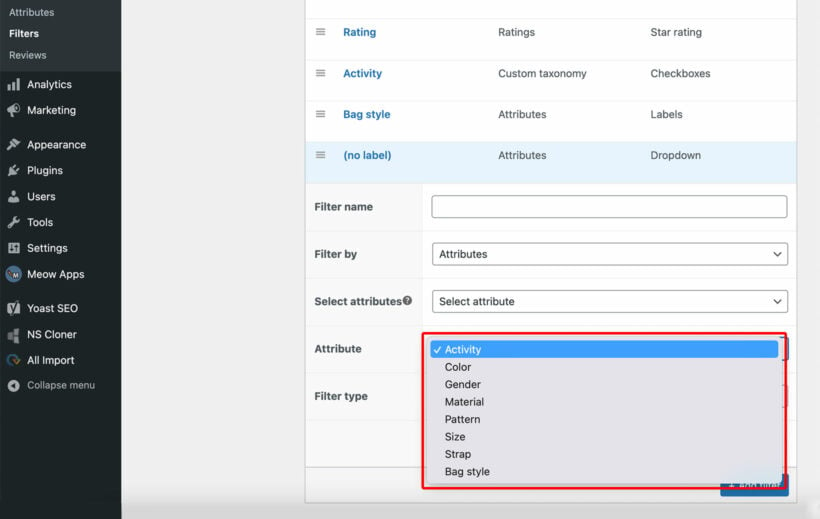
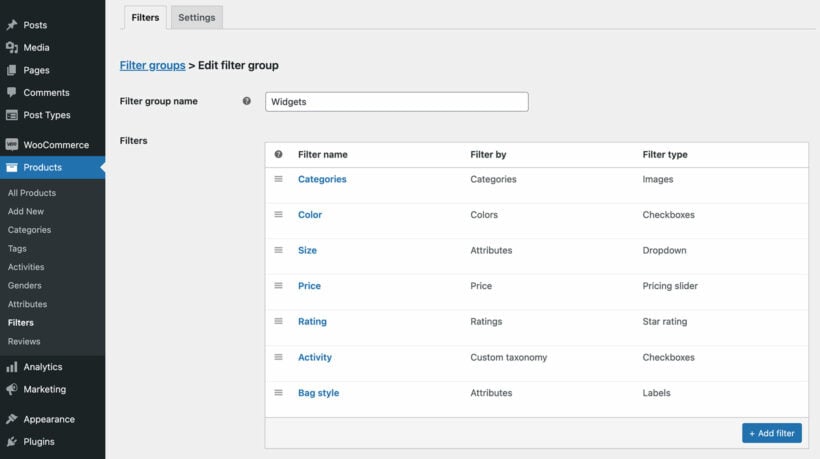
Creating a WooCommerce search filter is pretty easy. Just go into Products → Filters and set details such as your filter name and the data that the filter will use (such as tags or price). You should also pick a filter type (drop-down, checkbox, etc.)
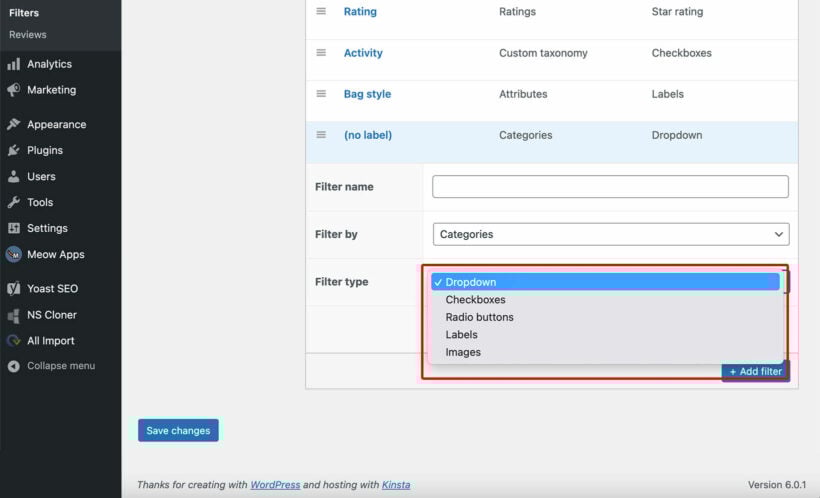
WooCommerce product filter settings showing the filter type options including dropdown and checkboxes

You can also structure filters into groups. This lets you display and manage them more conveniently. For instance, you can display one group of filters on one page and another group on a different page.

Now, all that's left to do is to tell the plugin where you want your filters displayed. Use the settings page to show the same filters at the top of all your store pages. Alternatively, use the 'Product Filters' widget to add search filters to the sidebar. The plugin also has a handy shortcode which lets you insert filters anywhere else that products are listed in your store.

WooCommerce Product Table

This plugin offers WooCommerce search filter features as an additional perk on top of its main functionality. So, what's the main functionality?

WooCommerce Product Table takes your product listings and displays them as a flexible order form. That's right, it actually changes the layout of your products to make them easier for customers to buy - in addition to adding search filters.

What a WooCommerce search filter looks like in a product table

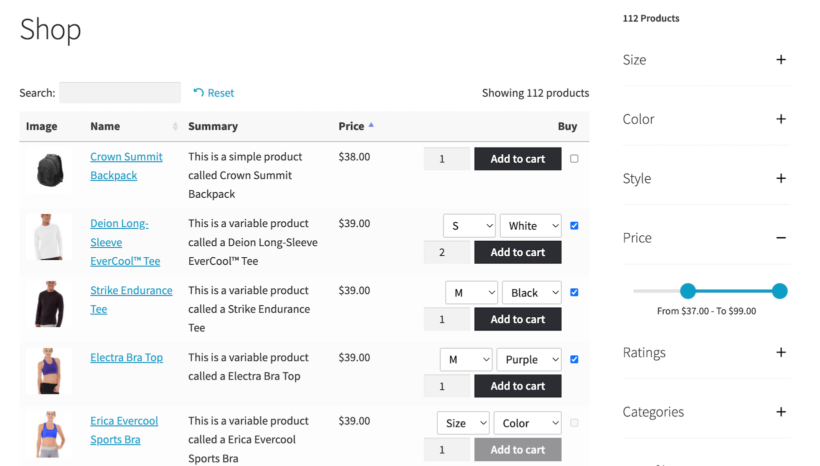
Here's an example of a product table with the search filters that it comes with. You'll see filter dropdowns above the list of products, a search box, sortable table columns, and basic filter widgets in the sidebar:
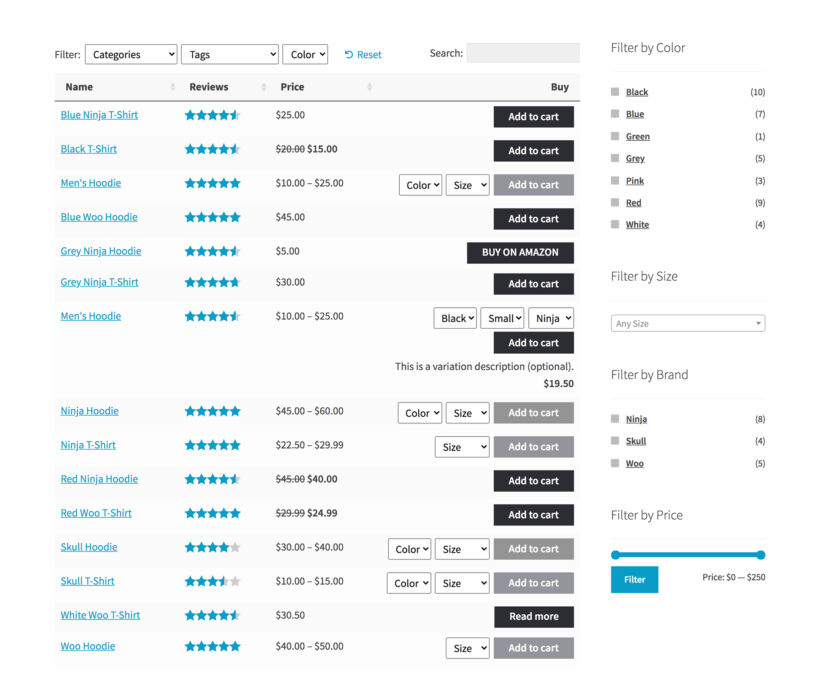
WooCommerce search and filter interface with dropdown filters above the product table and sidebar attribute widgets

This sort of presentation makes it faster for customers to buy multiple products at once without having to go to each product's individual page. There's even an option to add quantity pickers and variation dropdowns to the table, so that customers can choose options without leaving the page.

Back to the plugin's WooCommerce search filter features:

On top of the product table, you can choose to display a range of filters based on the criteria selected by you. Here's what that can look like:
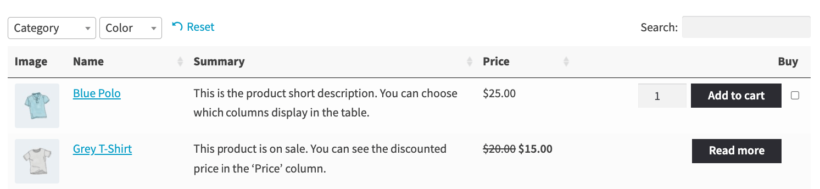
WooCommerce search filter dropdowns displayed above the product listings

These filters - and the search box as well - work in real time using JavaScript. This means that the list of products will update the second a filter is adjusted.

You can also display search filters as a sidebar widget that goes alongside the main table of products. These are the same as the ones you get with WooCommerce itself, and aren't as advanced as the ones in the WooCommerce Product Filters plugin that we featured earlier in this article. (But keep reading for a solution to this!)

This WooCommerce search filter mechanism is a great solution in case you have loads of products that you want to display on the same page while also giving your customers an option to look through them quickly and remove the ones that don't meet their needs.

The customer can add these products to cart without leaving the table and having to visit individual product pages. This is a great way to reduce the number of steps that your checkout takes.

How to create a product table with WooCommerce search filters

First, the obvious stuff - installing the plugin. You can get WooCommerce Product Table from the official link here. Next, go to Plugins → Add New → Upload Plugin to add the plugin to your WordPress install. Click on Activate when the upload finishes.

Use the plugin setup wizard to activate your license key. It will also prompt you to set the basic details of how you want your new product tables displayed. You can set the overall style of the table, pick where you want it shown, tweak the columns, choose how to handle product images, and more. Here's the official documentation on all this.

But we didn't come here to talk about the table itself, right? Back to WooCommerce search filters! As we have seen, WooCommerce Product Table comes with two types of filters:

  • Dropdowns - those are shown above the table.
  • Widgets - you can add them to the sidebar.
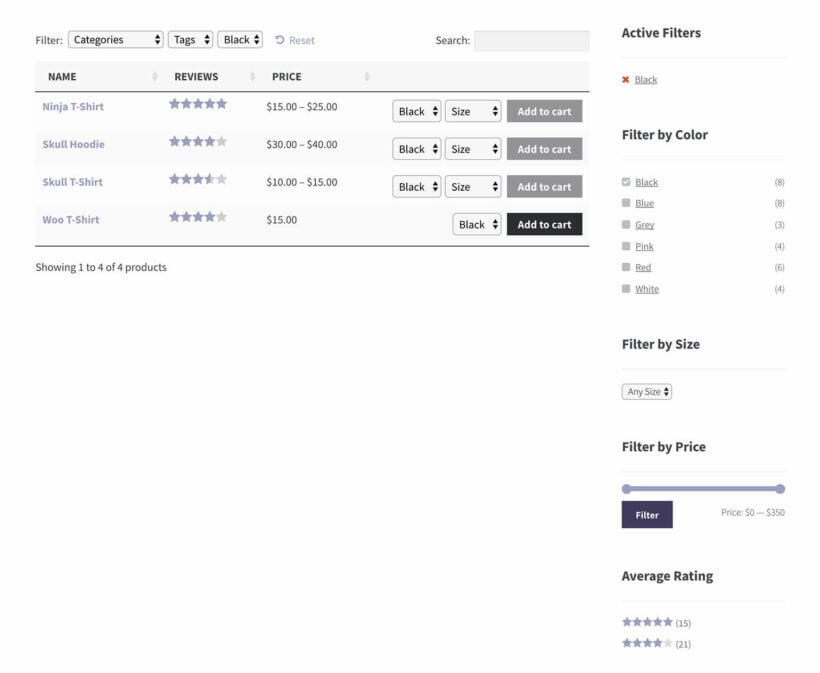
WooCommerce product table with search filters and sidebar filter widgets

By default, WooCommerce Product Table allows you to add filters to your table in a simplified way just by enabling the Filters option in the setup wizard or settings page. This will create filters automatically based on the columns already in the table.

If you'd like to customize the filters and pick what gets used as a filter and what doesn't, you can do that by choosing the Custom filters option. This lets you list exactly what filter dropdowns to display above the table. Here's an example of what this can look like on the settings page:

Product Table settings for adding search filter dropdowns above the table

Can you use both plugins together for better WooCommerce search filters?

So, do WooCommerce Product Filters and WooCommerce Product Table go well together?

Absolutely!

Using both plugins in tandem is a great idea. This gives you the compact and functional presentation of the product table, with the more advanced and customizable filters from WooCommerce Product Filters. The end result will be something like this:
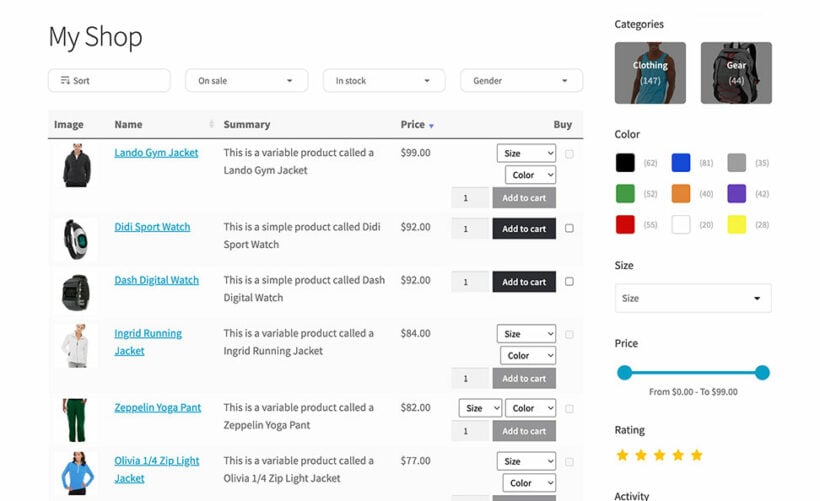
WooCommerce search filter combined with a product table and sidebar attribute filters

Where to get the plugins

As we said at the beginning, WooCommerce search filters are an exceptional tool. They help your customers to look through your product catalog and quickly find products that match their exact needs.

Although advanced search filters are not available in WooCommerce itself, you can achieve this with either (or both) of the following plugins:

  • WooCommerce Product Filters gives you access to an advanced filtering feature that's customizable and user-friendly at the same time.
  • WooCommerce Product Table lets you turn your product listings into an order form. Your customers can use it to add products to cart without leaving the page. At the same time, they can filter through the product catalog quickly.

Use WooCommerce Product Filters alone, or with WooCommerce Product Table to transform your products layouts as well as how customers find them.

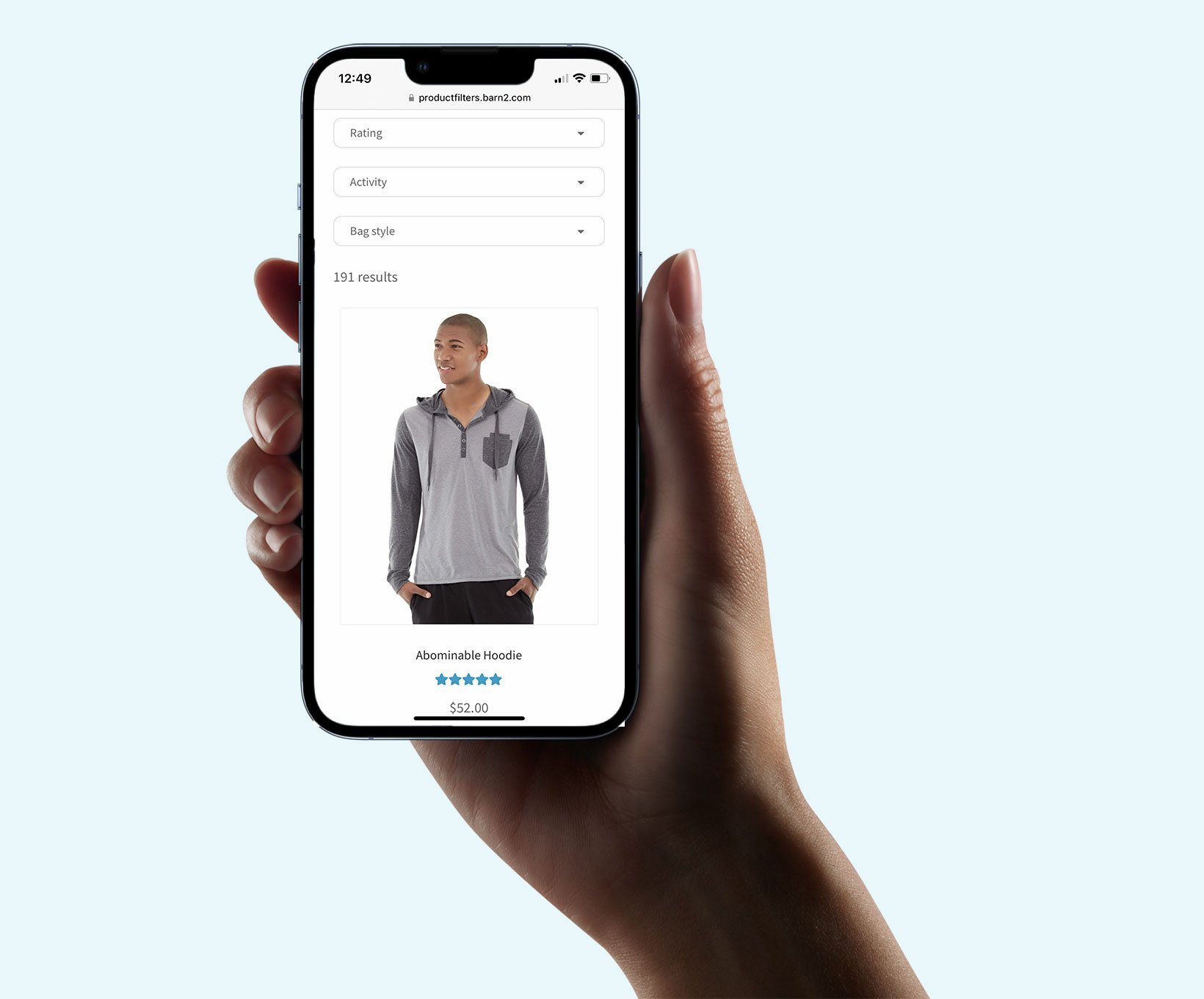
Shopper filtering products on a mobile store catalog

With online shopping the most convenient it's ever been, a WooCommerce store should be as organized and user-friendly as possible. Keep reading to learn how to make it easy for your customers to find what they want and increase your revenue. All you need is WooCommerce plus the best product filter plugin to allow customers to filter by attribute and other criteria.

If you sell multiple types of products, you'll know that it's ideal to let shoppers search for what they want - it should be fast and easy for them to find things to buy.

However, there are plenty of products a customer might like, but they might not know how to find it or won't even know it exists yet. This is where product filters and attributes come in!

What is an attribute filter and why do customers love them?

A product filter (also known as faceted search) is a tool on a shop page to help customers discover new products by searching by any criteria. This means that if a customer is looking for a blue T-shirt, they can apply "T-shirt" and "Blue" on a product filter to find every blue T-shirt in the store.

Most WooCommerce stores use attributes to store data about their products. This might be size, color, brand, and so on. As a result, WooCommerce product attribute filters are an excellent opportunity to help customers to find products using this important data.

Product attribute filters benefit stores in a variety of ways:

  • Increase time spent in the shop.
  • Add to discoverability of all products (it's easier for any product to be seen by a customer).
  • Increase conversion rate.
  • A user-friendly store creates more customer loyalty.

Adding attribute filters to your shop page allows customers to find items that match their personal preferences faster. This is how they can find all kinds of great new products.

Further reading: The best AJAX product filter plugins for WooCommerce

Native WooCommerce filter by attribute options

WooCommerce includes a built-in Filter Products by Attribute widget. This widget displays attribute options as checkboxes or dropdowns. The native widget works with global product attributes.

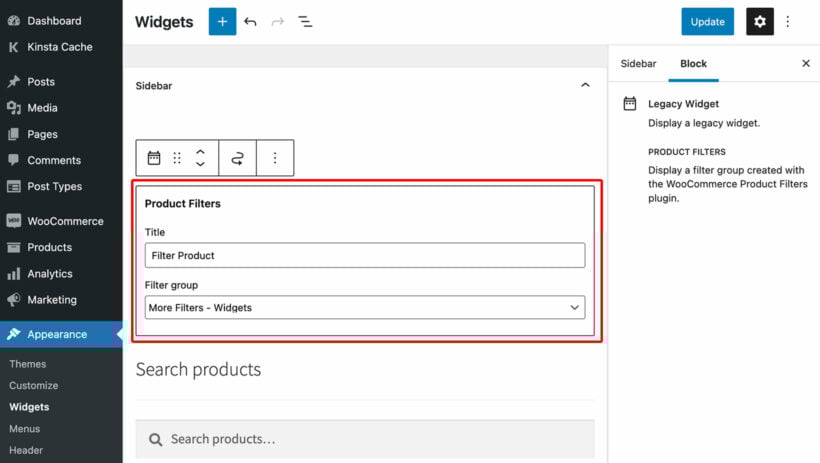
To set up the native attribute filter widget, navigate to Appearance → Widgets in your WordPress dashboard. Click the plus (+) button to add a new block to your desired widget area, typically a sidebar or footer. Search for and select "Product Filters" from the available blocks. Once added, you'll need to configure the widget settings.

WordPress Widgets editor showing the Product Filters block being added to a sidebar widget area

The configuration options include selecting which attribute to display (such as color, size, or brand), choosing the display type (dropdown or list), and setting the query type (AND or OR logic). The widget will then appear on your shop pages, allowing customers to filter products based on the selected attribute values.

When customers interact with the native widget, it filters the product display to show only items matching their selected attributes. The widget automatically updates based on the products visible on the current page, hiding attribute options that don't apply to the displayed products.

While the native widget handles basic filtering, it has limitations for complex product catalogs.

Limitations of the native filter widget

The native WooCommerce attribute filter has several significant limitations that affect user experience. First, it struggles with variable products, often displaying all variations rather than filtering intelligently. This creates confusion when customers see products that don't actually match their selected attributes.

WooCommerce product filter sidebar rendered on the shop page with price, rating, color, and stock filters

Page reloads are another major issue. Every time a customer selects a filter option, the entire page refreshes, disrupting their browsing flow and potentially losing their place on the page. This becomes particularly frustrating on mobile devices with slower connections.

The styling options are extremely limited, making it difficult to match the widget's appearance with your store's design. You're stuck with basic checkboxes or a simple dropdown, with minimal control over colors, fonts, or layout.

For stores with large catalogs, these limitations create a poor user experience that can directly impact conversion rates. Customers expect smooth, instant filtering that helps them find products quickly without constant page refreshes or confusing results.

Enhanced filtering with WooCommerce Product Filters

Enhanced WooCommerce filter plugins provide advanced attribute filtering capabilities. These plugins support AJAX filtering, custom styling, and better variable product handling. WooCommerce Product Filters offers comprehensive filtering solutions with six display styles.

WooCommerce faceted search filters
A WooCommerce store with attribute filters for gender, color, size, and activity

Fortunately, there's a beginner-friendly WordPress plugin that lets you add professional-level WooCommerce attribute filters to any shop page. The best all-in-one product filter plugin on WordPress is WooCommerce Product Filters. It's the perfect mix of full customization power, plus an easy-to-manage back end with drag-and-drop options and straightforward settings.

If you want to add attribute filters to WooCommerce, then there are 6 professional-looking filter styles to choose from:

  • Dropdown - The product attributes are listed in a dropdown/select list. Customers can select one at a time.
  • Checkboxes - Attributes are listed as a series of tick boxes. Customers can select as many attributes as they like, e.g. red, green and blue.
  • Radio buttons - The product attributes are listed as radio buttons, where the customer can select one at a time.
  • Labels - Attributes are displayed as text labels, similar to a tag cloud. This is a nice visual way to display a small number of attributes, for example 3-5 size options.
  • Images - For an even more visual way to add attribute filters to WooCommerce, you can display them as images. Select an image on the edit page for each attribute term, and they will appear in the filter. Customers click on an attribute image to filter by that. They can filter by as many attributes as they like. You can choose whether to show the image on its own, or with the name of the attribute term as an overlay.
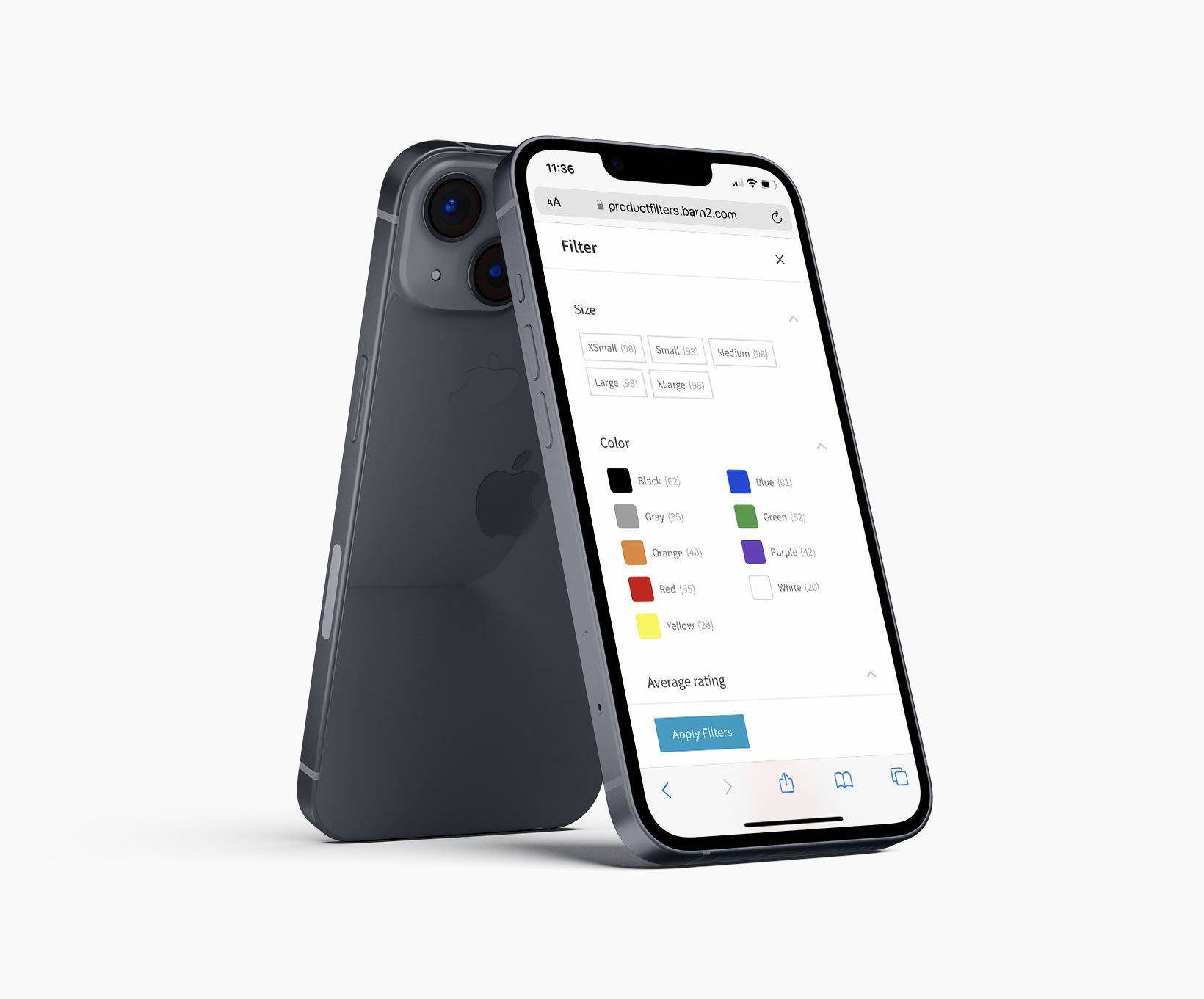
  • Color swatches - Finally, you can display color attributes as square blocks of color - either with or without labels. Customers filter by all the color attributes that they wish to see results for.

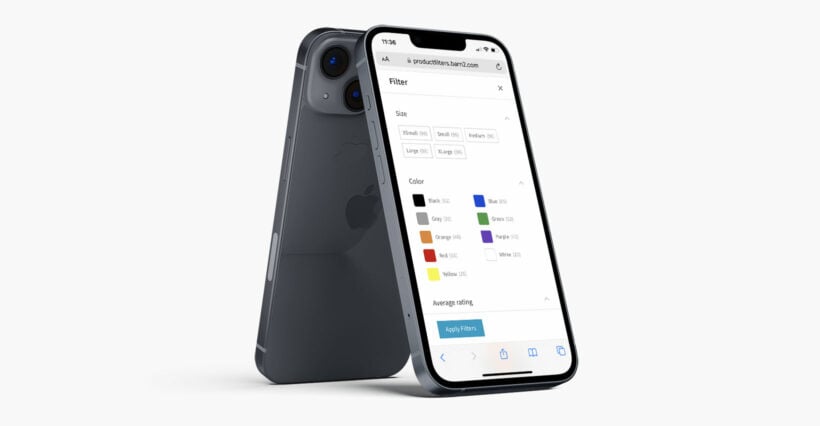
The filters are also 100% mobile friendly, so customers can easily filter by attribute from any device!

WooCommerce filter by attribute plugin with mobile slide-out panel

And there's more!

As well as having a choice of styles for your WooCommerce product attribute filters, you have full control over how the filters behave:

  • Choose whether to use AJAX to load results instantly, or select multiple filters and then apply them together.
  • Add filters anywhere on your site, including as a widget or shortcode.
  • Filter by product attributes like size, color, brand, and more - in a better way!
  • Add additional filters such as price, rating, On Sale, In Stock, custom taxonomy, and much more.
  • Visually engaging and intuitive design.
  • Works with Elementor, Divi Builder, mobile, and any WordPress themes.
  • No technical experience needed!

Custom product attribute filters can be easy to set up and manage even without any technical experience. We'll show you how to set up product filters for any WooCommerce store in just 5 minutes, and how to filter by product attributes in a cleaner, user-friendly manner.

As you can see, using WooCommerce Product Filters is a powerful plugin that would take you a long time to code from scratch. That's why you can save a lot of time and money compared to coding a WooCommerce product filter programmatically.

How to add your own WooCommerce product attribute filters

Now we get to the tutorial part of our article. First, I'll give you the super-fast way to add WooCommerce attribute filters plus a video where you can copy us setting it up. Below, I'll provide a more in-depth step-by-step tutorial.

How do I filter by attribute in WooCommerce?

Install and activate the WooCommerce Product Filters plugin. Navigate to Products → Filters and create a new filter group. Add attribute filters to your filter group. Place the Product Filters widget in your sidebar via Appearance → Widgets.

Start with your basic WooCommerce store

Before we add filters, you'll need to have a WooCommerce store. Simply install the WooCommerce plugin on any WordPress website, then add some products to start.

At this point your customers will see all the items you have available in the WooCommerce default product layout, without filters. You'll have a main shop homepage, plus a separate page for each category.

However, displaying WooCommerce products by category is only the very beginning. As we saw earlier, you need attribute filters to help customers to find products more easily.

Next, let's take a look at how you can enable this plugin and apply custom filters in your website in minutes with or without any experience. We will:

  1. Install the product filter plugin
  2. Create filters so that customers can filter by attribute
  3. Place product filters anywhere on your site

1. Install the best WooCommerce product filter plugin

First, buy the WooCommerce Product Filters plugin. Download the plugin from your Order Confirmation page or confirmation email, then install and activate it on WordPress.

The setup wizard will open, asking you to enter your license key and choose the main settings for your product filters. Here's a summary of some of the most important settings for your attribute filters:

Filter mode

  • Button - You can choose to let users manually apply their filter options by clicking a button with your custom text. When "Button" under Filter Mode is selected, a text box will appear where you can input your own button text.
  • Instant / AJAX - To add an automatic product filter to WooCommerce, select "Instant" under Filter Mode.
    • What is an AJAX product filter? - An AJAX product filter is a filter that will apply each selection immediately — no other clicking required.
    • Should you use an instant filter or button? - A WooCommerce AJAX product filter can be beneficial to your store because it decreases the amount of clicks for a customer as well as the time it takes to see the products they want. When a selection is made, items will be filtered automatically with no extra refresh time, making this option generally more user-friendly.
      However, in some cases, it's best to have the manual button available — for example, when there are a lot of filters on one page, and it could take a while for a shopper to select all the product attributes and filters they want to apply before they are ready to browse products.

Filter visibility

  • Display on shop pages or archive - All of your filter groups are automatically available in this dropdown. Simply pick one to display above the product area on your shop pages, or leave this blank if you'd rather manually place filters in other places in your shop.
  • Hide filters by default - As a 100% mobile-friendly product filter, WooCommerce Product Filters offers this option that allows filters to be minimized right when the page loads. This means that a customer will need to click on a button to view them. By default, this will be enabled on mobile and disabled on desktop, but you can choose whether to hide your filters on both or neither.
Here's a great example of what hidden filters can look like on mobile:

Play around with these options until you're happy, and then click 'Save changes.'

Other options

  • Product count - Display the number of products within each filter option. Knowing how many items are in each option can be helpful for the customer. Or you can hide the product count by un-checking the box.
  • Button text - There are several options for changing the button text that appears in your filters. Change it to whatever you like, in your language.
  • Toggle filters - If this option is enabled, customers can click to manually open or close each option in your filters. A plus (+) icon will appear on the right side of each filter option.
  • Default status - You'll see this option if Toggle filters are enabled. 'Open' will show all filter options when a page first loads. When 'Closed' is selected, customers will need to click on filter headings to see what options are available.

Play around with these options until you're happy, and then click 'Save changes.'

Once you've done that, you're just a few minutes away from having live product attribute filters on your store!

2. Create WooCommerce attribute filters

WooCommerce attribute filters display product characteristics as selectable options for customer filtering. Now that the WooCommerce product filter plugin is set up, it's time to make your first attribute filter! You can easily create a few simple filters or tons of totally unique filters. Whatever the needs of your store - it can be done right here.

  1. Start at Products → Filters.
  2. Click on the default filter group or create a new one.
  3. Use the 'Add new filter' form on the left side of the page to enter your filter's information:
    • WooCommerce filter by product attribute
      Filter name - Add any name for customers to identify this filter. For example: "Drinks" or "Filter by color".
    • Filter by - Let shoppers filter your products by one or more of the following filter options:
      • Categories
      • Product Attributes (you'll want to choose this if you're creating a WooCommerce attribute filter)
      • Colors
      • Tags
      • Custom taxonomy
      • Price
      • Ratings
      • In stock
      • On sale
      • Sort by
    • Filter type - You'll see this field if you've selected to filter by categories, attributes, taxonomies, or tags. These types of filters can be displayed as:
      • Dropdown
      • Checkboxes
      • Radio buttons
      • Labels
      • Images (available for categories, attributes, or custom taxonomies)
    • When you create WooCommerce attribute filters, some additional options will appear. These let you choose whether to automatically display filters based on the attributes of the current page, or whether to select a specific attribute (e.g. color or size). If different products have different attributes then I recommend the automatic option.
    • Finally, click the 'Add new filter' button.
  4. Repeat step 3 to make as many filters as you want!

3. Place product filters anywhere on your site

Every store layout has different places where a product filter will look and perform best. Of course, you should be able to put your filters anywhere you want to, and you absolutely can!

Once you have your groups and individual filters, easily put them anywhere on your site. The options are to automatically display a filter group on all your store pages, or to add filters using a sidebar widget or shortcode.

On your shop pages

horizontal product filter dropdowns added above WooCommerce shop products

To display horizontal filter dropdowns above all your shop pages, select a filter group on the plugin settings page (Products → Filters) or in the setup wizard.

Attribute filter widgets

Adding the Product Filters widget and selecting a filter group for the sidebar

You can add the Product Filters widget to a page sidebar. Similar to other widgets, find it in Appearance → Widgets in WordPress and drag the Product Filters widget to where you want it.

Shortcode placement — anywhere!

Display your default filter group anywhere using this shortcode:

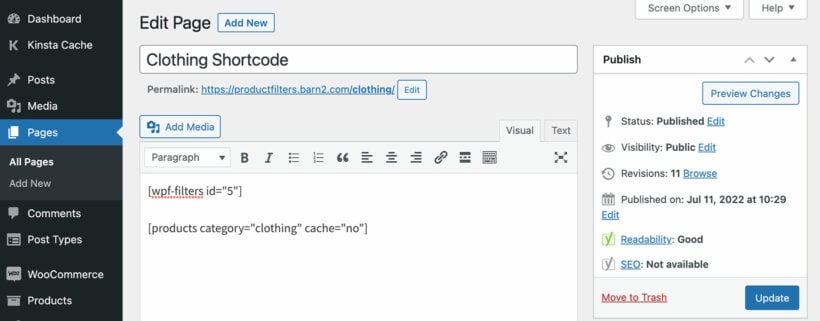
[wpf-filters id=1]

Display the filter group of your choice by following these steps:

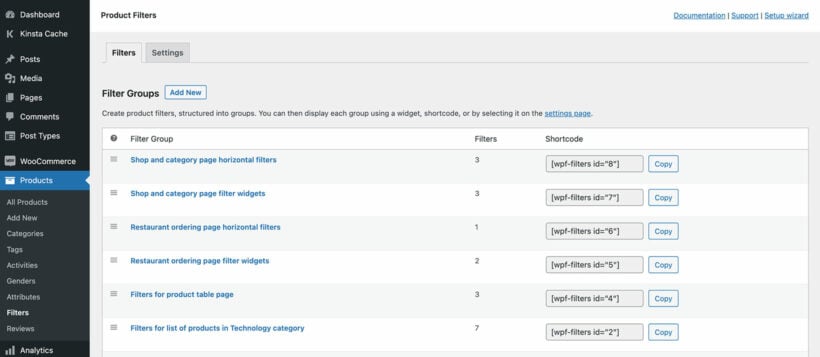
  1. Go to Products → Filters, then the 'Filter Groups' tab.
  2. Find the group you want on the right side of the page. Click the 'Copy' option next to that group.
  3. Finally, paste its shortcode anywhere you want your group to show up!
WooCommerce product attribute filter groups
Attribute filters shown above a WooCommerce products shortcode block

It's time to test your attribute filters!

Now that the WooCommerce attribute filters are set up, it's important to test them out on your WordPress site. Click around your shop to make sure that:

  1. The filters are in the perfect locations.
  2. Types of filters and filter behaviors are to your liking. For example, if you've created an attribute filter, make sure all your product attributes are correctly named and added and are being displayed accurately.
  3. Your products are organized by the correct filters.

WooCommerce product filters that work with Elementor and Divi Builder

Page builders like Elementor and Divi Builder make it possible to construct a website completely visually, with or without any coding experience. Tools like these create an accessible space for pros and total beginners alike to design the websites of their dreams. While Elementor and Divid are the most popular WordPress page builders, there's a surprising number of WooCommerce plugins that are not compatible with them.
With the option to display any filter group as a shortcode, WooCommerce Product Filters is the best and most flexible WooCommerce product filter for Elementor and Divi. Use it with either to create a space where you can fully design a WooCommerce store with custom product attribute filters by using mostly visual and drag-and-drop methods.

Bonus: Display product attributes in a table for faster orders - perfect for wholesale and more

In some cases, it's more convenient for customers to see products in a list-style catalog. The WooCommerce Product Table plugin works perfectly with WooCommerce Product Filters, displaying filtered results in an efficient table format ideal for wholesale, B2B, and quick ordering.

WooCommerce Product Table with Attribute Filters
WooCommerce Product Table used together with the WooCommerce Product Filters plugin

Set up your custom product filters to filter by attribute for WooCommerce in just 5 minutes

WooCommerce is a truly flexible e-commerce platform with a wide variety of custom options and plugins for any store. Overall, WooCommerce Product Filters is the best plug-and-play answer for store owners with a variety of products to show off. Enjoy increased revenue and loyalty from customers who know how to navigate your shop every time.

It's fast, easy, and totally customizable for beginners and pros alike. Your WooCommerce store is now more user-friendly than ever!

Next steps

In this article, we explored the most important aspects of custom attribute filters:

  • How to add a WooCommerce AJAX product filter on top, on the side, or anywhere on your site as a widget or shortcode.
  • Allow filtering by product attributes, price, product category, color, tags, custom taxonomies, stock, sales, ratings, sorting, and more.
  • Choosing the right look for your filters: dropdowns, checkboxes, radio buttons, labels, color swatches, or images.
  • Adding a clickable button or using instant filtering.
  • Creating filter groups and how to change any setting in seconds.

If you're looking for a WooCommerce product filter with 100% custom options, that allows you to add filtering by attributes and more anywhere on your website, with collapsible product filters for mobile friendliness - WooCommerce Product Filters is perfect for you!

Your customers will love it as much as you do. Get your store the best WooCommerce store filters available →

How to add a price filter in WooCommerce: Complete Guide

Do you know what’s the single BIGGEST factor influencing customer purchasing decisions? It’s the product price. That's why you need to add a WooCommerce price filter to your store.

Studies show that pricing has a significant impact on the buying behavior of consumers. Yet, the price filter in WooCommerce itself isn’t good enough to help customers find products within their budget. It lets customers sort the product catalog in two ways: Price High to Low or Price Low to High.

As a consumer, I’m sure you can understand how this isn’t nearly as user-friendly as a price filter that lets customers set a price range i.e. minimum order amount or maximum price value.

Keep reading to discover the best way to add a WooCommerce price filter to your online store.

Why do all online stores need a WooCommerce price filter plugin?

A customer browsing your product catalog should be able to sort it by price. This way, they can quickly see items sorted by their product price – either low to high or high to low. It makes it easier for customers to find what they’re looking for.

Think about the last time you visited a major e-commerce store to buy something. If you’re like most people, I’ll bet the first thing you did was sort all products by price.

According to Prisync, 60% of consumers consider pricing to be the very first criteria on their buying decision. And the most important store features driving the purchase decision (80%) is competitive pricing.

The problem with filtering products by price in WooCommerce

The WooCommerce plugin provides a price widget out of the box. However, it’s not really fit for purpose because:

  • It doesn’t use AJAX. This means that the page reloads every time a customer selects something from the price filter. That is a very poor user experience if they are filtering for multiple items at once, or if they are already part-way down the page.
  • Limited display options. The price widget only appears in the sidebar widget area and not above the list of products.
  • It’s quite fiddly to use. The WooCommerce price widget isn’t very intuitive from a technical standpoint.

In addition to all of this, the other filters that come with WooCommerce are also very limited. For example, you can’t display a category filter above your WooCommerce price filter. It makes sense to plan all your filters together to create the best possible experience for customers, so this is a big limitation.

The perfect WooCommerce price filter plugin

WooCommerce price filter showing a range slider alongside category and size filter options

WooCommerce Product Filters is a price filter plugin that lets you create individual price filters, structure them into logical groups, and display them anywhere on your online store.

Key features

It’s an advanced price filter that lets you display a price slider. Customers can use it to set a low and high price to filter the product catalog by. This way, they can set a price range (minimum price value and a maximum price value) to quickly find products within their budget.

Unlike the WooCommerce price widget, the price filter can appear either above the list of products or in a left (or right) sidebar on the page.

You can choose between two different filter behavior options: instant AJAX or button click. If you go with the AJAX option, the product catalog will update without a page refresh when the customer sets the price filter to show relevant products only. On the flip side, if you choose the button click option then the user will have to click the Apply Filters button to see the filtered list of products.

WooCommerce cart showing a flat rate shipping fee on a product sample

And it's not just a price filter plugin!

WooCommerce Product Filters also lets you add a Product sort dropdown to your shop pages. This allows users to sort the product catalog by price. The product sort dropdown can appear above the list of products or in the sidebar.

In addition to a robust price filter, the WooCommerce Product Filters plugin also lets you create filters for categories, attributes, colors, tags, custom taxonomies, ratings, stock status, and on-sale products. This way, you can let users filter products in a variety of different ways.

Combining a price filter widget with other filter types (like dropdowns, checkboxes, or radio buttons) makes it easier for customers to find exactly what they’re looking for and get to the correct product page faster. For example, if someone is looking for a red t-shirt between $15 to $25, they can quickly filter products to see only those products that fit those specifications:

  • Category: T-shirts
  • Colors: Red
  • Price: $15 to $25

Tutorial: how to add a WooCommerce price filter to your store

Here, we'll show you step-by-step how to add a price filter to your online store using the WooCommerce Product Filters plugin.

Step #1: Install the WooCommerce Product Filters plugin

Get the WooCommerce Product Filters plugin and install it on your WordPress site. You'll receive a license key and the plugin files in a confirmation email. Activate the license key in the plugin setup wizard and configure how you want the filters to behave.

Click the Save changes button to continue.

Step #2: Create a price filter

To create a price filter, head over to Products → Filters. Click on the filter group that you want to add the WooCommerce price filter to, and fill in the information on the Add new filter form.

You can set a filter name, select the data the filter will use, select the filter type (dropdown, checkbox, radio button, etc...), and assign it to a group. The WooCommerce Product Filters plugin lets you create as many filters as you'd like. So, you can combine the price filter with other filters such as product categories, attributes, tags, colors, ratings, stock status, and more.

WooCommerce Product Filters add edit manage filters
Add as many filters as you like, including a WooCommerce price range filter

Step #3: Add the price filter to a page

The WooCommerce Product Filters plugin comes with an option that lets you automatically a selected filter group above the products on your main shop pages. You can select this in the setup wizard or in Products → Filters → Settings.

This will show all filters in a horizontal layout above the list of products on the shop page and archive pages. To use the price filter, customers open the 'Price' dropdown and use the slider to select a low and high price.

Alternatively (or as well), you can use the Product Filters widget to display the price filter in your store's sidebar.

Adding the Product Filters widget to the sidebar to show a price filter
Add the Product Filters widget to the sidebar

Each filter group also has a shortcode which you can use to insert the price filter (and other filters) anywhere in your store. This is useful if you create custom lists of products. Examples of this might include pages built using Elementor or Gutenberg.

WooCommerce product filter groups
Copy the WooCommerce price filter shortcode and insert it wherever you list products

Bonus: list products in a table view with price filter

WooCommerce product table with a price filter slider and category image filters in the sidebar

The WooCommerce Product Table plugin lets you list products in a neat and organized table layout that works just like an order form. Customers can add multiple products and variations to their cart in one click.

The WooCommerce Product Table plugin also lets customers find products with instant product search and sort. It’s the perfect addition to WooCommerce Product Filters. You can use both of these plugins on your WordPress site to create the best possible price filtering experience for customers. For example, you might create a WooCommerce price list complete with price filters.

You can use WooCommerce Product Table to create one-page order forms so that customers can view and select products quickly and use WooCommerce Product Filters to add stylish price filters which refine the products in the table by price.

This is especially useful for stores that sell lots of products (like wholesale stores) as well as stores that sell products that are better suited to a table layout (like restaurants or hardware stores).

WooCommerce product table with a price filter slider in the sidebar

With WooCommerce Product Table, customers can also click on the price column in the table to sort products by price in either ascending (i.e. price low to high) or descending order (i.e. price high to low).

As a store owner, you can use the WooCommerce Product Table plugin to insert lists of products anywhere on your WordPress site, complete with a robust WooCommerce price filter. So, it’s not just for the shop and category pages.

WooCommerce price filter plugin

Price has (and probably always will have) a significant impact on the buying behavior of consumers. Since the price widget that comes with WooCommerce out of the box is pretty limited, you’re better off using a WooCommerce price filter plugin like WooCommerce Product Filters.

WooCommerce Product Filters lets you:

  • Add an advanced price filter anywhere on your WooCommerce store.
  • Have the price filter appear above the list of products or in a sidebar.
  • Choose to go with instant AJAX functionality or button click.
  • Use the product sort dropdown to let customers sort products by price.
  • Combine the price filter with a variety of other filters including categories, attributes, colors, tags, custom taxonomies, ratings, stock status, and on-sale products.

In addition to this, you can combine the WooCommerce Product Filters plugin with the WooCommerce Product Table plugin to list products in a one-page order form layout with price filters. It works seamlessly with just about every WordPress theme and page builder including Elementor.

Ready to add an advanced WooCommerce price filter to your online store? Get WooCommerce Product Filters today!

Illustration of advanced faceted search filters on an online store

Not sure how to set up advanced faceted search on your WordPress site? Not even sure what faceted filters are? Although WordPress comes with a basic search out of the box, it doesn’t pull up the most relevant results. Keep reading to discover how to supercharge your store's search and filtering.

WordPress sites are a unique world of their own. You might publish all sorts of content - posts, products, and so on. However, visitors hardly ever know what to search for. What if they type the wrong thing and don't find what they need?

The solution is to set up smart search options, such as advanced faceted search and filtering. The right search features are more attuned to online shopping and anticipate your customer's needs, helping them to find what they want more easily.

In this complete guide, I’m going to explain what WordPress faceted search is and why it can make such a huge difference to sales in your store. I’ll also share the best WordPress faceted search plugin, both for filtering products or any other type of information.  Finally, you'll learn step-by-step how to set it up.

Faceted search enables users to filter what they’re looking for by different criteria. They can narrow down their selection and quickly find specific items in your online store or website.

Advanced faceted search example

Think of facets as categories or attributes that the information on your WordPress site can be grouped into and filtered by. Here are a few examples:

  • Computer hardware stores that sell products like SSDs might have different facets for platform support, capacity, connection type, and compatible devices.
  • A WordPress blog might have facets to help users to find the type of posts they're looking for.
  • Stores that sell clothes often have facets for color, fabric, occasion, and size.
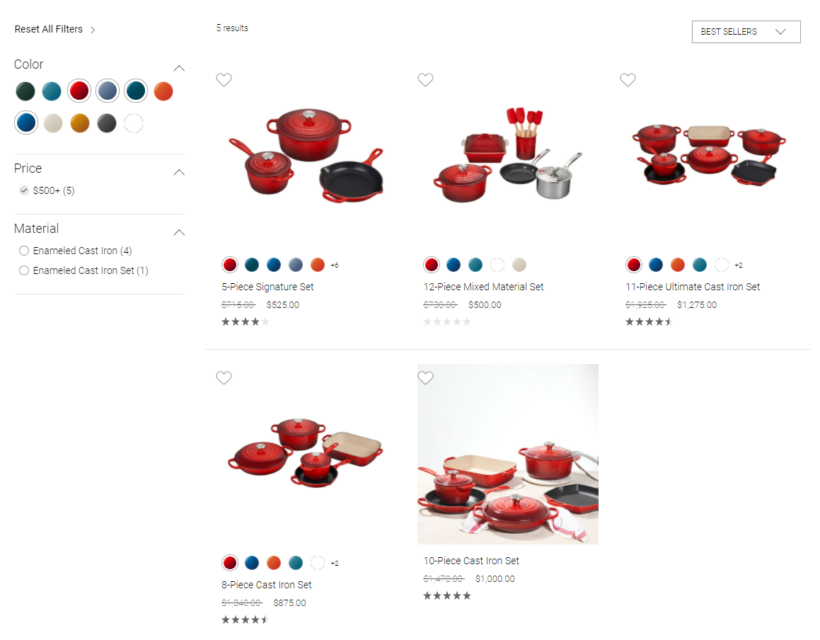
  • Stores that sell cookware have facets for material, price, and color.
  • A WordPress consultants directory might have faceted filters to help users to find a consults with the skills they require.

This way, customers can quickly make their selection and find exactly what they’re looking for.

Facets vs filters vs search: what’s the difference?

The problem with a regular search bar is that users often don’t know what to search for. This is especially true if this is their first time visiting your website.

In addition to this, search results don’t offer support for typos, errors, or common keyword synonyms. For example, a customer might want to purchase a red t-shirt from your e-commerce store. But, if you’ve named the product Crimson T-shirt, it won’t appear in the search results.

Filtered search is when customers can use a filter dropdown or other types of filter to narrow down their search results. So, following our example, a customer might select T-shirts using the category filter to view all t-shirt products.

Faceted search is similar to filters but they’re different search methods. With faceted search, customers see a logical interface that helps them quickly find what they’re looking for. Following our example from above, customers could set the Type facet to T-shirt and the Color facet to Crimson.

These are the main differences between facets and filters:

  • Narrowing down search results. Regular filters let users narrow down search results one at a time. Faceted filters use multiple filters that can be applied at once. This way, users can quickly find what they’re looking for.
  • Filtering results based on different attributes. With faceted filters, you can create filters based on different product attributes. This is also a great way to use keywords in your faceted search.
  • Improving website structure. With faceted filters, users are more likely to find exactly what they’re looking for rather, even if you have a huge site. For example, if you sell hardware goods like nuts and bolts of different sizes, faceted filters will improve the product catalog structure and make it easy for customers to find the exact product quickly.

To sum it up, faceted filters let users narrow down search results based on the exact information they're looking for. Unlike basic filtering, WordPress advanced faceted search lets users select multiple pieces of data. These drill down the results, only displaying relevant items.

Before we get into which types of WordPress sites need advanced faceted search, let’s quickly step through some important statistics.

Research conducted by the Nielsen Norman Group concluded:

Users notice and complain in the rare cases when facets are absent. These days, ecommerce sites without faceted search are the exception, rather than the rule.

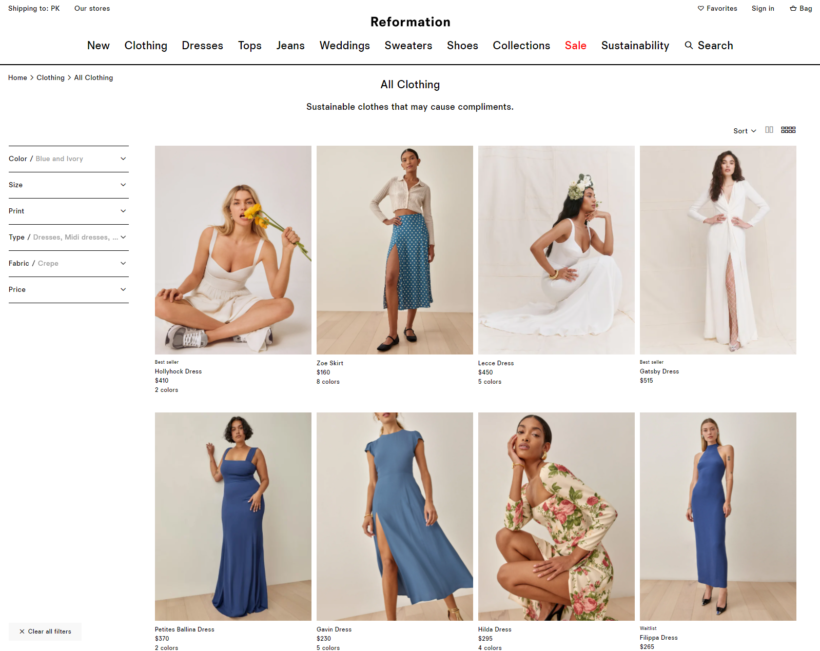
Reformation faceted filters

The same study found that 27% of search failures were a result of not being able to find suitable items on stores, even though at least one matching product was available.

The Nielsen Norman Group also reports that in 2000, only 64% of all in-site searches were ultimately successful. In 2011, this increased to 74% and, in 2017, a whopping 92% of all in-site searches were successful.

While the statistics are particularly significant for e-commerce stores, the same principles apply to any type of WordPress site. Basically, if you have lots of data for users to sift through, then you need a WordPress advanced faceted search plugin.

What about faceted filters in WooCommerce?

WooCommerce is the world's biggest e-commerce plugin, but surprisingly few stores use facets for their in-site search. That's because the filters that come with WooCommerce out of the box are pretty basic.

A WooCommerce faceted search plugin is essential for stores that sell dozens, hundreds, or thousands of products. Customers will benefit from being able to select specific product attributes to narrow down their selection.

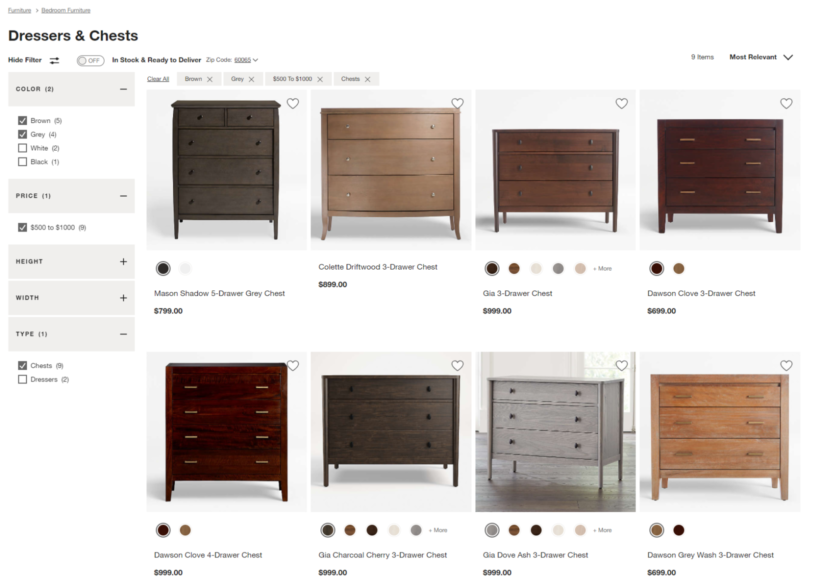
Crate and Barrel faceted filters

Let’s look at some examples:

  • Clothing stores. Stores that sell apparel can set up facets for type, fabric, size, fit, color, and price.
  • Hardware stores. Stores that sell products like fasteners, nuts and bolts, screws, locks, hinges, power tools, and plumbing supplies can use facets for availability, department, dimensions, and ratings.
  • Furniture stores. Furniture stores might consider creating facets for attributes like color, price, width, height, and type.

As you can see, faceted filters make it easy for customers to narrow down the options and find what they’re looking for. Stores that sell a medium or large number of products can benefit from speeding up the browsing experience.

What is the best WordPress advanced faceted search plugin?

Next, it's time to discover the best plugins for adding advanced facets to WordPress. I recommend a different plugin depending on whether you're adding faceted search to a WooCommerce store or to a general WordPress site:

  • Adding faceted search to a WooCommerce store - Without doubt, WooCommerce Product Filters is the best advanced faceted search plugin for e-commerce stores. It comes with a huge range of facet styles and types, and everything else you need.
  • Adding facets to a general WordPress site - If you're adding facets to any other type of website content (resources, blog posts, members, etc.) then Posts Table Pro is the plugin for you. It takes any type of information from your website and displays in an instant table - complete with advanced faceted search filters, AJAX-powered keyword search, and more.

Best for e-commerce: WooCommerce Product Filters

Advanced faceted search filters showing category checkboxes, price range, and color swatches in the sidebar

WooCommerce Product Filters is the best advanced faceted search plugin for WooCommerce. As well as having all the faceted filters you could need, it has clever logic built-in to avoid frustration and ensure that customers always see results.

This is achieved by never showing empty filter options. In other words, customers will see faceted filters for available products only. The plugin also provides the option to display the number of products within each option so that customers will naturally stop choosing options when the number of results gets too low.

Now that we’ve chosen an e-commerce faceted search plugin, the next step is to plan the sort of data that you want to help customers search by.

The faceted search plugin gives you the following options:

  • Categories - Essential for stores that sell lots of different types of products. Customers can select the facet for the type of product they’re looking for e.g. Tops, Dresses, Pants, or Shoes.
  • Attributes - Product attributes – like size, weight, dimensions – are important for stores that sell products like hardware goods or furniture.
  • Colors - Stores that sell apparel, furniture, or cookware can help customers quickly find products by color using this facet.
  • Tags - Depending on how you’ve set up product tags, you might want to let customers select tag facets to narrow down their search.
  • Custom taxonomy - You can use the custom taxonomy facet if you’ve created custom taxonomies to better organize your products. For example, if you sell products by different brands, you can make it easy for customers to find the exact product they’re looking for.
  • Price - A price facet is beneficial for almost every type of e-commerce store. It lets customers set the price range and filter out less expensive (or more expensive) items.
  • Ratings - Setting up a ratings faceted filter on your store makes it easy for customers to find high-quality products. It’s also a good way to use social proof on your online store.
  • In stock - This is perfect for stores that sell out quickly. For example, hardware stores and furniture stores often have some products in stock while others are on backorder or temporarily out of stock. This faceted filter lets customers only view the products that are in stock.
  • On sale - Customers can select this facet to only view products that are on sale.

What the faceted filters look like in your store

Once you've installed the plugin, it only takes a few minutes to add advanced faceted search filters to your store. The end result will be something like this on desktop:

WooCommerce faceted search filters

And either this or this on mobile, depending on how you set it up for mobile users:

Either way, it's the perfect way to add advanced faceted search to an e-commerce store!

How to add WordPress faceted filters to your store

Here’s what you need to do to set up advanced faceted filters search:

Step #1: Install Product Filters

Get the Product Filters plugin if you haven’t done so already. Install and activate it on your WordPress site.

Step #2: Configure the faceted filters

The setup wizard will open next. Enter your license key and choose how you want your faceted filters to behave. Here's some more information about the main settings.

Filter behavior and content
Plugin setup wizard filter behavior settings including product count display options

You can set the Filter mode option to either Instant or Button click. By default, it’s set to instantly update the list of products using AJAX as soon as the customer selects an item from any of the filters. Use this if you want AJAX faceted filters in your store.

The Product Filters plugin also gives you the option to display the total product count next to each option. You can set this using the Product count option.

Filter visibility

Use this option to show selected filter groups on the shop page, category pages, and product tag archives. Optionally, you can disable this option if you want to add filters to pages manually or display filters in a sidebar.

The plugin lets you hide all faceted filters by default. If you enable this option, customers won’t see the filters when the page first loads. They’ll need to click a button to view the faceted filters and refine their search. This is perfect for hiding filters on mobile devices.

Finally, you can change the Show filters button text and display faceted filters in a slide-out panel instead of directly on the page.

Toggle filters
WooCommerce toggle product filters open closed
Facets with the filters toggled to closed

This option lets you add a an open/close arrow to the right of each filter heading. Customers can click it to open/close faceted filters. If you have a small number of filters, you should leave this option set to Open. However, if you have tons of filters on the page, you should set it to Closed to save space on the page.

Step #3: Create faceted filters

WooCommerce Product Filters lets you create all sorts of faceted filters for your online store. Depending on the types of products you sell, you can use any combination of the available filters to enhance the search and browsing experience of your store.

Think about the best way to present each filter on your product catalog pages. You can use dropdowns, radio buttons, color swatches, images, or checkboxes. The aim is to make things as easy as possible for customers so that they intuitively select the options they want and perform an advanced faceted search without having to think.

Advanced faceted search filter type options including dropdowns, checkboxes, radio buttons, and image filters

Next, go to Products → Filters in the WordPress admin. You'll see a default filter group containing some popular facets. Either edit this, or great your own.

Whichever you do, fill in the details to add a new filter. You can set the name, filter by, filter type, and assign to group options. Repeat this step to create as many facets as you’d like.

Best advanced faceted search plugin for other types of website content: Posts Table Pro

So far, we've discovered the best faceted search plugin for e-commerce. But what if you want to add faceted search for other types of information on your website, instead of products? That's when you need Posts Table Pro.

Posts Table Pro is a dynamic WordPress table plugin which creates instant tables of any type of information from your website. This might be your normal WordPress pages and posts, or any custom post type (consultants, members, articles, resources, audio files, videos, etc.).

The table makes it super-simple for your users to find the information they're looking for. For example, it has:

  • Advanced faceted search filter dropdowns, which appear above the table. Users can select information from multiple dropdowns to drill down their search and combine multiple facets.
  • AJAX-powered search box to the top right of the table. With this, users can enter a keyword and search for absolutely anything.
  • Easy column sorting so that users can re-order the list by any column.

Types of faceted search available in Posts Table Pro

The faceted filter dropdowns which are built into Posts Table Pro look like this (depending on your theme):

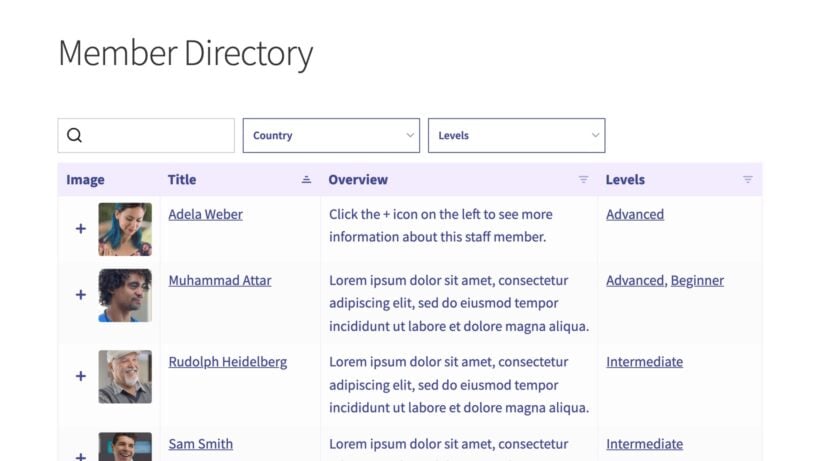
Posts table with faceted filter dropdowns and a keyword search box
Posts Table Pro comes with faceted filter dropdowns, plus a keyword search

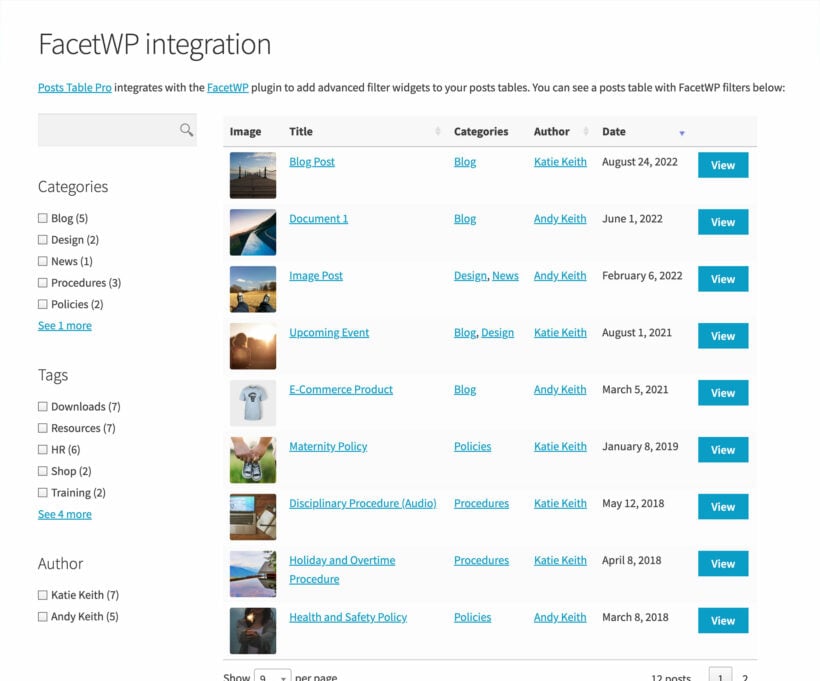
And if you want other types of facet, such as filter widgets and checkboxes, then you can use Posts Table Pro with the FacetWP plugin. This adds filter widgets alongside the table, like this:

WordPress table plugin filter widgets

Tutorial: How to set up advanced faceted search with Posts Table Pro

It's easy to install Posts Table Pro and start adding facets:

  1. Install Posts Table Pro.
  2. The setup wizard will open. Follow the steps to choose how you want your tables to look and behave.
  3. On the filtering page, follow the instructions to add filter dropdowns to the table.

Alternatively, if you want to use Posts Table Pro with the FacetWP plugin, then you can read the documentation on how to use the two plugins together. Either way, you'll be adding advanced faceted search to your WordPress site in no time!

Where to get the plugins

Implementing seamless in-site search becomes significantly easier with faceted filters. It's super-quick for users to find what they're looking for based on the information they're interested in. This saves them time, making them more likely to convert - whether you want them to buy your products, subscribe to your blog, or something else.

Which is the best WordPress advanced faceted search plugin depends on the sort of information you want to filter by:

  • Use WooCommerce Product Filters to add faceted search to your online store and give customers plenty of options to narrow down their search.
  • Or use Posts Table Pro to add advanced facets for any other information on your WordPress site.

Ready to set up an advanced faceted search solution? Get the plugin today!

Complete guide to using product sampling for your WooCommerce site marketing strategy

Product sampling marketing is a major strategy which businesses use to boost conversion rates and brand awareness at face-to-face events. But did you know that you can do it in your WooCommerce store too?

Are you looking for an effective way to acquire new customers in your WooCommerce online store? In that case, you may want to consider offering your store visitors free samples of your product. Product sampling marketing gets products in a prospective buyer's hands at no cost to them.
When shopping, most people prefer to buy familiar products to minimize the risk of making a bad purchase decision. If you're a completely new brand, getting the buyer to try out your product can be very difficult. This is particularly true if there's a lot of competition in your industry.

To help buyers overcome this fear, marketers use the product sampling marketing technique to give them a feel of their product. This strategy has proven highly successful over the years. According to a Product Sampling Study report, 35% of the people who tried out a product bought the product that same day.

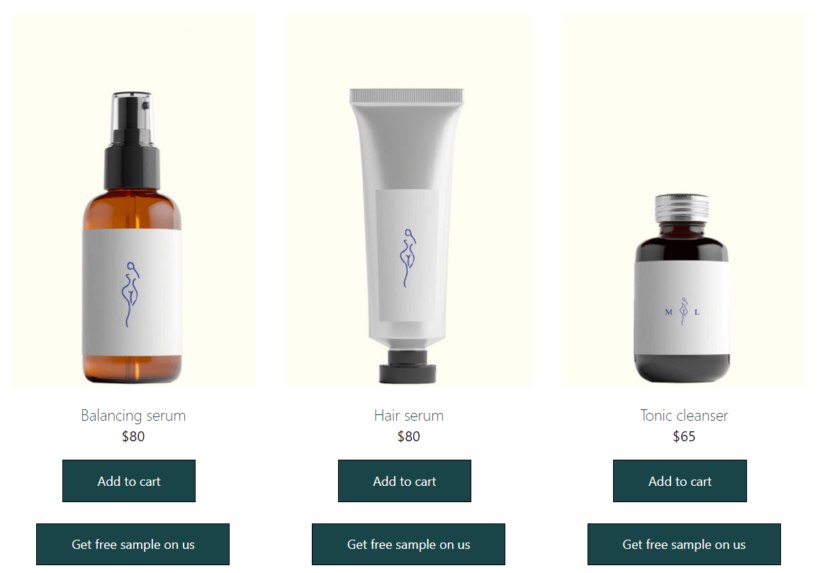
Skincare shop offering a free sample alongside each product

Product sampling is not only good for new businesses looking to increase sales and brand awareness. Established brands can also use it to get people who have heard about their products to commit to a purchase.

In this article, we'll cover everything you need to know about using product sampling marketing in WooCommerce. We'll bring it to life using some e-commerce product sampling marketing examples. You'll discover how to bring it to your store using the WooCommerce Product Sample plugin. At the end, you'll have everything you need to create a free sample marketing strategy to take your sales to the next level.

Can product sampling form part of your online e-commerce strategy?

Traditionally, marketers are more familiar with offline product sampling, especially at face-to-face events and activities. In this case, businesses employ store sampling experts and brand ambassadors who ensure that passers-by or invited guests get a great feel of their product. It could be as simple as offering a scoop of a dairy product. Or as intriguing as inviting a window shopper to test-drive a luxury car.

As a WooCommerce store owner, you'd be delighted to learn that you can use these same successful product sampling marketing techniques too. Online product sampling is an experiential marketing strategy that is becoming increasingly popular. In fact, it has the potential to generate more results than offline product sampling due to the increased market size.

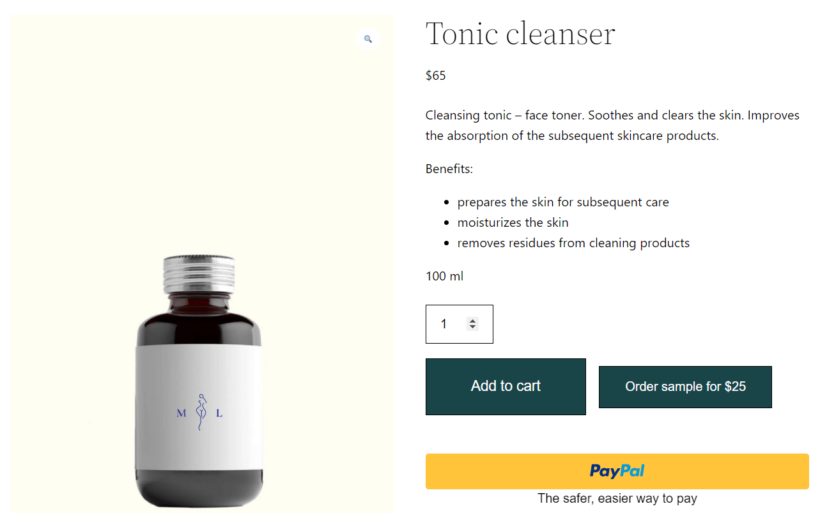
Single product page with an order sample button beside add to cart

Unlike offline sampling, setting up an online sampling procedure doesn't require significant capital commitment. Once the sampling experience has been added to WooCommerce, you won't need to deal with staffing issues or negotiate with physical shopping centers or supermarkets. This is highly cost-effective and results in a higher return-on-investment (ROI).

E-commerce product sampling also has a better tracking system that you can use to measure your products. An effective product sampling strategy backed by top-notch site analytics provides you with important insights to improve your business. Similarly, you can advertise your sampling campaign on multiple platforms like social media, influencer markets, and Google AdWords.

Why is product sampling marketing so effective?

When marketing a new product, getting desired results often requires more than conventional marketing techniques. One of the most effective ways to beat the competition is to allow consumers to try your products. The psychology behind this technique leverages typical consumer behavior to create a win-win situation for you and the buyer.

Here are some of the reasons why product sampling marketing is so effective:

  • Product sampling gets potential customers to experience your product and eliminate risk aversion. Buyers would be happy to use a product they aren't familiar with at a lower cost or no cost at all.
  • It gets your target audience thinking about your product.
  • It can be a great way to build customer loyalty. Many consumers perceive a free WooCommerce product or discounted sample as a kind gesture. You can use this to leave a good first impression on the customer.
  • It's an effective way to beat the competition. Most online retailers aren't using this technique yet. You can use product sampling to establish your brand presence quickly.

No doubt, there are lots of conversion and brand awareness opportunities in online product sampling marketing.

But how can you bring these benefits to your WooCommerce store?

Introducing WooCommerce Product Sample

Are you looking for the best way to get your products into the customer's hands and boost acquisition? WooCommerce Product Sample is the best WordPress product sampling marketing plugin on the market. It adds product sampling marketing to your store, making buyers much more likely to purchase the full product.

Using this plugin, you can either offer completely free products or let the customer get samples at a discounted price. You can also choose to charge a delivery fee or ship the sample for free.

Here are some of the key features that make WooCommerce Product Sample so powerful:

  • Free and paid samples for all or some of your productsOffer your customers samples of your products at either a discounted or zero cost. You can enable these samples for individual products, product variations, product categories, or all products sitewide.
  • Full control over your product sampling campaignDetermine the price of the WooCommerce free samples, their shipping and tax classes, and also manage unique stock for samples only. You can also decide where to place the 'Order Sample' button on your shop, product, and category pages.
  • Set a maximum order quantity for samplesSet a sample order quantity threshold to prevent customers from emptying your inventory. This helps your business to maintain profitability.
  • Send follow-up emails to remind your customers to buyAfter getting a feel of your product, customers become more open to making a real purchase. This plugin is the only WooCommerce product sample plugin sends automated emails reminding your customers to get the full product.

Before we show you how to use WooCommerce Product Sample, let's share a few product sampling examples.

Product sampling marketing examples

To get an idea of how businesses use product sampling marketing techniques online, we'll briefly share 3 use cases we've seen in the past:

  • Boosting awareness during new product launchesAccording to PowerReviews research, 72% of the customers of online grocery stores are more likely to buy a product that has reviews. One of the easiest ways to generate these reviews for a new product line is to offer free samples. This technique also works efficiently for products in other categories too.
  • Generating fresh reviews from new and existing customers Reviews aren't useful for new products only. Google and other search engines love fresh content. You can always boost your product pages' SEO ranking by using product sampling to drive an organic flow of content consistently. The report referenced above also reveals that sampling programs have the highest review completion rate in any industry—86%.
  • Moving a seasonal product's inventorySelling products that will only be available for a limited period can be challenging. You can combine product sampling with your other marketing techniques to move a particular product's inventory faster.

As you can see, each of these product sampling marketing examples works excellently in nearly any e-commerce niche. It's ideal for consumer products like fashion and apparel, entertainment, personal care, homeware, electronics, and other industries too.

If I allow free sampling online, will I lose out on postage?

You do not have to lose out on postage when you allow free sampling online.

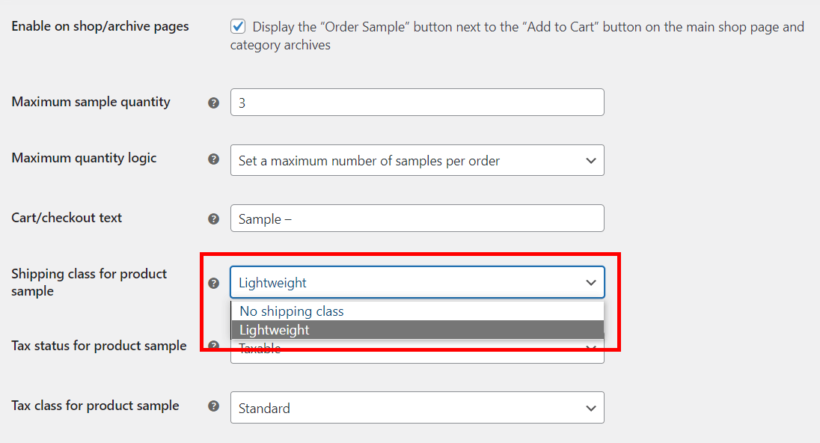
When offering free sampling in your WooCommerce store, the Product Sample plugin allows you to decide who pays for shipping. You set the price for product samples separately from the shipping cost. You can set a shipping cost for the products by assigning them to a shipping class.

assign shipping class to woocommerce product samples

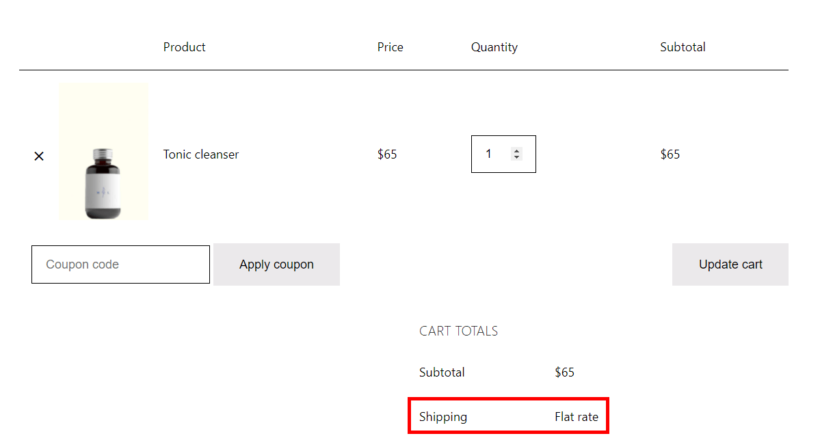
In terms of product pricing, you can choose to either offer the product for free or charge a discounted fee. Similarly, you can charge the customer for postage only or offer them free shipping.

WooCommerce cart applying flat rate shipping to a product sample

Charging for delivery allows you to maintain your capital advantage over offline product sampling where customers get the product in person.

In general, it's important to adopt a model that works best for the type of product you're selling and your business's profitability.

How to enable product sampling marketing in WooCommerce

You can enable product sampling marketing on your WooCommerce site by following these 4 simple steps.

Step 1: Install and activate WooCommerce Product Sample

To launch your first product sampling marketing campaign, you can get your copy of the WooCommerce Product Sample plugin here.

Once you've completed your registration, you'll receive a license key and download link in your email. Next;

  1. Log into your WordPress backend and go to Plugins → Add New → Upload Plugin.
  2. Here, click Choose File and select the ZIP file you downloaded earlier. Then click Install Now followed by Activate Plugin.
  3. Upon activation, you also need to enter the license key and click Activate.

Hooray! WooCommerce Product Sample is now active and ready for use.

Step 2: Configure the plugin global settings

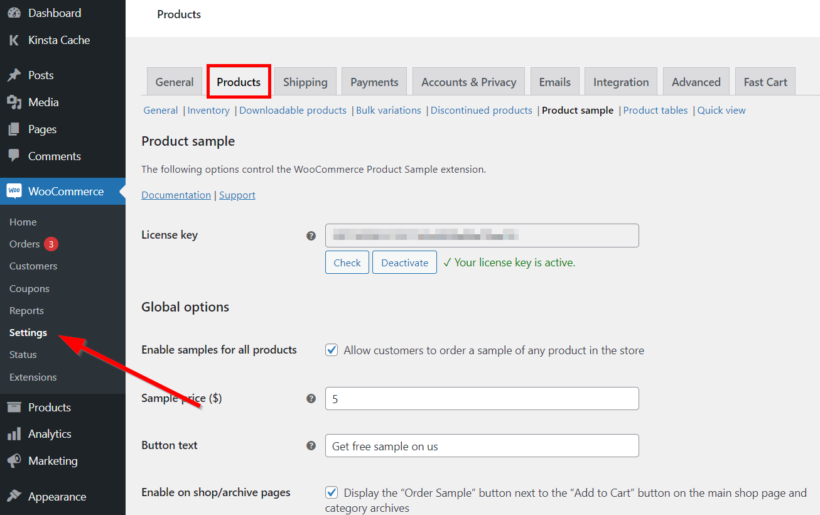
Now, it's time to set up a product sampling marketing campaign. You can do this by navigating to WooCommerce → Settings → Products → Product sample.

WooCommerce Product Sample plugin settings under the Products tab

On this page, you'll be able to tweak all the global options available using the plugin.

If you want to offer free samples for all your store products by default, check 'Enable samples for all products'. If you uncheck this box, samples will only be available for the products and product categories you configure individually.

On the same page, configure other elements like the sample price, button text, maximum sample quantity, shipping class, and a sample label. This label will be displayed before the name of the product when it's in the cart.

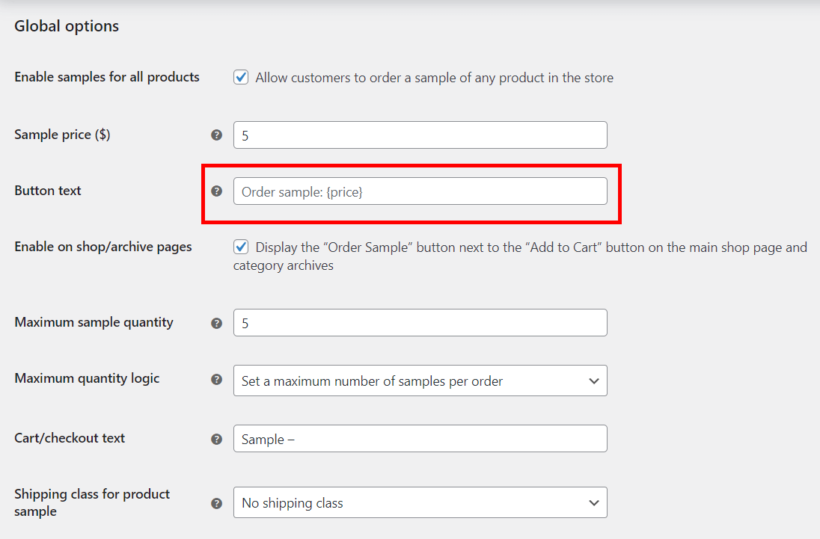
By default, the sample order button text is 'Order sample: {price}'. {price} is a placeholder for any value you enter in the 'Sample price' field above.

Setting the product sample button text in WooCommerce options

You can edit both the text and price fields as you wish. To offer completely free samples, add your text without the price placeholder.

Step 3: Adjust sample settings for individual products or categories

In certain cases, you may want to override the global settings for a particular product, product variation, or category. To do this, navigate to product or category settings.

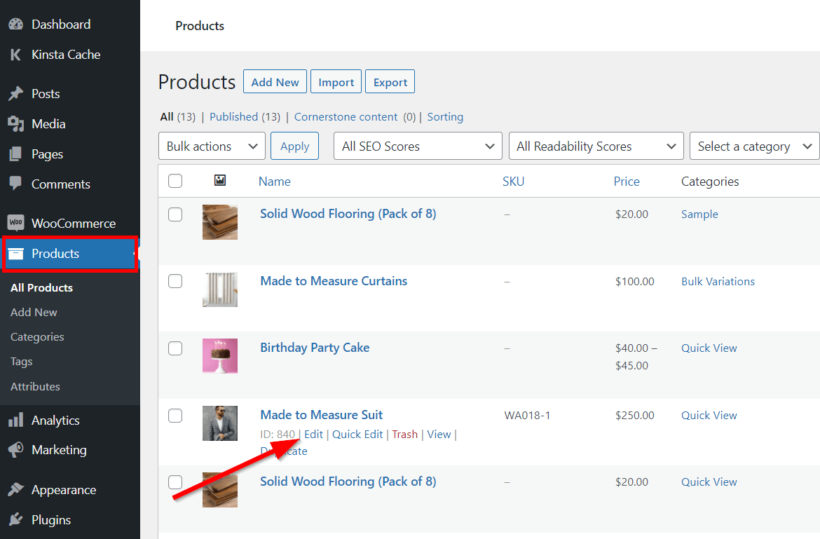
For example, you can go to Products and select the product you want to edit.

WooCommerce products list where you can edit individual product sample settings

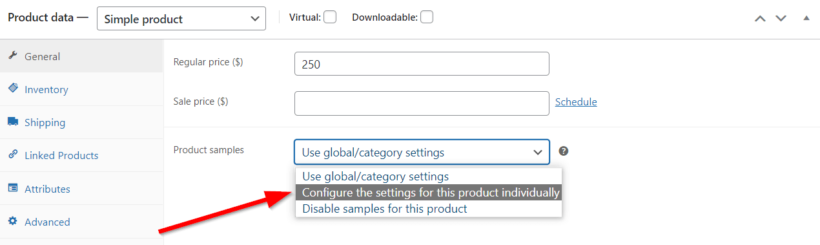
Next, scroll down to the 'Product data' section and open the 'Product samples' dropdown. Then select 'Configure the settings for this product individually'.

Product samples dropdown set to configure settings for an individual product

Now, you'll be able to enter a unique sample price. Otherwise, you can also disable samples for the product.

You can follow a similar procedure to override the global settings for a product variation or category.

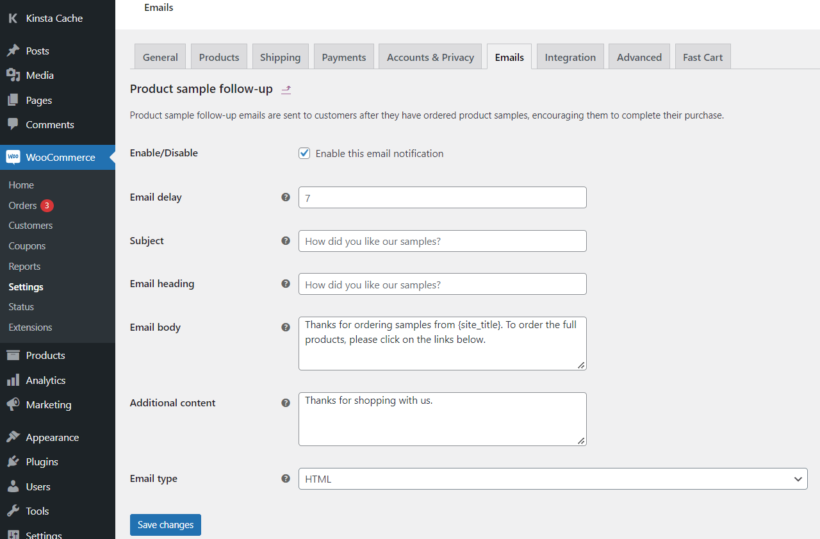
Step 4: Customize the follow-up emails

The last step you want to take is to set up follow-up emails to remind your customers to buy the full product after testing out the sample.

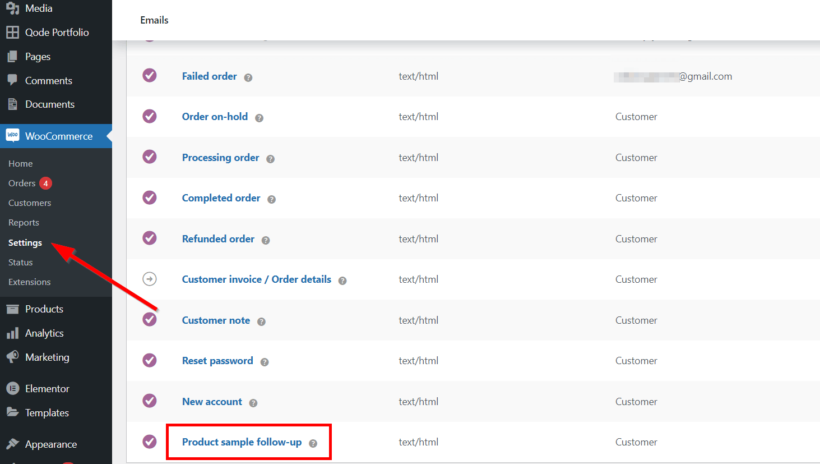
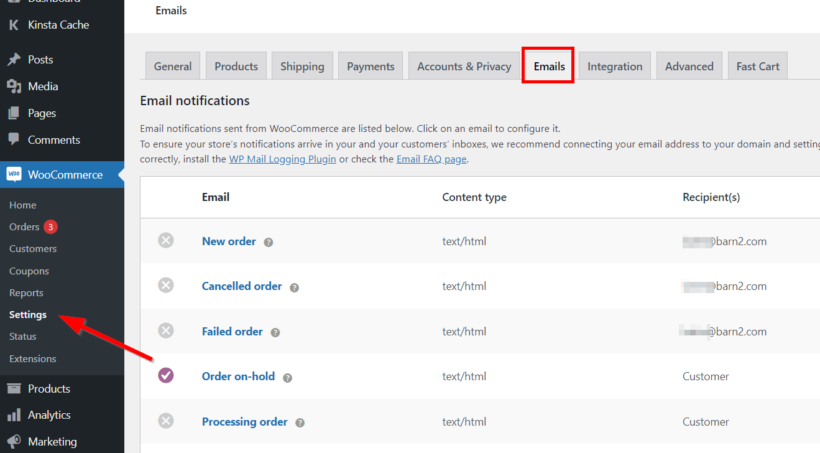
To do this, go to WooCommerce → Settings → Emails.

WooCommerce email notification settings for sample follow-up emails

Click Manage next to 'Product sample follow-up'. Edit the necessary fields and click Save changes.

Product sample follow-up email settings in WooCommerce

The 'Email delay' allows you to sent the number of days after which WooCommerce will send the reminder email automatically.

Where to get the plugin

Product sampling marketing is a powerful marketing strategy which WooCommerce store owners can use to efficiently drive sales, brand awareness, and customer acquisition. The technique is so effective because it helps customers overcome the initial fear of trying an unfamiliar product.

In this article, we've shown you how to use WooCommerce Product Sample effectively in WooCommerce. We've looked at some product sampling marketing examples and learned how to create a free sample marketing strategy.

Not it's time to install the plugin and put it into practice.

This amazing plugin allows you to:

  • Offer free or paid samples for all or some of your products
  • Gain full control over your product sampling campaign
  • Send follow-up emails to remind customers to buy the full product

Ready to launch your first product sampling marketing campaign in WooCommerce? You can start by getting your copy of WooCommerce Product Sample.

Setting up free products in your WooCommerce website: Complete guide

Just like all entrepreneurs, WooCommerce retailers and digital product vendors always want more and more sales. One effective way to achieve this is to offer your customers WooCommerce free products. After all, people say the best things in life are free. And online shoppers take this rather seriously.

There are a good number of benefits to enjoy by offering your customers WooCommerce free products. Free gifts can help you boost your sales and conversion rate. You can use this strategy to also increase brand awareness and customer loyalty.

But offering freebies in your online store will only give you a good return-on-investment (ROI) if you put the right strategy in place.

There are several ways to offer WooCommerce gift products and effectively drive up sales. Some of them include:

  • Creating free products deals such as 'Buy one get one free' or 'Buy two t-shirts and get another one free'.
  • Sending completely free products to WooCommerce customers who have a coupon code or bought other products.
  • Offering product samples at no cost to the customer to encourage them to order the full-priced version of the product.

In this article, we'll share some expert tips and popular use cases for leveraging WooCommerce free products to your store's benefit. We'll then consider the best WordPress plugins for offering them and share a tutorial on how to set up our number 1 pick, WooCommerce Discount Manager.

Types of WooCommerce free products

As a WooCommerce store owner, there are multiple types of free product packages which you can offer your customers. As I mentioned earlier, the success of your WooCommerce free product campaign depends largely on the strategy you choose.

When choosing the ideal type of WooCommerce gift products for your store, it's important to consider your campaign goals. For example, you'll need different types of free products to drive sales, engagement, and brand awareness.

Skincare products each showing a free sample button on the shop page

Instead of sharing a long listicle of several WooCommerce free product types, we'll discuss two common use cases. These examples cover the major reasons why a store owner may want to offer their customers free products. We'll also suggest the best WordPress plugin for each use case.

This way, you can quickly find the ideal solution for your campaign instead of having to trawl through lots of options.

Let's get to it!

Method 1: Use WooCommerce Discount Manager to offer a wide range of free product deals

WooCommerce product page offering a free product with purchase

WooCommerce Discount Manager is the ultimate discount plugin for WooCommerce. It lets you create all sorts of deals and discounts, including a special type where you can offer free gift products.

The 'Free products' deal is surprisingly flexible and you can use it to configure a wide range of free products deals. For example:

  • Product selection - Offer any products in your store as potential free gifts, or specific products or categories only. For example, you can:
    • Set up a buy one get one free deal which will gift the cheapest item whenever the customer meets the minimum quantity for the deal.
    • Allow customers to mix and match different products and variations to get their free gift, or apply it on like-for-like products only.
  • Minimum quantities - Choose how many products must be in the cart in order to qualify for the WooCommerce free products offer.
  • Number of free products - Choose how many of the products in the cart will be gifted free of charge when the customer qualifies for the deal.
  • User selection - Either offer the free gifts to all customers, or specific roles or even selected individual users. For example, you might offer free products to new users only (which you can do by selecting the "guest" role).
  • Schedule the offer - Optionally set a start and end for when the WooCommerce free gifts will be available.
  • Promote the deal - Add custom content which appears on products pages and above the cart. These draw attention to the offer, encouraging customers to take advantage of it.

The most obvious type of free products deal is WooCommerce Buy One Get One Free (BOGOF) products. However, you can use WooCommerce Discount Manager to set up a much wider range of gift product details.

How to set up WooCommerce free products

The plugin is easy to use. Simply install it, go to Marketing → Discounts, click to add a new discount and select the 'Free Products' discount type.

WooCommerce Discount Manager add discount type

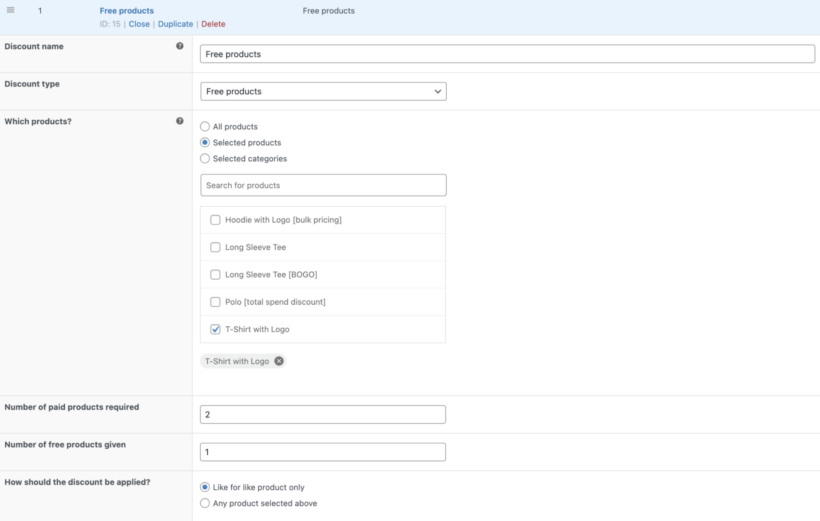
Next, fill in the information about how you'd like your WooCommerce free products to work?

WooCommerce Discount Manager free products BOGO
Setting up a BOGO deal with WooCommerce Discount Manager

Use case 2: Give away free product samples

Free product samples are a highly effective marketing strategy for acquiring new customers and even selling more to your existing customers. A typical online shopper is averse to the risk of trying out a new product, especially from a new brand.

Buyers are generally more comfortable reordering a product they've used in the past. If your business is relatively new or you're launching a new product line, convincing customers to commit to a purchase can be quite difficult.

One easy way to get around this challenge is to offer your site visitors product samples in form of WooCommerce free products. This is quite similar to the traditional in-person product sampling businesses have used in the past.

This time, instead of putting up massive face-to-face events, renting event centers, and hiring sampling experts, you can easily deliver the same experience in your WooCommerce store. If well-executed, online product sampling can generate massive return-on-investment (ROI).

This approach works for both physical retail products and digital downloadable products. For example, you can offer:

  • Free samples of downloadable products e.g. music and video snippets to encourage people to buy the full version.
  • Free fabric, paint, or color samples of curtains, tiles, paint, flooring, etc.
  • Paper samples before a custom printing job e.g. wedding invitations or B2B printing.
  • Free eBooks (e.g. the first chapter of a paid eBook). Or it could be a short excerpt of any part of a book or publication that site visitors can download for free.

However you choose to use this strategy, the main idea is to give your customers a feel of your product. For the best results, you need to ensure that you leave a great first impression that encourages the customer to continue to the checkout process. Otherwise, you may be losing a potential high-quality customer and even damaging your brand reputation.

Let's look at some benefits of using this free products strategy.

Benefits of WooCommerce free product samples

Offering your site visitors WooCommerce free product samples can help boost your sales, conversions, and brand engagement rapidly. The psychology behind this strategy's effectiveness is pretty simple: everyone loves freebies!

Here are some of the major ways this method influences your store visitors:

  • By allowing your customers to try your product at no cost to them, they gain enough confidence to order the full product. This helps them get over the initial buyer's fear.
  • You get your products into the potential buyer's hands. Now they know how the product really looks and feels. This is a further step from just seeing online images that may not be as accurate or convincing.
  • This strategy keeps the shopper thinking about your product. If you manage to leave a very good first impression, the customer may end up doing some mouth-to-mouth advertising on your behalf. This is particularly good for brand awareness and lead generation.
  • It can also help you to raise customer loyalty and outperform the competition. Sending product samples always leaves your customers with a positive image of your brand and you can tap into this sentiment in the long term.

If you're worried about maintaining your profit margins, consider adding a charge for shipping free samples of physical products. You can also charge a discounted sum for the samples as well, if you don't want to offer them for free. Of course, you can offer a smaller version of the product for free, and charge for the full sized version.

Similarly, you can incorporate follow-up emails into your strategy to significantly boost the chances of getting customers to buy the full product. This is particularly important if customers have ordered samples from more than one company.

The WooCommerce free product plugin we'll be showing you next can help you implement all these features in your store.

WooCommerce Product Sample plugin

Order sample button on a flooring product page in WooCommerce

Looking for the best way to use free product samples to encourage your store visitors to buy the full version of a product? The easiest all-in-one solution is to use the best WooCommerce free product sampling plugin—WooCommerce Product Sample.

This plugin packs all the features you need to convince your store visitors to commit to a full purchase. You can use it to offer your customers free and paid samples of both simple products and WooCommerce product variations. This gives you complete control over your profit margin while offering your customers the best experience possible.

Key Features

  • Enable samples for product categories, individual products, or globally Choose the specific products you want customers to be able to order free or paid samples of. This works for all the WooCommerce product types. You can add ‘Order a free sample’ buttons to single product pages, shop, and category pages and customize them as you wish. This also applies to WooCommerce elements powered by other plugins like WooCommerce Product Table.
  • Manage product samples separately from other products Control sample product attributes like stock, maximum order quantity, and even shipping classes independent of the main products.
  • Send follow-up emails to push customers to buy the full product This is the only WooCommerce free products plugin that allows you to send email reminders to your customers. These emails tend to have a high CTR and conversion rate because the shopper now has a feel of your product.

How to offer free product samples in WooCommerce

To add free WooCommerce free product samples to your store, you can start by getting the WooCommerce Product Sample plugin here.

After getting the plugin;

  1. Log into your WordPress dashboard and go to Plugins → Add New → Upload Plugin.
  2. Next, choose the plugin ZIP file you downloaded and click Install Now then Activate Plugin.
  3. After getting the plugin, you must have received an email with your license key. Now, enter the license key and click Activate.

The next step is to enable product samples and complete the configurations of the plugin's general settings. To do this, navigate to WooCommerce → Settings → Products → Product sample.

WooCommerce Product Sample settings for configuring free product samples

On this page, you can enable the product sample feature. Also, edit other settings like the maximum order quantity, shipping class, and dynamic pricing if you want to offer samples at a discounted price.

To edit sample settings for individual products or categories, navigate to the product or category settings page and change the settings in the Product samples tab dropdown.

Choosing to configure free sample settings individually for a product

Finally, set up follow-up emails for product samples by going to WooCommerce → Settings → Emails.

Scroll down and click Manage next to 'Product sample follow-up'.

WooCommerce emails list with the product sample follow-up notification highlighted

After editing the necessary fields, click Save changes.

Editing the free sample follow-up email in WooCommerce settings

That's it! You've now successfully added WooCommerce free product samples to the front end of your ecommerce store.

How to make WooCommerce gift products profitable

Before we finish, let's discuss the elephant in the room 🐘. That's right - the question "How can I afford to give away products for free?"

You might be worried that gifting free products can negatively affect your store's profit margin. Instinctively, that makes sense as you're giving away free products with no guarantee that they will convert into future sales.

It's a fair point. Offering free gift products in WooCommerce can be a powerful sales incentive, but it’s essential to approach it strategically to ensure profitability. Here are some tips to consider:

  • Cost analysis:
    • Before offering WooCommerce free gift promotions, evaluate the cost of the free products. Calculate the production or procurement cost, packaging, and shipping expenses. Ensure that the cost of the gift doesn’t exceed the potential increase in sales.
    • Consider the long-term impact: While immediate costs matter, think about the overall customer lifetime value. A satisfied customer who receives a thoughtful gift product may become a loyal repeat buyer.
  • Set minimum purchase thresholds:
    • To make free products profitable, set minimum purchase thresholds. For example, offer a free product only when customers spend a certain amount. This is easy to do in WooCommerce Discount Manager and encourages larger orders. This ensures that the gift doesn’t eat into your margins for smaller transactions.
    • Monitor the average order value (AOV) before and after offering free product offers. If the AOV increases significantly, it’s a positive sign.
  • Strategic product selection:
    • Choose your WooCommerce gift products wisely. Opt for items that have a lower cost but high perceived value. For instance, sample-sized products, branded merchandise, or exclusive items work well.
    • Align the free product with your brand and target audience. For example, if you sell skincare products then a free travel-sized lotion could be enticing.
  • Promotion timing:
    • Time your free gift promotions strategically. Consider holidays, special occasions, or product launches. Seasonal offers can boost sales and create a sense of urgency.
    • Monitor the impact on overall sales during and after the promotion. If there’s a significant spike, it indicates success.
  • Track metrics:
    • Use analytics tools to track the performance of free gift campaigns. Monitor metrics like conversion rates, revenue, and customer retention.
    • Look beyond immediate sales. Assess whether the free gifts lead to repeat purchases, referrals, or increased customer loyalty.
  • Upsell and cross-sell opportunities:
    • Use free WooCommerce products to upsell or cross-sell. For example, offer a free accessory (like a phone case) with the purchase of a high-value item (like a smartphone).
    • Monitor the impact on related product sales. If customers buy additional items alongside the free gift, it’s a win.

Remember, the goal is not just short-term sales but building a loyal customer base. By strategically implementing WooCommerce free gift promotions, you can enhance customer satisfaction, drive repeat business, and ultimately improve profitability 📈

Start offering free products today!

Offering your store visitors WooCommerce free products is a tried and tested way of driving e-commerce sales, conversion, and brand awareness. But to get the best results, you need to back your 'giveaway' campaign with a solid strategy.

To start offering WooCommerce free products in your store, you can either:

Illustration of managing WooCommerce product variations in bulk

While it’s important to offer an easy way for customers to browse through your WooCommerce products, you also need an easy way to manage all your products and variations. WooCommerce easy variations management is essential for stores selling products with many variations. A bulk variations plugin makes it easier to edit and manage product variation options, saving you heaps of time.

As it comes, WooCommerce doesn't provide an easy way to manage variations in bulk. Fortunately, you can achieve this by installing a WooCommerce bulk variations manager plugin.

In this complete guide, we’ll dive deeper into why you need WooCommerce easy variations management, and how to get it. You'll learn how to:

  • Display all variations from your store in an easy bulk management interface, like a spreadsheet. We'll do this using the Setary app.
  • Manage bulk variations on the 'Edit Product' page, and display them on the front end in a user-friendly variation order form. We'll use the WooCommerce Bulk Variations plugin for this.

We'll do it with Setary, the best tool for easy variations management.

What are WooCommerce variations (and why are they so difficult to manage)?

WooCommerce lets you display different options or variations for your products. Here’s what it looks like:

Default WooCommerce size dropdown on a four cheese pizza product page

You can add multiple product variations to each product and edit variation prices and variation images (or variation swatches) for each one. Adding product variations in WooCommerce is great for selling products that come in different colors or sizes.

For instance, if you sell apparel items such as t-shirts or shoes, you can have variations based on size and color product attributes. Similarly, if you sell stationery items such as ball pens or chart paper, you can create multiple product variations based on colors and brands.

Customers can select the product variant they want and add the desired quantity to their shopping cart, without having to go through multiple shop pages.

Why are variations so difficult to manage?

WooCommerce makes it very difficult to manage bulk product variations, especially if you have a lot of variations for each product. The whole process is time-consuming, tedious, and error-prone.

For instance, imagine that you have multiple size and color variations for a t-shirt product and want to add the same thumbnail for each blue option. Amazingly, you have to manually add the product image individually for each size variant 😫

Adding and managing product variations - the slow way 🐌

Here’s how you normally create variations in bulk from within the WordPress admin:

Creating product variations one at a time in the WordPress admin
  1. Navigate to the product’s edit screen. Click on the Variations tab from the Product data meta box to configure variation settings. This is the default variation management tab in WooCommerce.
  2. Click on the variation you want to edit and set the price for each variation. WooCommerce also lets you set the Regular Price for all variations. However, this might not work for you if you want to charge a different price for each variation.
  3. Similarly, if you want to add a variation image (or variation swatches), you have to find and select the variation and click on the Image button.
  4. Make sure to click on the Update button to save changes on the front end.

As you can see, the process is very tedious if you have more than a couple of variations. This is because WooCommerce doesn’t offer a way to bulk manage variations.

Setary: The easiest way to manage bulk variations in WooCommerce

Setary homepage for managing WooCommerce variations in bulk

While WooCommerce itself doesn’t come built-in with bulk variation management, there's an easy way to add this to your store. Setary is a bulk editing web app which integrates with your WooCommerce site. It provides a central bulk management interface outside of the WordPress admin, allowing you to easily bulk manage variations without weighing down your site.

Setary's interface looks like a spreadsheet, with each product and variation listed on its own row. You can:

  • Choose which columns of product data to display and manage.
  • Use the search box and advanced filters to select specific variations (e.g. all blue t-shirts).
  • Make changes inline directly in the spreadsheet, or apply bulk edits to multiple variations at once.
  • Preview your changes before applying them to the live store.
  • Easily bulk manage variations across multiple WooCommerce stores or WordPress multisites.
  • Manage absolutely any type of data about your products and variations, including custom data added by other plugins.
Setary spreadsheet displaying variable products alongside their individual variations for easy WooCommerce management

I can't even begin to tell you how much time Setary can save you. It's just so much easier to manage variations from a central interface than having to do it manually for each product 🚀

Next, I'll tell you how to set it up (which only takes a minute).

How to set up the Setary bulk variation manager

  1. First, sign up to a free trial of Setary.
  2. Once you've done this, you'll be promoted to install the Setary helper plugin on your WordPress site. This is what connects your store to Setary's secure bulk management interface.
  3. Back on the Setary website, enter the URL of your store to finish connecting it.
  4. Next, you'll see all your products and variations listed in Setary's bulk management spreadsheet.

How to easily bulk manage variations in Setary

Once you've set up Setary, the first step is to filter the spreadsheet to view the variations and data you want want to manage:

  1. First, click the 'Columns' button and select which types of product data you want to manage in bulk.
    Selecting variation columns to manage in the Setary product spreadsheet
  2. Next, use the search box and/or the filters at the top of each column to narrow down the list. For example, you might want to use the Type column to select variations only (i.e. not entire products), and the Color attribute column to only view blue variants.
    Setary spreadsheet filtered to show only Blue WooCommerce variations for easier variation management

And now you're ready to start making changes. There are 2 easy ways to use the bulk variation management features:

  • Make changes inline - Simply click in any call of the spreadsheet to manage the variation data. For example, you can update the variation description, image or prices (or anything else) in this way.
  • Apply bulk actions - Alternatively, use the checkboxes on the left to multi-select all the variations you wish to manage together. A 'Bulk Actions' button will then appear. Click this to select from all the available bulk actions.
Applying a bulk action to selected products in the Setary editor

Once you've made changes to the product variations, you can view them in the spreadsheet. A blue dot appears next to each change, so you can easily see what's new. Check everything looks good, then click 'Save' to apply the changes to your live site.

Alternate option - Improve bulk variation management on the Edit Product screen

WooCommerce Bulk Variations sales page for managing variations in bulk

As you can see, Setary is the ideal solution from bulk managing variations across multiple products from a spreadsheet. Before we finish, I want to tell you about an alternative type of easy WooCommerce variations management - WooCommerce Bulk Variations.

The WooCommerce Bulk Variations plugin works different to Setary. Instead of bringing all your variations together into a central interface, it improves the bulk management functionality on the WooCommerce Add/Edit Product screen. If you're working with products from within the WordPress admin, then it can be a useful tool to have.

The other benefit of using WooCommerce Bulk Variations is that it also improves how variations are displayed on the front end of your ecommerce store. That's right, it improves the way that you edit and display variations in bulk 🌟

2 ways to manage and display bulk variations

  • Bulk variations management. For starters, you can add and manage WooCommerce bulk variations using the default product edit page, an interface you’re already familiar with. This lets you apply bulk actions to specific or select product variations and customize prices, images, and manage stock status in bulk for all “similar” product variations.
    Filtering WooCommerce variations to bulk edit prices, images and stock
  • Bulk variations order form. WooCommerce Bulk Variations also lets you display variations in a bulk order form. For instance, you can display and update all attributes, product options, stock quantity information, and prices in an attractive table layout. Customers can quickly add multiple products to their cart and select the product options. This is much faster than forcing customers to select and add each variation to their cart one by one.
    Candy variations grid letting customers order several weights and flavors at once

How to add easy variations management to the Edit Product screen

As we have seen, the WooCommerce Bulk Variations plugin makes it really easy for store owners to manage product variations in bulk. Here’s how you can do that on your WooCommerce site.

First, install the plugin

After installing WooCommerce Bulk Variations on your WordPress site, navigate WooCommerce → Settings → Products. Click on the Bulk variations link to configure the plugin’s settings.

WooCommerce Bulk Variations settings with the license key activated

Select your desired Grid Options and choose how to display images for product variations using the dropdown menu next to Variations images.

You can also set default attributes for all new variable products you add to your WooCommerce site. Once you’re done, remember to click on the Save Changes button to continue.

How to manage bulk variations on the Edit Product screen

Now, with the WooCommerce plugin fully set up, you can start bulk managing product variations on your WooCommerce site. To do this, go to the product’s edit page.

Candy product variations listed by weight and flavor on the edit product page

You can use the Filters field to filter out the product variations you want to bulk manage.

Filtering variations by weight to bulk manage a subset of options

This will only select the product variations you want to manage and not all product variations for your product. Now, select Set thumbnail using the dropdown menu above.

Next, select a common image for all the selected product variation options. Click on the Select Image button to continue.

Make sure to click on the Update button to save changes.

To sum up, the WooCommerce Bulk Variations plugin offers an easy way to manage all product variations in bulk. It lets you manage product attributes in bulk and makes it easier to customize multiple product variations at once. This way, you save time and make it easier to manage all variable products on your WooCommerce site.

Bonus: Display product variations better

If you don't want to change how variations are displayed in the front end, then you can skip this section. Alternatively, here’s what you need to do to enable the bulk variations order form:

Product level controls to override global settings and enable the variations grid
  1. First, enable a grid-style layout for product variations. You can do this on the plugin’s settings screen. This will enable the grid for all variable products, replacing the standard variation dropdowns. If you prefer, then use steps 2-4 to enable it (or customize it) for specific products only.
  2. Using the product’s edit page, scroll down to the Product data meta box and click on the Bulk Variations tab.
  3. Select the Override the global settings for this product and the Enable the bulk variation grid for this product checkboxes and choose your display options.
  4. Finally, make sure the Disable purchasing is unchecked before clicking on the Update button.

Customers can select their desired product variation options using the variations matrix layout and quickly add multiple products to their cart from a single page.

As a result, you enhance the single product page’s user experience and encourage more people to purchase from your online store.

It's time to bring easy variations management to WooCommerce!

WooCommerce makes it easy to sell simple product types. But if you sell products with more than one or two variations, then you need a bulk variations manager plugin.

Setary provides the easiest way to manage variations in bulk. It lets you:

  • View all your products and variations in a user-friendly spreadsheet interface.
  • Make inline changes to any type of data about your products and variations, including variation images.
  • Search and filter to select specific variations, and then apply bulk changes.
  • Allow colleagues and clients to add and bulk manage variations without needing to access the WordPress admin.
  • Make it easier for customers to buy products.

Start saving time and set up Setary today! It comes with a free trial, so you can try it risk-free!

Illustration of a customer typing a delivery address into a Fast Cart popup

Did you know that you can increase conversions for your online store by auto-filling the customer’s address? All you have to do is set up Google address autocomplete in WooCommerce.

So, when customers start entering their address at the WooCommerce checkout, the autocomplete address form will provide auto-populate suggested results based on the user’s input. This can speed up checkout form completion by up to 30%!

By replacing the standard checkout with the WooCommerce Fast Cart plugin, you can boost conversions by allowing customers to review their selections and checkout in a popup cart without leaving the page. And, instead of entering their billing or shipping address manually, they can complete it with Google address autocomplete.

What is Google address autocomplete?

If you shop online, you’ve probably come across checkout forms that autocomplete your address as soon as you start typing it. It fills out the street address, city, zip code, state, and country fields automatically.

This is a feature of the Places library in Google’s Maps JavaScript API. As a result, it gives you access to addresses all over the world. In fact, it’s the type-ahead-search behavior of the Google Maps search field.

The WooCommerce Fast Cart plugin integrates with Google autocomplete to save customers even more time. Instead of manually entering their address and filling out all address fields, they can simply pick from the suggestions provided when they start typing their address.

It’s incredibly intuitive and speeds up the checkout process for customers too. And even better, customers are already familiar with Google address autocomplete.

What is WooCommerce Fast Cart?

The WooCommerce Fast Cart plugin adds a popup cart and checkout to your online store.

This makes it easy for customers to review their orders when they’re done shopping and place their orders without leaving the page. In addition to this, they can change quantities, remove items, and redeem discount codes from the popup cart.

The WooCommerce Fast Cart plugin supports WooCommerce’s product recommendation engine by displaying related products based on the products customers have added to their cart. This helps you increase the average order value and cross-sell to customers.

You can display the checkout within the mini popup cart and enable customers to checkout without leaving the page. In fact, this is the easiest way to speed up the checkout flow for your store. To take things to the next level, you can enable Google address autocomplete in WooCommerce to automatically fill out the address fields.

The WooCommerce Fast Cart plugin can be configured to display the popup cart either as a side cart on the right of the screen or in a larger lightbox in the middle of the screen.

Tutorial: how to set up WooCommerce autocomplete

Here’s what you need to do to set up Google address autocomplete in WooCommerce:

Step #1: Install the WooCommerce Fast Cart plugin

Get the WooCommerce Fast Cart plugin. Log into the WordPress admin area and then install and activate the WooCommerce Fast Cart plugin. Head over to WooCommerceExtensions to activate the plugin’s license key.

Activating the WooCommerce Fast Cart license key in the plugin settings

Click the Save changes button to continue.

Step #2: Enable Google address autocomplete

Fast Cart content settings with the Google API key field for address autocomplete
  1. Go to WooCommerce SettingsProductsFast cart to configure the plugin’s settings.
  2. Enable the Allow fast checkout option and then tick the Enable address autocomplete checkbox which appears underneath it.
  3. A text field called Google API key will apper underneath the checkbox. You need a Google API key to use Google address autocomplete in WooCommerce. This will allow your website to access the address data from Google’s API.
  4. Check out our tutorial on how to get your Google API key for step-by-step instructions.
  5. You can select other WooCommerce Fast Cart options as needed from the same screen. Here are some suggestions:
  6. You can enable the Direct Checkout option if you want to skip the cart completely and allow customers to checkout without having to go through a cart stage first.
  7. In addition, you can choose to auto-open the fast cart and checkout so that customers are prompted to complete their purchase without having to click on a floating cart icon first.

Step #3: Test the Google address autocomplete

Finally, test the fast cart feature on your WooCommerce store. First, make sure you’re not logged in. If you are logged in to your WordPress site, WooCommerce might already have your address stored which means it won’t need to use the Google address autocomplete feature.

Add a product to your shopping cart, open the popup checkout, and start typing your address.

Google address autocomplete suggesting addresses in the Fast Cart checkout

Like magic, the Google address autocomplete will do the hard work for you and fill out the address fields!

Where to get the plugin

With Google address autocomplete in WooCommerce, you can speed up the checkout process on your store and minimize cart abandonment rates.

WooCommerce Fast Cart makes it incredibly easy to offer the fastest checkout experience complete with Google address autocomplete and direct checkout.

Ready to set up Google address autocomplete in WooCommerce? Get WooCommerce Fast Cart today!

The Complete Guide to setting up related products in WooCommerce for effective upselling

If you want to increase the average order value in your e-commerce store, then a WooCommerce related product plugin is the perfect way to achieve this.

WooCommerce related products is a simple but effective way to recommend products to your customers. It works by suggesting additional products that are related to the ones the customer is currently viewing, has recently viewed, or added to their cart. This can help increase your sales by encouraging customers to purchase more products from your online store.

In this tutorial, I will tell you:

  • How to set up the basic related products feature which comes with WooCommerce itself, and why there are better ways to do it.
  • How you can sell more by using the bestWooCommerce related product plugins. I'll share two plugins with you: one to display related items above the add to cart button on your product pages; and one to display them in a popup cart. 
  • And finally, I will provide step-by-step instructions on how to add related products using these two WooCommerce plugins.

What are related products? (with examples)

Related products in WooCommerce are extra items suggested to customers alongside the main one they're viewing. The suggestion can be based on the current product, items in the cart, or the customer's browsing history. The aim is to gently prompt the customer to buy more without feeling pushy.

Most ecommerce categories use related products in slightly different ways. Here are five concrete examples:

  • Fashion: A customer viewing a dress sees recommended shoes, a handbag, or a matching jacket.
  • Beauty: A customer adding mascara to their cart sees a recommended primer, makeup remover, or coordinating lipstick.
  • Electronics: A customer buying a smartphone sees recommended cases, screen protectors and chargers.
  • Home goods: A customer ordering a sofa sees recommended cushions, throws or coffee tables.
  • Food and drink: A customer ordering coffee beans sees recommended grinders, filters or milk frothers.

The right related product feels like a natural next step from the customer's primary purchase decision.

In the world of e-commerce, customer experience is everything. Offering personalized WooCommerce product recommendations can go a long way in making customers feel valued and engaged with your brand.

There are few better ways to increase your average order value than by using a WooCommerce related product plugin.

Research shows that customers who click on related products have a 5.5x higher conversion rate than those who do not. Isn't that amazing! And to add to that, if customers click on related products then they are more likely to purchase multiple items, also increasing your average order value.

What you can achieve with related products in WooCommerce

In practical terms, you can use the idea of related products to do a couple of things:

  • Make it easier for customers to find additional products that are relevant. A good recommendation is one that's related to what the customer is thinking of buying already and increases the overall value that the customer gets from the whole purchase. For example, whoever's looking at guitar strings will most likely also be interested in guitar picks and maybe also capos, slides, straps, and other accessories. WooCommerce related products are where you can show them all that.
  • Use WooCommerce recommended products to upsell product variations or customizations. This is in the realm of "things that not all customers think of out the gate". For example, for a business that sells hand-made jewelry, offering a custom engraving service/upsell can be a great way to increase the average order value.
  • Encourage customers to buy more expensive products or special versions of the current product. This type of related product is more about showing people some options that they might not have considered on their own.

Honestly, this is just the tip of the iceberg. There are no limits when it comes to how you can use WooCommerce related products plugin in your store or the kinds of products you can showcase. Speaking of showcasing related products.......

How related products are shown by default

WooCommerce has some basic functionality for related products built in from the get-go. However, that functionality is a little limited in how it's presented and how it works overall.

First things first, WooCommerce lets you assign two main types of related products: upsells (products related to the current one but more expensive or with higher margins) and cross-sells (products that "are frequently bought together").

WooCommerce displays upsell products right on the front-end product page and cross-sell products in the shopping cart (similarly to how Amazon does this).

Here's what upsells look like in default WooCommerce:

Default WooCommerce related products shown below the single product description

And here's what cross-sells look like by default in the shopping cart:

Default WooCommerce cross-sells shown on the cart page under You may be interested in

You can enable both of these on the 'Edit Product' screen. Just go to the 'Product Data' part of the page and open the 'Cross-Sells' tab.

Apart from these, WooCommerce will also show a small related products section automatically on each product page. Those are lined up based on the product category or product tags they share with the currently viewed item. You'll usually find those listings at the very bottom of the product page or you can add them via shortcode.

The downside of how WooCommerce displays related products

Now, even though I'm showing you examples here, this doesn't mean that it's all going to work the same on your WordPress website. The way upsells, cross-sells, or related products are displayed all depends on the theme (or child theme) your WooCommerce store uses. Some templates ignore related products completely and don't display them.
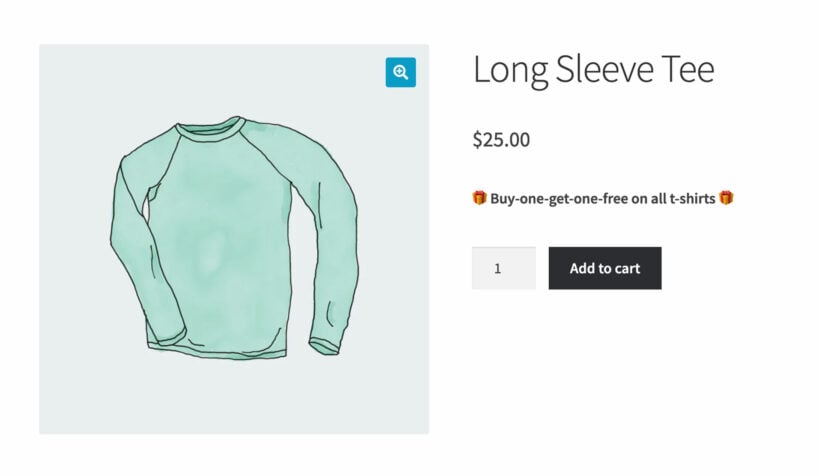
However, even for themes that do display them, they typically appear quite low down on the single product page or in the cart. This can be problematic for store owners with long product descriptions. As a result, those related products are easy to miss.
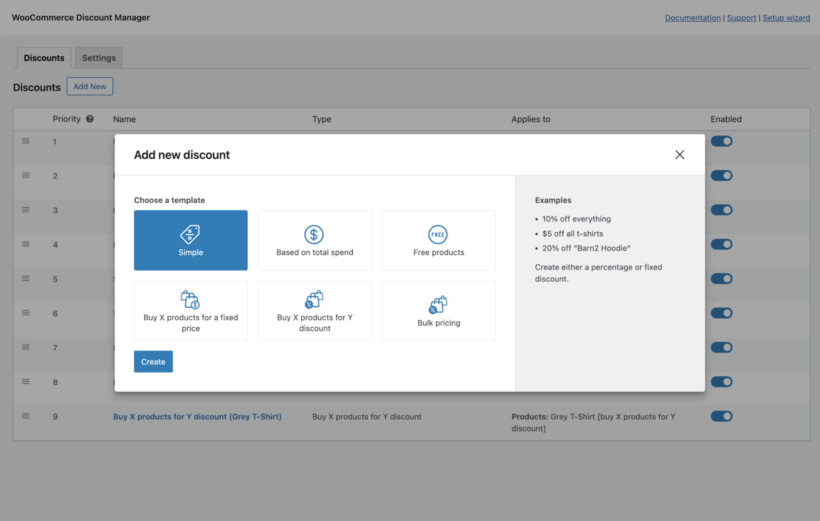
The most common issues with the default way of displaying related products in WooCommerce are:

  • Related products are buried on the product pages or in the shopping cart.
  • Not all themes support the native way of handling WooCommerce related products settings.
  • It's easy for customers to miss your related products.
  • Related products cannot be added to the cart quickly.
  • There's no way to customize the presentation of your related product listings.

How to solve all this? You've guessed it; plugins! The right lineup of WooCommerce extensions will allow you to handle related products in a much better way.

Next, I will share two recommendations on the best WooCommerce related products plugins which are much more effective than the built-in upsells and cross-sells.

WooCommerce Product Options - Display related products above the add to cart button

Related products shown as add-ons above the add to cart button

Look at the smartphone product in the screenshot above. Can you see how incredibly prominent the related products are?

That's right - instead of displaying WooCommerce related products at the bottom of the page, they've given pride of place above the add to cart button. The customer is taken on a carefully planned journey which prompts them to make a series of decisions on related products to buy alongside their smartphone. First, they are asked to select a case. Next, they are asked to add accessories. After making their selections, they click a single 'Add to cart' button to add the smartphone and the related products together.

As you can see, presenting related products in this way is significantly more likely to generate sales then hiding them at the end of the page. And you can do it with the WooCommerce Product Options plugin.

This handy plugin lets you add a range of extra add-on options to your products. One of these is the ability to display products from other parts of your store as options. I'll show you how to do that now.

How to display related products above the add to cart button

  1. Install the WooCommerce Product Options plugin on your WordPress site.
  2. Go to Products → Options.
  3. Click 'Add new' to create a new options group for the product that you wish to display related products on.
  4. Select the product. Either select just one product, or if you want to show the same related products on all products in a category, then select the entire category instead.
  5. Click 'Add Option' and choose the 'Products' option type.
  6. Configure and select each specific product that you wish to display, or let the plugin select related products dynamically from a certain category.
WooCommerce select other products as options

When you add the new option, there are lots of other options to customize it as you like. For example, you can choose from a wide range of styles for displaying the related products. These include checkboxes, radio buttons, clickable images, and so on. You can also set them as required fields, or set minimum and maximum quantities. There's even a conditional logic option so that you can show and hide different related products based on the customer's other selections.

Once you've saved your product options group, view the product page. You'll see the related products neatly displayed above the add to cart button. Perfect!

WooCommerce Fast Cart - Display related products in a popup cart

WooCommerce popup cart demo

So far, I've told you how to use the WooCommerce Product Options plugin to display related products above the add to cart button on product pages. That's step 1 of the journey to encouraging customers to buy more. But how can you convince the customers who didn't respond to step 1?

The solution is to display related products in the cart, too. This creates a drip-drip effect, as customers may respond to the second prompt rather than the first.

Now, as we saw earlier, WooCommerce itself does have an upsell feature which displays related products on the cart page. However that's no use because it displays them low down the page where they're easy to miss.

Instead, you can use the WooCommerce Fast Cart to display related products in a popup mini cart.

Why is a mini cart a better way to display related products?

The popup cart replaces the main cart page, which brings many benefits:

  • Prominently displays related productsThe popup cart includes related products in a "You may also like" section. This as appears as a "You may be interested in..." carousel. It's powered by the cross-sells feature which comes with WooCommerce itself, and simply displays the products in a better way that is more likely to convert.
    Related products shown inside a WooCommerce Fast Cart popup
    A fast cart popup containing related products
  • Easy to review cartYou can either launch the mini cart as soon as customers add items to their cart, or they can click a floating cart icon. Either way, the popup cart provides a quick and easy way for shoppers to review their order, make changes, add related products, and proceed to the checkout page.
  • Fast on-page checkoutWooCommerce Fast Cart doesn't just replace the cart page. It also comes with a fast on-page checkout so that customers can complete their order without ever leaving the current page. This makes a big difference to conversion rates by removing friction and enabling customers to submit their order as quickly as possible.
    Popup checkout letting customers complete their order quickly

Step 1. Add cross-sells to your products

As I mentioned above, the related products in WooCommerce Fast Cart use the cross-sell feature which is part of WooCommerce. This means that in order to display related items in the add to cart popup, you need to add some cross-sells.

I recommend doing this manually for each product so that you can choose the most relevant similar products for each one. For example, let's go back to our smartphone example from earlier, where customers were prompted to choose a case and accessories on the product page. In this case, I'd recommend adding the most popular case and accessories as cross-sells to display in the popup cart.

How to add product cross-sells to appear in the WooCommerce cart:
  1. Go to the 'Products' section of your WordPress dashboard, and click on a product that you want to add upsells to.
  2. Scroll down to the 'Product Data' panel and open the Linked Products tab.
  3. Start typing a product name or ID (not SKU) in the 'Cross-sells' field. WooCommerce will display some suggestions for you to click on.
  4. Add as many cross-sell products as you like, and then click Update.
Upsells and cross-sells fields on the WooCommerce Linked Products tab

Step 2. Set up WooCommerce Fast Cart

Next, it's time to install the WooCommerce Fast Cart plugin and use it to display the cross-sells in a popup cart:

  1. Install WooCommerce Fast Cart and activate the plugin.
  2. In the setup wizard, choose the content that you want to appear in the fast cart. Make sure that you enable WooCommerce related products.
  3. Choose whether or not to enable the popup checkout, and other features like whether to open it automatically when customers add products to their cart.

Here are the elements that you can customize in the popup cart, and where they appear. As you can see, you can include a product image and choose what to include in the product data section:

Fast Cart popup with cross-sells shown as related products

What's great about all this is that WooCommerce Fast Cart adapts the appearance and layout of related products based on how many such products are available for the items already in the cart.

For example, here's a case where there are just two WooCommerce related products assigned to the main product in the cart:

Two WooCommerce related products suggested in the popup cart

As you can see, the plugin displays custom related products straight up under the main buy button. However, if there's a higher number of related products available, WooCommerce Fast Cart will add a slider/carousel feature to show them all:

WooCommerce related products shown in a slider inside the popup cart

How to choose the right related products

Before we finish, I will give you some bonus tips to help you to choose the right related products for each item in your store. This is important because it makes a huge difference to whether customers buy the extra items. And when shopping online, I see a lot of ecommerce stores get this wrong!

You shouldn't pick related products at random. Think carefully about which products really are a fit with the current one. Also consider which customers are most likely to buy.

A good way to think about this is to consider a couple of types of related products:

  • First, gather the products that are a natural upgrade over the current one - maybe they're of better quality, come from a better-known manufacturer, or are simply more profitable for you.
  • Think of all the products that will improve the customer's experience with the current product (make it easier or more enjoyable to use).
  • List all the products that previously customers have commonly bought together with the current product.
  • List all the products that would make a nice set or bundle with the current one for whatever reason.

Use this to prioritize which related products to display on the product page. Once you've done that, display the top few in the popup cart to give them an extra boost.

Remember to check your related products regularly, as these may benefit from being tweaked over time. For example, if you have a new product then you can boost sales by displaying it for other products in your store.

Frequently asked questions

What's the difference between related, cross-sell and upsell products?

A related product is any item suggested alongside the main one a customer is viewing. Cross-sells and upsells are two specific types. A cross-sell is a complementary product, like a phone case for a phone. An upsell is a more expensive or upgraded version of the product the customer is already considering. In WooCommerce, "Related products" specifically refers to items linked by shared category or tag. Cross-sells and upsells are different and are picked manually per product.

How many related products should I show?

Three to six is a sensible range for most product pages. Fewer than three can feel sparse. More than six often becomes visual noise and dilutes the customer's attention from the main product. If you're using the popup cart approach with WooCommerce Fast Cart, two to four works well. The popup is smaller and you want the customer to keep moving toward checkout.

Where on the page should related products appear?

The default WooCommerce position is at the bottom of the product page, but that's the worst place. Customers are most likely to engage with related products that appear above the add to cart button. That makes them part of the buying decision. The second-best position is inside the cart or popup cart. The customer has already committed to buying there and is open to adding more. Avoid placing related products below the fold on the product page where they're easy to miss.

WooCommerce related products can be a great way of increasing your store's revenue without any additional investments needed. This is a really cost-effective strategy and can be incredibly powerful.

For maximum results, use the following plugins together to make related products super-prominent in your store:

  • Use WooCommerce Product Options to force customers to make an active decision on which related products to buy. The related products appear above the add to cart button, making them impossible to miss rather than an afterthought.
  • Also use WooCommerce Fast Cart to display the most important related products in a popup cart window. This gives you a second change to convince customers to add them to their cart, maximizing your chances of conversion!

Questions about how to craft your strategy with related products for WooCommerce? Let us know in the comments below.