10 ways to build stronger donor relationships


Strong donor relationships are the single biggest predictor of repeat giving, and most nonprofits leave them to chance. Here are 10 practical ways to deepen donor relationships on a WordPress nonprofit site, even with a small team.
Donor retention rates in the US nonprofit sector hover around 45% according to AFP's Fundraising Effectiveness Project. Just over half of first-time donors give a second time, and acquiring a new donor typically costs 5 to 7 times more than keeping an existing one. That makes the existing-donor relationship the highest-leverage thing a small fundraising team can focus on.
The good news is that most of what drives donor retention is achievable on a two-person team. It doesn't need a six-figure CRM rollout. Personalized thank-yous, clear receipts, exclusive donor-only content and regular updates that actually arrive when promised will move retention more than any expensive platform will.
Below, I'll walk through 10 ways to strengthen donor relationships, then show the WordPress and WooCommerce setup that makes any of them runnable by a small team. I'll close with a donor resource portal idea that ties most of these together.
Why donor relationships matter for nonprofit retention
A 45% sector-wide retention rate sounds bleak until you compare it to first-time-donor retention, which sits closer to 19%. Recurring and major donors retain much higher than that, often 70% or more. The gap is almost entirely about how the nonprofit treats people in the first 90 days after the first gift.
Lifetime value adds up quickly. A donor who gives $50 once is worth $50. A donor who gives $50 a year for seven years is worth $350, and that's before the lift from increasing the gift size or unlocking a major-gift conversation. Every retention point you add to the bottom of the funnel is worth real money over a 5-year horizon.
For small nonprofits, the math also runs the other way. Losing a regular $25-a-month supporter costs $300 of annualized revenue, plus whatever it costs to replace them. That's why the 10 ways below all skew toward retaining existing donors rather than chasing new ones.
10 ways to strengthen donor relationships
These are ordered roughly by impact and ease. Start with the first two or three before reaching for the more involved ones.
1. Send a real thank you within 48 hours
The single highest-leverage donor relationship habit is a fast, personal thank you. Not the automated transaction receipt. A separate message that uses the donor's name, references what they gave to (the campaign, not just the dollar amount) and says what the money will do.
For donations under $100, a templated email signed by the executive director is fine, as long as the templating leaves room for a sentence specific to that donor. For gifts of $250 or more, send a handwritten card. For $1,000+, pick up the phone within 72 hours. None of this requires a tech upgrade. It requires someone on the team committing to the workflow and protecting the time on their calendar.

A small physical token can amplify the thank you. The Barn2 guide to donor gift ideas walks through five formats that small nonprofits can run sustainably, from digital downloads to free product tied to donation tiers.
2. Build a clean donation experience
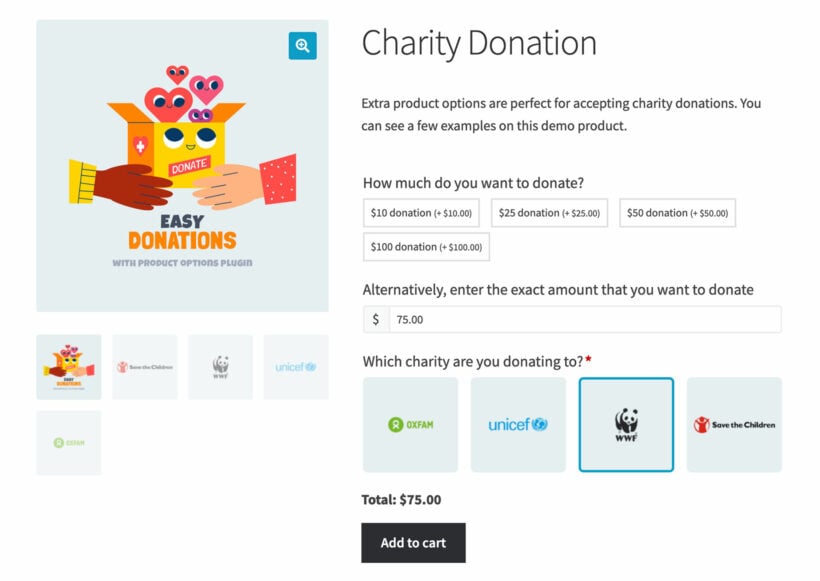
The donation form is the first interaction every donor has with the nonprofit. If it's slow, confusing or asks for too much information, the gift either doesn't happen or it leaves a worse impression than no form at all.
Three things consistently improve donation forms:
- One column, mobile-first. Phone is the dominant device for first-time gifts.
- Three suggested amounts plus a custom amount. Defaulting to a sensible mid-tier suggestion lifts the average gift.
- Optional fields should really be optional. Address, phone and "how did you hear about us" are the three fields most often skipped or abandoned over.
The choice of donation plugin matters less than the form configuration. The Barn2 roundup of WordPress donation plugins covers the current options. For nonprofits already on WooCommerce, the WooCommerce donation plugin guide walks through using the store as a donation engine.
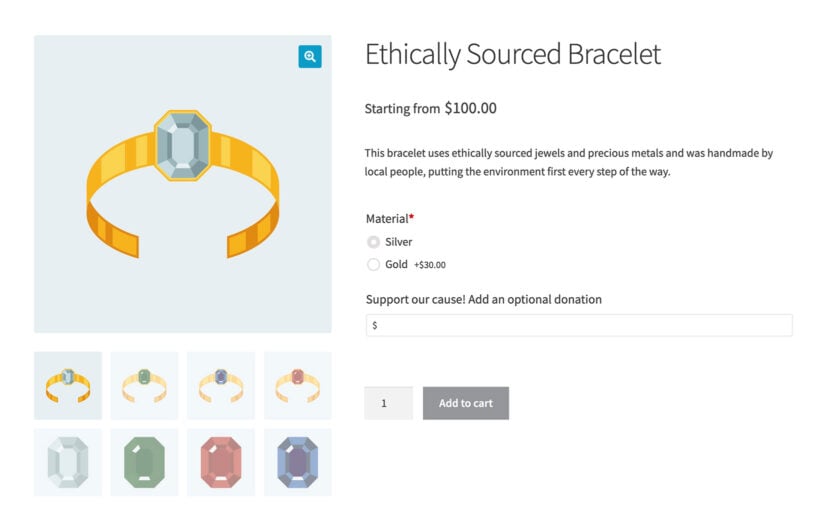
For example, the WooCommerce Product Options plugin works with any WordPress WooCommerce store and makes it easy to create flexible donation forms. these can either be standalone donation products or extra fields added to any other product you might be selling.
3. Ask donors what they want to hear about
Short post-donation donor surveys will tell you more about each donor than any marketing analytics report. Ask three questions: what made you give today, what would you most like to hear about, and how often would you like to hear from us.
The answers feed the rest of the donor communication system. A donor who said "monthly email is fine, I want stories from the field" gets a different sequence than one who said "twice a year, just impact reports." That single act of asking and then honoring the answer is the difference between a respectful donor relationship and a list.
The simplest way to run the survey is a free-text reply to the thank-you email. If you want it structured, use a WordPress form plugin to embed a short survey and pipe responses into a spreadsheet. Save the heavy CRM integrations for later.
4. Protect donor data and be transparent about it
Donor trust is the underlying asset behind every donor relationship. A leaked email list or an opaque data practice will erode in one incident what took years to build.
The defensive setup for a small nonprofit is straightforward. Use HTTPS across the site. Pick a donation plugin that doesn't store full card numbers (almost all of them tokenize through Stripe, PayPal or similar). Keep WordPress core and plugins updated. Don't share donor lists with partners or advertisers without opt-in consent. Write a one-page privacy notice that says what you collect and what you do with it, and link to it from the donation form.
If your nonprofit handles UK or EU donors, GDPR compliance is the floor, not the ceiling. The same opt-in discipline that GDPR forces is what most US donors expect anyway.
5. Know who your donors are
The "know your donor" step is less about expensive prospect research and more about reading what you already have. Most donation plugins capture a useful set of fields on every gift: name, email, amount, campaign, date and source. Six fields are enough to start building a real donor database picture of the donor base.
Group donors into a small number of cohorts: first-time, recurring under $25/month, recurring $25+/month, mid-level ($250-$1,000 one-time), major ($1,000+). Each cohort gets a different communication cadence and a different ask. Same person, same site, very different relationship math.
WordPress makes the cohort split easier than it sounds. Most donation plugins expose donor records as a custom post type or a WordPress user role, which means the cohort can drive everything from email segmentation to gated content rules.
6. Match your outreach to the donor lifecycle stage
The donor relationship cycle has five stages: identification, qualification, cultivation, solicitation and stewardship. Each one needs a different touch.
- Identification - The prospect lands on the site. Job: capture an email address, not a donation.
- Qualification - The prospect engages with content or a small first donation. Job: learn what they care about.
- Cultivation - Regular updates and stories. Job: build the emotional connection before the next ask.
- Solicitation - The next ask, sized to where the donor is. Job: make the case clearly and personally.
- Stewardship - Thank, report and recognize, then repeat the cycle. Job: keep the existing relationship strong so the next ask lands easily.
Most nonprofits spend disproportionate time on solicitation and almost none on stewardship. Flipping that ratio is one of the cheapest ways to lift retention, because it changes nothing about the budget and almost everything about how donors experience the organization.
7. Send receipts that feel personal
Receipts have to be sent for tax and accounting reasons, which means every donor gets one. That makes the receipt the most reliably-opened email a nonprofit will ever send. Treat it as a communication channel, not a compliance document.
A useful receipt covers four things:
- The donation amount.
- The tax-deductibility line.
- A one-sentence thank you signed by a named person.
- One piece of impact information, such as "Your $50 funds 10 meals at the community kitchen this week".
Year-end summary receipts get extra mileage if they include a full-year recap of what the donor's gifts funded across all the campaigns they touched.
For nonprofits running donations through WooCommerce, a transactional email plugin or the donation plugin's built-in receipt template will handle the rendering. The variable that matters is the copy inside the template, not the delivery mechanism.
8. Plan your donor communications in advance
A three-page communication calendar will outperform every CRM automation system if it actually gets followed. List the touches you'll send each month: which segments hear what, on which date, signed by whom. Tie campaign-specific sends to milestones (giving anniversaries, programme launches and fiscal year end).
The trap most small nonprofits fall into is reactive communication. Something happens, an email goes out. Something else happens, another email goes out. By month six, donors are getting twice as much email as they signed up for, and most of it isn't relevant to them. A pre-built calendar with a cap on monthly sends prevents that.
For a small team, three to five donor touches a year per cohort is plenty. More than that needs real segmentation discipline to avoid fatigue.
9. Use email to share impact, not asks
Email is the workhorse channel for donor relationships. About half of donors prefer hearing from nonprofits by email, more than any other channel. That makes email worth doing well.
The 80/20 rule applies to nonprofit email: 80% of sends should be impact, story or update, not asks. The 20% that are asks land harder because of the goodwill the other 80% has built. The reverse ratio is what most small nonprofits accidentally end up running, which is why their open rates drop over time.
Practical email habits that add up over time:
- Use the donor's name in the subject line for transactional sends, the cause's name for impact sends.
- Quote a real beneficiary in every impact update. Even one sentence in a person's own voice carries more weight than a paragraph of summary.
- Use a real reply-to address. No-reply is the corporate signal nonprofits least benefit from sending.
10. Use SMS for time-sensitive moments
Text messaging is the right channel for two things only: time-sensitive campaigns (Giving Tuesday, year-end deadlines and emergency appeals) and recurring-donor service messages (card expiry warnings and missed payments). It is the wrong channel for general newsletters.
The bar for SMS opt-in is higher than email and the bar for unsubscribing is lower. Most donors will tolerate one or two relevant texts a year. Five will get you unsubscribed. Get explicit opt-in at the donation form, and use a real, recognizable sender name.
For nonprofits with a strong volunteer or recurring base, an annual mobile-only campaign segment is worth running just to keep the channel warm.
A donor resource portal that supports all 10 of these
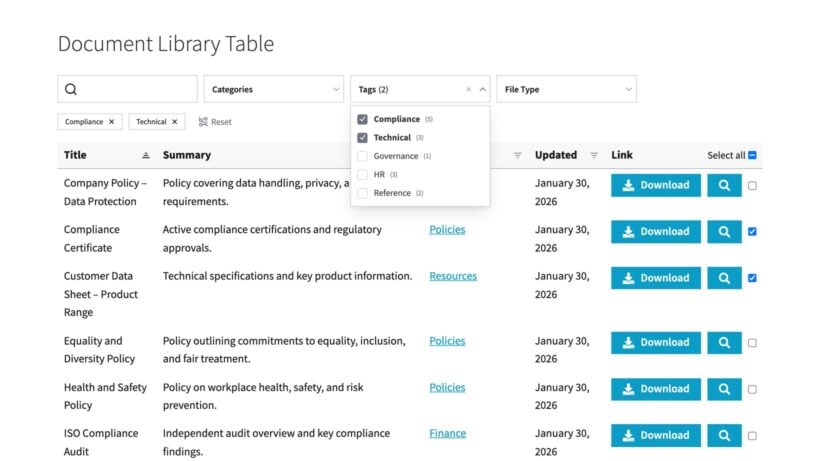
Another part of their website that many nonprofits overlook is the need for a document or resource library. This is a single area that holds the materials donors care about, with access either public or controlled by donor tier.
The resource portal solves several problems at once:
- Annual reports, impact decks and named-gift letters live in one searchable place rather than scattered across email attachments.
- Donor-only content (behind-the-scenes videos, advance access to programmes and monthly briefings from the executive director) sits behind a gated content rule so it feels like a real benefit, not just an attachment.
- Volunteers and board members can self-serve the sponsor packs, nonprofit brand identity assets and donor letters they need without messaging the comms team every time.
You can easily add this to any WordPress site using Document Library Pro. This plugin turns a section of the WordPress site into a filterable archive with categories, search and per-document access control. Public-facing materials (annual reports, transparency documents and programme brochures) sit in the open library. Donor-only materials sit behind gated content rules tied to donor user roles or recurring-donation status.
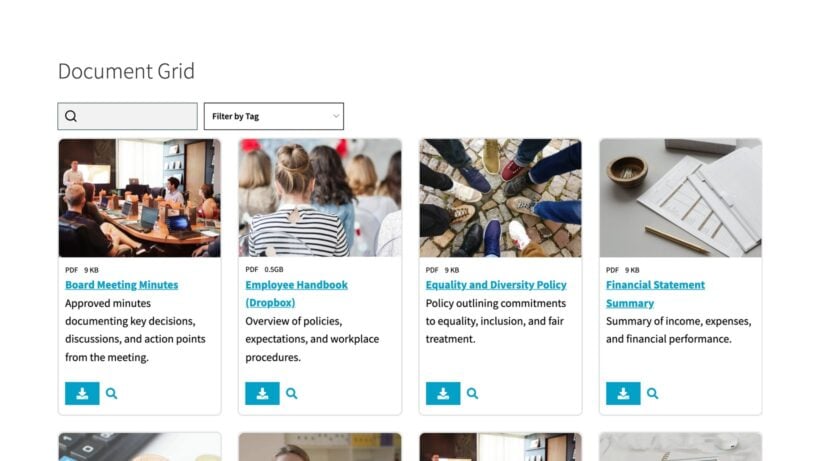
The pattern that scales best is one library with multiple campaign-specific sections, rather than a separate site for every campaign. Five real organizations show how they built theirs in the Barn2 roundup of nonprofit resource library examples.
Frequently asked questions about donor relationships
What is a donor relationship and why does it matter?
A donor relationship is the ongoing connection between a nonprofit and an individual supporter, measured by repeat giving, retention and recommendation. It matters because retained donors are 5 to 7 times cheaper to keep than new donors are to acquire, and they make up most of the lifetime value of the fundraising programme.
How do I improve donor relationships on a small nonprofit team?
Start with the first three strategies in this guide: fast personal thank-yous, a clean donation form, and a short post-donation survey. Together they cost almost nothing and lift retention more than any tool purchase will. Add the rest once the basics are running consistently.
What tools help manage donor relationships on a WordPress site?
You need a donation plugin (covered in the WordPress donation plugins roundup), an email tool with basic segmentation (Mailchimp, MailPoet or ConvertKit) and a document library plugin for the donor resource portal. Most small nonprofits don't need a full CRM for the first two or three years.
How do I keep donors engaged between campaigns?
Send impact updates that quote a real beneficiary, share programme news and recognize donors publicly where appropriate. The rough mix is 80% impact and stories, 20% asks. A small donor gift at a campaign milestone keeps the relationship warm without needing a fresh ask, and tying a donor recognition page to the website lets supporters see themselves credited without you sending an individual email each time.
How often should I email donors?
Three to five times a year per donor cohort is the sustainable range for a small team. Recurring donors can take more frequent service messages on top of that. Test against your unsubscribe and complaint rates rather than assuming more emails always work harder.
Do donor relationships affect fundraising results?
Yes, directly. Retained donors give more often, give more over time and recommend the nonprofit to others. Lifetime value builds across a 5-year window in a way that one-off acquisition campaigns cannot match. Strong donor relationships also de-risk the fundraising calendar by smoothing income across the year.
Final thoughts
Donor relationships are the part of nonprofit work that builds value year on year. A first gift earns nothing on its own. A first gift followed by a fast thank you, a clean second-gift experience and a year of relevant updates earns repeat donations, referrals and eventually larger gifts. Everything above serves that long-term build.
The right WordPress setup makes them runnable by a small team: a clean donation form, segmented email lists tied to donor tiers, and a donor resource portal that holds the recognition and access pieces. None of it is expensive. The investment is in the workflow discipline, not the tooling budget.