The average Shopify app is doing worse than you think

Shopify's revenue grows every year, and the number of apps in its App Store has more than doubled since 2023. I've discovered that while the platform is booming, things are getting harder for app companies.
Shopify's growth is seen as good news for everyone building on the platform. In its most recent quarter it reported 34% year-on-year revenue growth.
We launched our first Shopify app last year and I've been trying to get it noticed ever since, so I decided to investigate what that growth has meant for the apps themselves. It turns out that it has become harder for apps to grow rather than easier, and no one is talking about that as they celebrate Shopify's success.
I'm going to tell you what I discovered:
- Shopify keeps winning new shops, but new apps are released even faster. Each app's slice of the pie shrinks, even as the pie grows.
- The money goes to a few dozen apps: The 16 largest take 40.6% of the revenue, and over half of all apps share 0.6% between them.
- Apps advertised for sale are often smaller than they look.
- How our own app has done since launch, and what I'd do differently next time.
New Shopify apps are growing faster than new stores
Every app in the App Store is now fighting for attention against many more rivals than it was three years ago. Shopify has gained new shops every year, so merchants aren't leaving. But the number of apps has grown much faster than the number of shops.
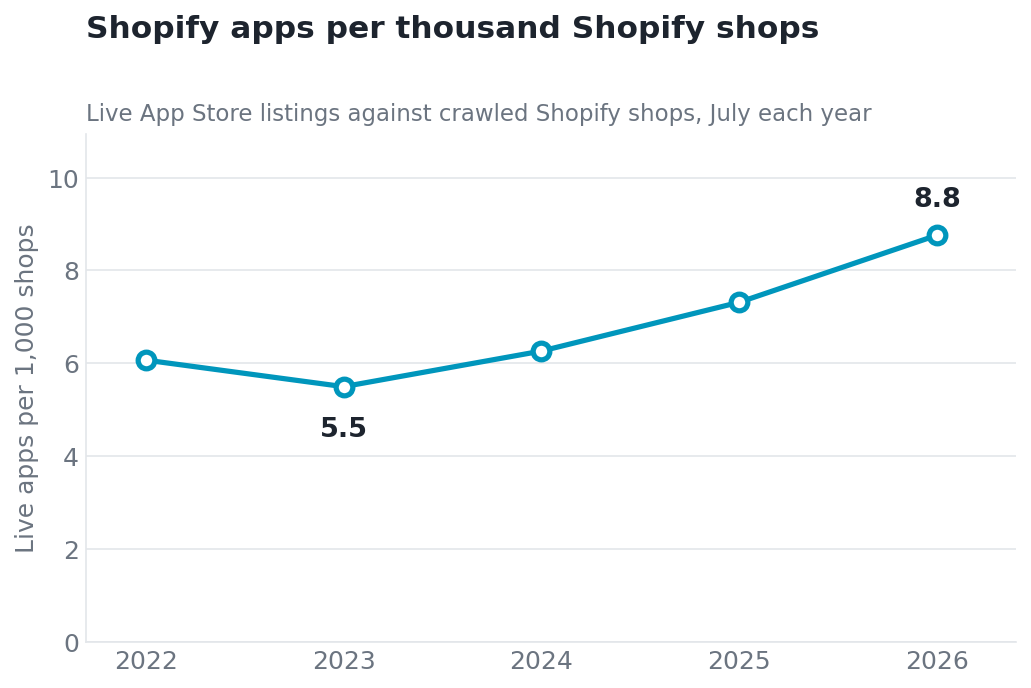
For every thousand Shopify shops there are now 8.8 apps, up from 5.5 in July 2023. This means that each shop now has about 60% more apps competing for it than it did in 2023. That's lovely for merchants, and not so lovely for app companies.
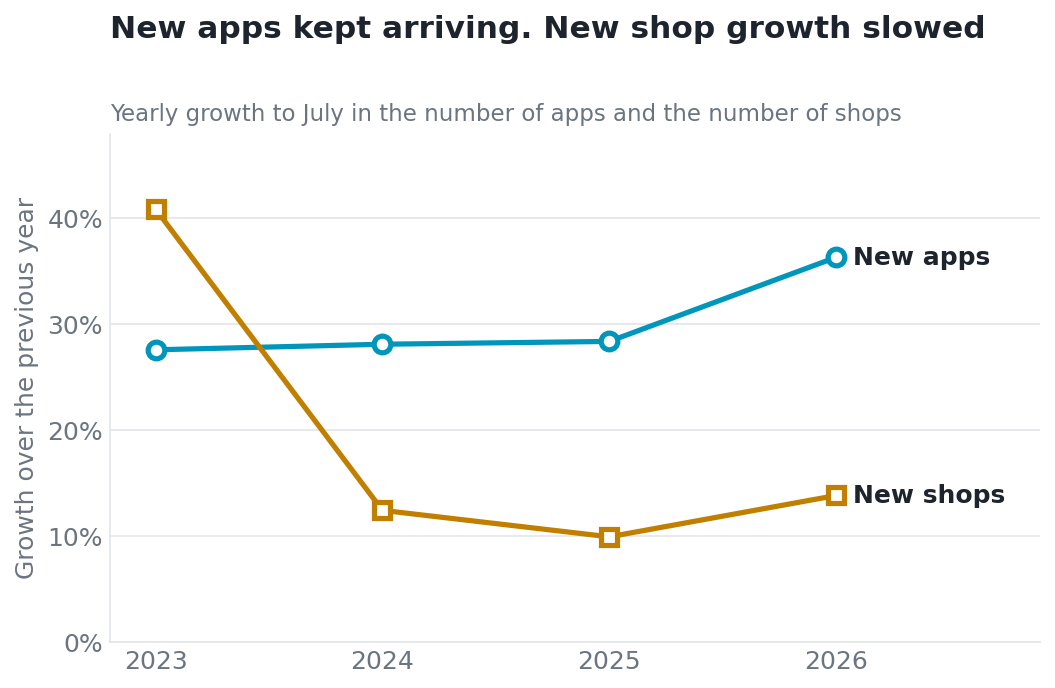
The number of apps grew by more than 28% every year right through that period.
In contrast, Shopify's shop count grew 41% in the year to July 2023, then slowed to between 10% and 14% a year. The two rates stopped matching in 2024, and the gap has widened every year since.
Beyond the data, I've seen a few clues that things are getting harder for Shopify app builders. When I attended the Shopify conference in Toronto in 2025, everyone I met was overwhelmingly positive about how their business was going. At the same event in 2026, quite a few people gave me a sheepish look and admitted that they are no longer growing.
The 16 largest Shopify apps take 40% of all the revenue
I already know about the 80/20 rule and would expect that the biggest apps take more than their fair share, just like most things in life. However, the Shopify App Store data takes this to extremes.
I calculated the likely revenue for the 1,675 apps that publish a price and run on enough shops for Store Leads to detect them. It turns out that nearly all the money goes to the top apps.
How I worked out what each Shopify app earns
Shopify apps don't publish their revenue, so I decided to create a tool to predict it based on the data that is publicly available. This gave me access to two of the three pieces of data I needed:
- How many shops are running each app.
- Each app's monthly pricing.
- The share of each app's shops that are paying rather than on a free plan, and the share which are on each of their paid plans. (No one publishes this.)
I gathered some averages for the third point by looking at a dozen or so apps that I have real financial data for and applying my findings to each one. I know that's not perfect, and testing my conclusions against real apps' revenue shows that I could be out by a factor of two. However, it's still useful for making comparisons and general predictions.
How concentrated is Shopify app revenue?
Based on my predictions, the 16 largest apps take 40.6% of all the revenue in those 1,675 apps on Store Leads. The top 83 take 72.2%. At the other end, half of those apps share 0.6% between them, which is less than the single largest app takes on its own.
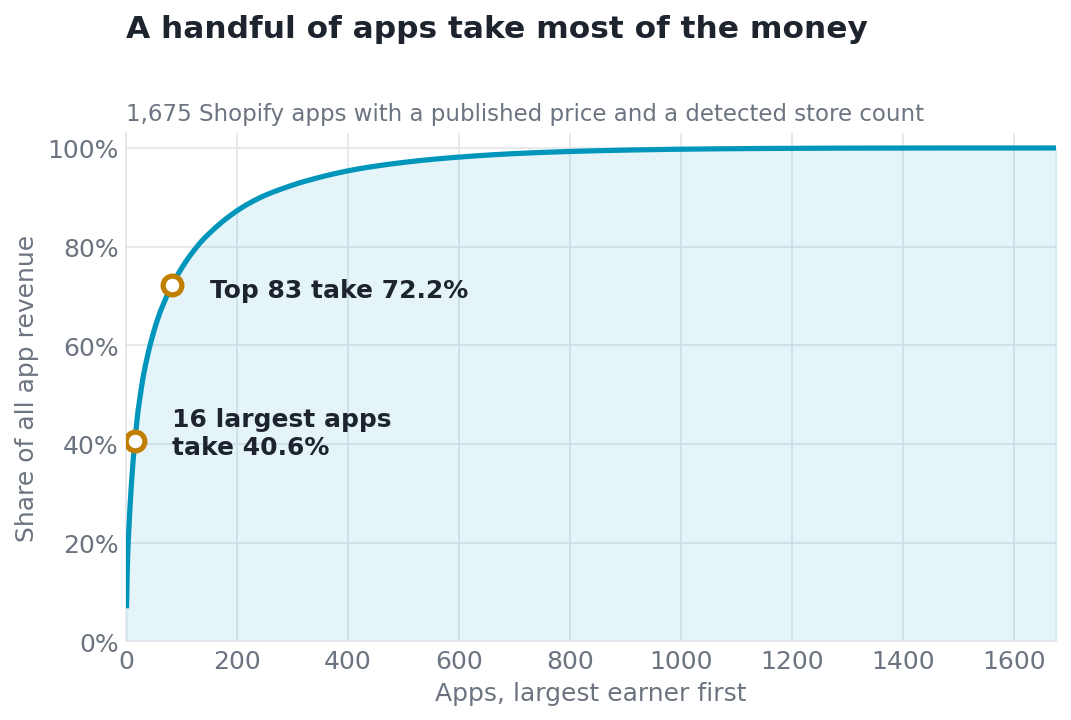
The middle app of the 1,675 earns somewhere between $2,500 and $5,200 a month, before Shopify's cut. That's one person's salary, not a company.
The largest app in the dataset earns around $9 million a month, which is roughly 2,500 times what the middle app makes. The top 16 all clear $1 million a month.
In reality, the rich-poor divide in the Shopify app world is almost certainly worse than I've calculated. Only 2,113 of the 4,438 apps in the App Store publish enough information to be measured on sites like Store Leads, and I only had full price data for 1,675 of those. Since my data overlooks the smallest apps, the biggest apps must take an even bigger proportion of revenue.
What affects how successful a Shopify app is?
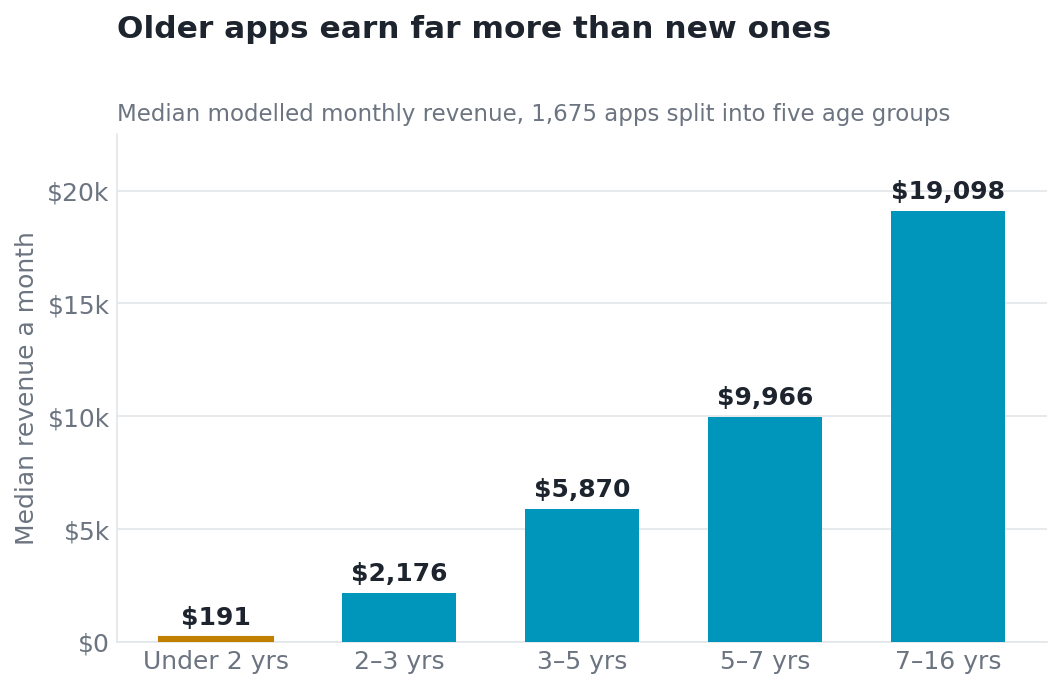
The single best predictor of what an app earns is simply how long ago it was released.
I worked this out using the same 1,675 apps and the same calculation. If you split these apps into five groups by age, the oldest fifth earns an average of roughly 100 times what the youngest fifth earns. In dollars that's about $19,100 a month against $190, or $13,200 to $27,700 against $130 to $280 once you allow for how rough the estimates are.
Review count is the next best predictor, and reviews also take years to build. I didn't find any correlation between an app's success and its star rating. So building a better app than the market leader won't, on its own, move you up.
The first mover advantage in Shopify is hugely significant. As a new entrant, it's incredibly difficult to compete with established apps that have been growing their review and install base for years. This reminds me of when I started selling WordPress plugins in 2016. Back then, the market was not saturated and it was easy to become the leader in the categories we chose to go into. Because we were so early, this gave us the momentum that we needed to survive when things became more competitive. Newer entrants have not been so lucky.
Shopify apps for sale are growing less than their listings suggest
If the top apps are where all the money is, the obvious move is to buy one rather than build one. That's what I'm trying to do, and it brought me to the next problem: The apps being advertised for sale mostly aren't growing either, whatever their headline figures claim.
When an app is advertised for sale, the listing quotes a revenue figure and a growth rate. Both are easy to cherry-pick and present flatteringly. I keep seeing two gaps in what sellers publish:
- If an app has recently had a good few months, the seller can annualize those months into an ARR (annual recurring revenue) figure far bigger than what they billed over the last 12 months.
- There's no requirement to separate revenue from new customers from revenue that simply recurs from existing ones, and not one of the 28 listings I looked at publishes it. An app can show total revenue rising while its new-customer revenue falls. This is dangerous because it means that total revenue is about to fall, but you have to look very closely to spot it.
I checked all 28 listings against both of those. Most sellers quote an ARR in line with the year they report. However, four of them advertise an ARR more than a quarter above it, and the worst is 61% above. Not one listing reports on new customer revenue separately from total revenue - I've had to ask each app seller individually.
So you can't predict an app's future growth from the headline figures. You have to go and ask for the number underneath them.
New-customer revenue tells you what the headline figures can't
If you have access to an app's full Shopify payment history, you can split every month's revenue into shops paying for the first time and shops that were already paying. When I did this for real apps, I discovered huge warning bells in several apps that were reporting strong growth.
For example, one app's revenue grew 14% over the last year but hadn't mentioned that its revenue from new customers fell 16%. The app isn't growing: Its existing subscriptions are simply still running, and being topped up by some new customers to create a temporary illusion of healthy growth.
Another app was growing fast, with revenue up 76% year on year. Even there, new customers had dropped from a quarter of monthly revenue to around 12% - another warning sign that the growth may not be sustainable.
An app whose new-customer revenue has declined or dried up can still report healthy growth for a year or two, because the subscriptions it won earlier keep renewing. The problem is that the growth you're being sold already happened.
Churn is what turns this into a problem. Store Leads tracks uninstalls as well as installs, and the typical app loses about four shops for every ten it gains over a year (I'll publish a separate post analyzing churn by category soon). An app that isn't winning enough new customers is losing ground every month, however flat or positive the headline revenue looks.
What does this mean for Shopify apps?
Of course, you could argue that the reason certain apps are advertised for sale is because they have problems. However, I also saw similar issues with apps that I reached out to directly which weren't being advertised for sale.
As a result, I believe that the Shopify app industry has got into a dangerous habit of only looking at total MRR and not analyzing how much of their revenue is coming from new customers. Given that it is becoming harder and harder to succeed, this could cause some nasty surprises later.
We launched our own Shopify app and discovered how hard it is to get noticed
Our first app, Barn2 Bulk Quantity Discounts, went live in September 2025. We did a lot of keyword research, read our competitors' listings closely and were careful about the wording and the images so that our listing would convert.
Getting anyone onto the listing in the first place was the hard part, and we knew that from the outset. At Barn2, we've always sold our WordPress plugins independently and aren't on any marketplaces. Instead, we've built up what I like to call the "Barn2 marketing machine", which we threw at our app just like we do for any other new product. It turns out that blog content has practically no impact for Shopify (apparently people simply don't Google how to do things in Shopify), and our YouTube channel delivers a small but steady stream of installs. However, the limited impact of our usual marketing showed that all that really matters in Shopify is the App Store. That's where nearly all merchants find apps.
So, how do you rank a new app in the App Store?
It turns out that it's not easy, at least not in a competitive category. Reviews are the single biggest factor - specifically, the number of recent positive reviews. And collecting reviews was far, far harder than I expected.
At the 2025 Shopify conference, several app founders advised me to release a free version. They explained that this brings in users so that you can get reviews more quickly. So we spent six months giving the app away for free.
It still took about six months and 1,000 free users to collect enough reviews to qualify for the Built for Shopify badge. We wanted that partly for the conversion rate, and mostly for the boost it gives you in the App Store. My support team asked the customers we helped for a review and we added the usual review prompts to our app and emails, but it was far harder than I expected and seemed to take forever.
Our Shopify app's ranking today
Today the app ranks 239th out of about 1,100 apps in Discounts, and roughly 130th out of 472 in Product Bundles. It has ten five-star reviews, while the three apps that Shopify shows under "more apps like this" have 3,526, 4,434 and 411.
When I look at what merchants typed to reach our listing, almost none of it is the terms we optimized for. Instead, it's misspellings and odd one-off phrases because we're not ranking for the terms that people actually search for. We're visible, but only to merchants who are actively looking for us:
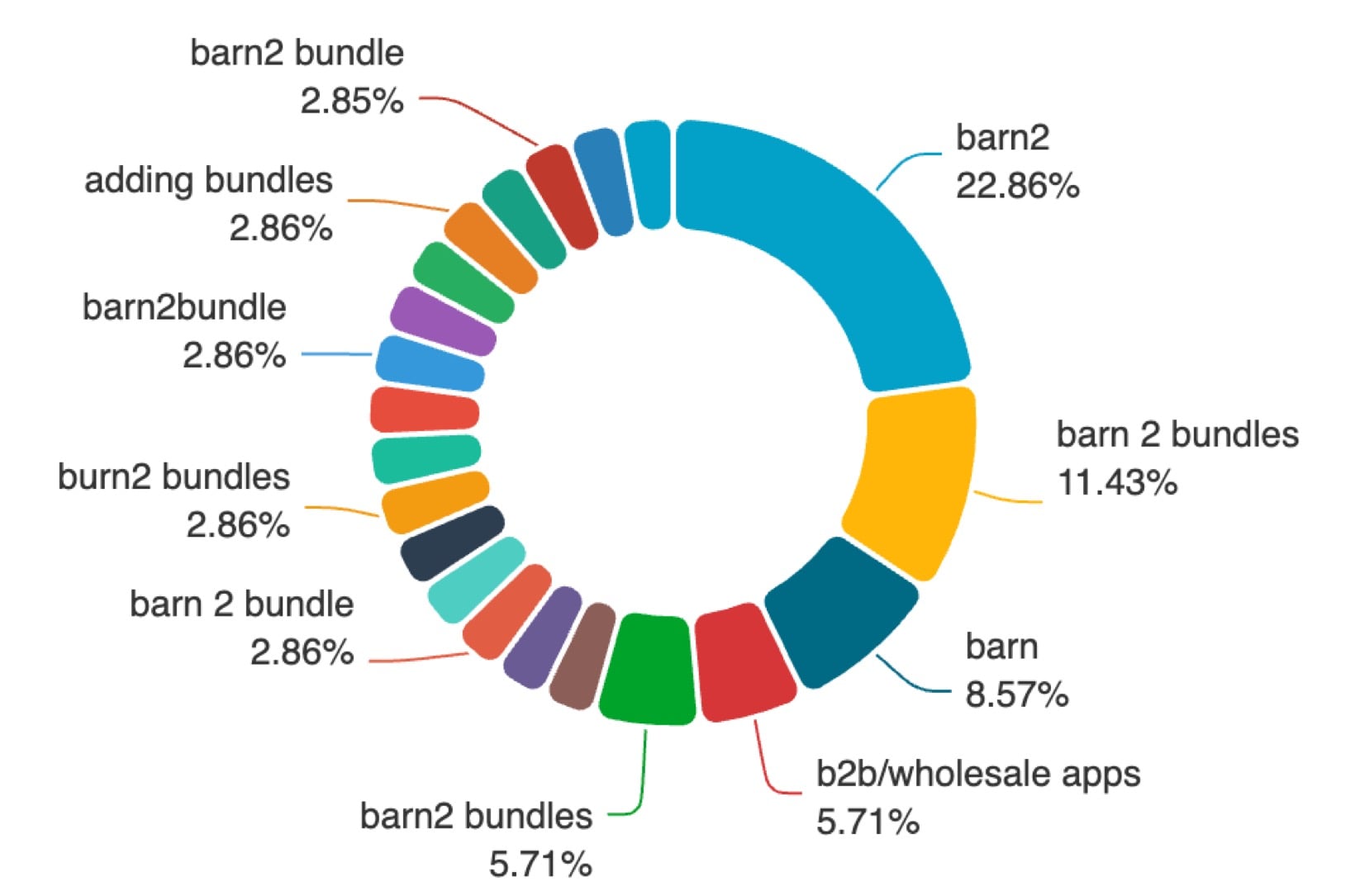
I've come to the conclusion that we can't realistically compete in such a competitive category. The best way forward is to reposition our app into less competitive categories and target different search terms.
Sources and limits behind these Shopify app figures
Every figure in this post comes from one of five sources:
- App counts, prices, ratings and reviewsCollected from the Shopify App Store's own listing pages on 7 September 2026, covering 4,438 apps.
- Shop countsFrom the HTTP Archive crawl for July of each year, which counts the Shopify shops it finds rather than every shop that exists. The crawl works the same way each year, so the 2023 and 2026 ratios are comparable.
- Detected shops per app and uninstall ratesFrom Store Leads, aggregated across the 12 months to August 2026. Store Leads identifies live stores from their code, so it undercounts. To show you how much, I can tell you that it detects 321 shops running our own app, while our records show 1,699. Everything I've taken from it compares apps against each other in a single snapshot, rather than tracking counts over time. That's deliberate: Store Leads has reported wildly different totals for Shopify over the past year, which I wrote about in my Shopify and WooCommerce market share research. Comparing apps measured the same way on the same day sidesteps that problem, because any undercount applies to all of them equally.
- Seller figuresFrom public listings of apps for sale on marketplace websites, read in October 2026.
- Our own app's numbersFrom Shopify's billing and install webhooks, which record every install, uninstall and plan change as it happens.
Revenue for an individual app is impossible to predict accurately, so I haven't named a figure for any single app. Every estimate uses the same scaling factor, which I fixed by testing it against a dozen apps whose real revenue I know. Any one app's figure could still be out by a factor of two in either direction. This data is for making comparisons and spotting trends, not for valuing an individual app.
My advice if you're building a Shopify app now
Do your research first and find a niche that isn't already oversaturated. That was my mistake. Bundles is one of the most crowded categories in the App Store. However good our app and listing is, it's very hard to fix being 239th after a year.
If you've set your heart on a competitive category, raise the money to acquire an app that already ranks there instead of starting from nothing. A listing with 300 reviews has a massive advantage over a better app with 10. If you do buy one, ask the seller about their revenue from new customers instead of trusting the headline figures.
We're doing both. We're looking for an app to acquire in a popular category, and launching narrower apps where the competition is thinner, like our document library app and a product table order form app.
Shopify's growth figures hide the reality for app sellers
Shopify grew revenue 34% last quarter. However, that describes Shopify's year rather than the year its app companies had.
Merchant numbers are growing at 10% to 14% a year while app numbers grow at 28%, so each merchant is being fought over by more apps every year. Almost all the money goes to a few dozen apps that got there early.
For merchants, all of this is good news: More apps, more competition and better prices. For anyone building an app, it's a market where the gap between the leaders and everyone else widens each year.
That leaves two realistic options: Find a corner nobody else has noticed, or buy your way into one that's already been won. Buying still works, but only if you get the new-customer split out of the seller before you sign anything. We're trying both, and I'll report back on how it goes.