10 best WooCommerce product page customization plugins


The standard WooCommerce product page is identical on every store: same image placement, same variation dropdowns, same 'Add to Cart' button. A handful of product page customization plugins let you reshape almost any part of it - layout, fields, delivery info, reviews, quote requests, or button text - without writing any code.
Most WooCommerce stores find the default product page works for the first few products and then starts limiting them as the catalog grows.
Customers want options the standard variation dropdown can't handle, specs they can scan without scrolling, shipping costs before they add to cart, or simply a less templated layout.
The 10 product page customization plugins below each tackle one of those gaps. Some add fields and configurators, others give you a full page builder, and the rest do one specific job each - delivery info, review collection, quote requests, or button text.
- Our WooCommerce Product Options plugin adds custom fields, configurators and conditional logic to the product page. It's the most flexible across use cases.
- WooBuilder Blocks rebuilds the product page layout with Gutenberg blocks. Best fit if your site already uses the block editor.
- CoDesigner does the same thing using Elementor. Best fit if your site is built on Elementor.
- CartFlows builds sales funnels with order bumps and post-purchase upsells linked to your product pages.
- Our WooCommerce Product Tabs plugin adds custom tabs to the product page for specifications, downloads, FAQs and similar information.
- WooCommerce Shipping Calculator shows real-time delivery options and costs on the product page itself. We originally built this one, before selling it to Kestrel.
- Our WooCommerce Discount Manager plugin displays discounts, BOGO offers and bulk-pricing tables directly on the product page.
- Customer Reviews for WooCommerce replaces WooCommerce's basic review section with a full review-collection system.
- YITH WooCommerce Request a Quote swaps the 'Add to Cart' button for an 'Add to Quote' button on selected products.
- WooCommerce Customizer (free) tweaks text and labels across the store without touching code.
Quick verdict: which plugin should you choose?
If you only have time to install one product page customization plugin, here's where to start based on what you sell:
- Best overallWooCommerce Product Options. Covers the broadest range of customizations - custom fields, configurators, conditional logic and custom pricing - and works on top of any theme.
- Best for redesigning the full layoutWooBuilder Blocks if your site uses Gutenberg, or CoDesigner if it's built on Elementor. Both let you rebuild the product page from scratch.
- Best for organizing information into tabsWooCommerce Product Tabs. Adds unlimited custom tabs for specs, downloads, FAQs and shipping info.
- Best free optionWooCommerce Customizer for basic text and label tweaks. Customer Reviews for WooCommerce and CartFlows also have substantial free versions.
Our criteria for picking these plugins
These plugins don't directly compete with each other. Each one customizes a different aspect of the product page - some add fields, some redesign the layout, others bolt on delivery or discount information.
You'd happily run two or three of them together on the same store. We picked each one on three things:
- How well it handles its own aspect of the product page.
- The quality of the implementation - setup time, theme compatibility and ongoing support.
- How well it fits alongside the other plugins on this list.
10 best WooCommerce product page customization plugins
Here's a closer look at each plugin, what it does well, and where it's less suitable.
| Plugin | What it customizes | Free version | Best for |
|---|---|---|---|
| WooCommerce Product Options | Custom fields, configurators, conditional logic and pricing | No | Configurable and personalized products |
| WooBuilder Blocks | The full product page layout, rebuilt with Gutenberg blocks | — | Rebuilding the layout on Gutenberg sites |
| CoDesigner | The product page layout, built with Elementor widgets | Free + Pro | Redesigning product pages on Elementor sites |
| CartFlows | A sales funnel around the product page, with order bumps and upsells | Free + Pro | Growing average order value |
| WooCommerce Product Tabs | Extra custom tabs for specs, FAQs and downloads | Free + Pro | Organizing extra content into tabs |
| WooCommerce Shipping Calculator | Live delivery costs shown on the product page | No | Stores where shipping cost drives the decision |
| WooCommerce Discount Manager | Discount messages and bulk-pricing tables in the product content | No | Showing offers where customers decide to buy |
| Customer Reviews for WooCommerce | Reviews with photos and a product Q&A section | Free + Pro | Upgrading the reviews experience |
| YITH WooCommerce Request a Quote | An Add to Quote button and hidden prices | Free + Pro | B2B and wholesale quote requests |
| WooCommerce Customizer | WooCommerce's default text and labels | Free | Quick text tweaks with no code |
1. WooCommerce Product Options

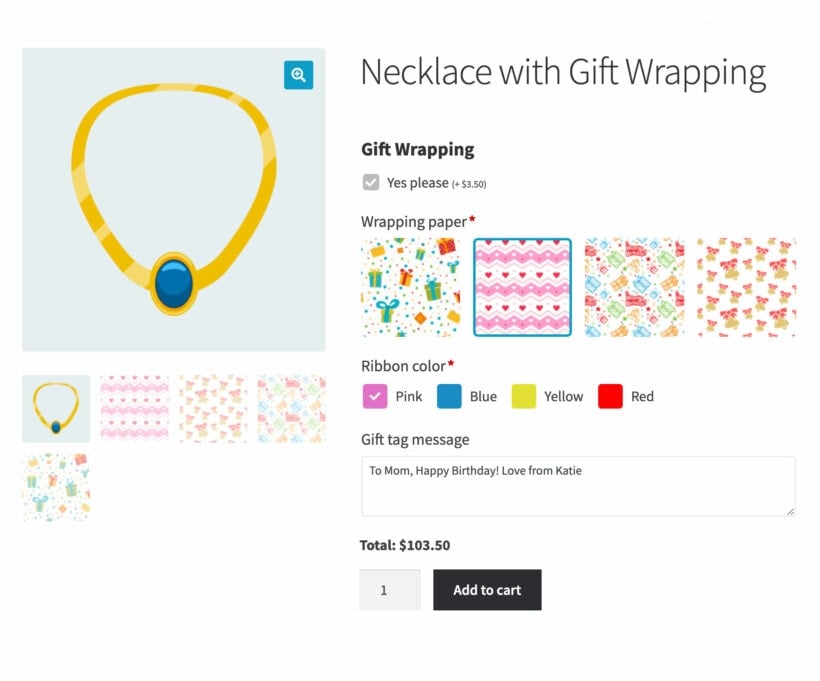
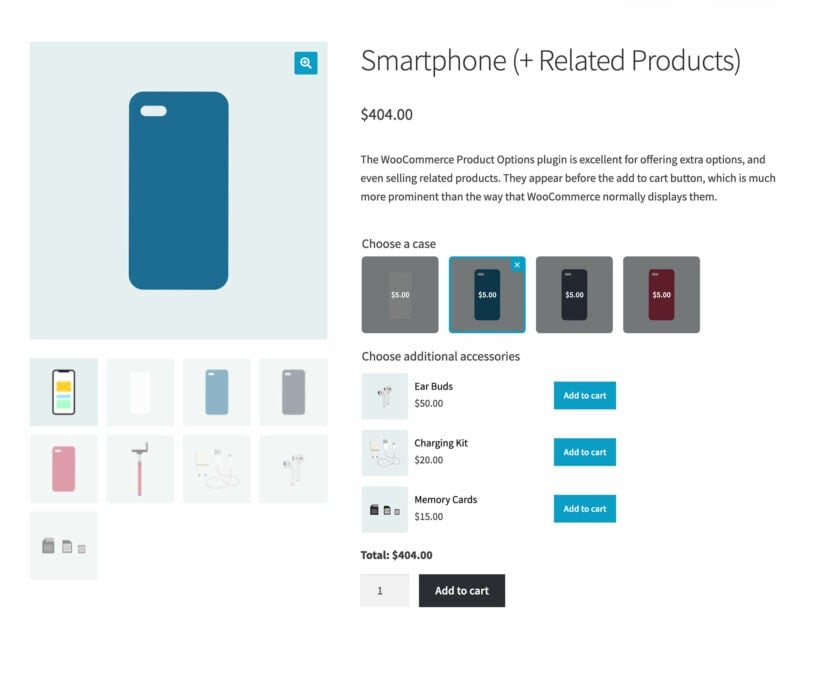
Our WooCommerce Product Options plugin adds custom fields, configurators and conditional logic to your product pages. It sits on top of your existing theme rather than replacing the layout, so the design stays the same and customers get a richer set of options to configure before they buy.
You can use it to build a WooCommerce measurement price calculator for made-to-order curtains, a gift-wrap toggle for jewelry, a 'choose your engraving' text field for personalized products, or a multi-section configurator for technical products. Custom pricing follows whatever the customer picks - a flat fee for gift wrap, a per-character cost for engraving, or a WooCommerce measurement price calculator based on size and material for curtains.
What it does well
- The plugin ships with 16+ field types including checkboxes, radio buttons, text fields, file uploads, date and time pickers, color swatches and image swatches.
- Conditional logic lets you show or hide options based on what a customer has already selected.
- You can set custom pricing per option, including flat fees, percentages, per-character pricing or full formula-based calculations.
- The live preview lets customers see their engraving or upload on the product before checking out.
- It works alongside variable products and can convert existing variations into checkboxes, swatches or radio buttons.
Where it's less suitable
- It extends the existing product page layout rather than rebuilding it. If you want a fundamentally different layout, pair it with WooBuilder Blocks or CoDesigner.
- The formula-based pricing builder takes some setup time on complex products like configurable furniture, though the built-in AI assistant can write most pricing formulas for you.
- It's paid only, with no free version on WordPress.org.

Easy to use, but we have a relatively complex setup. Solution? Barn2's customer service has been incredible. Highly, highly recommend, it's a high quality product backed by helpful people.
Mitch Hollander
2. WooBuilder Blocks
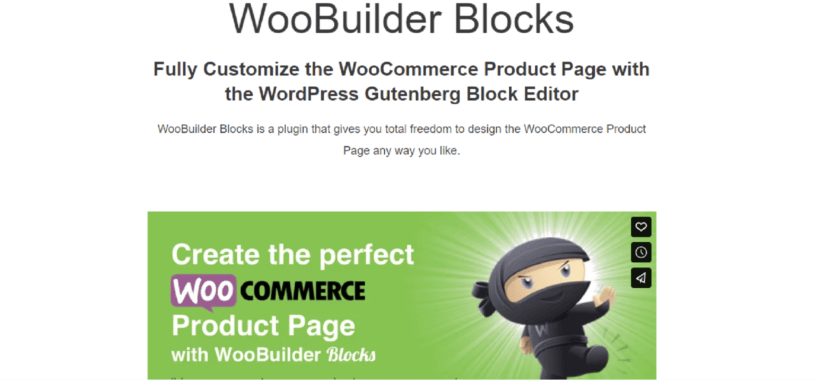
WooBuilder Blocks takes the Gutenberg block editor approach to product pages. Instead of editing your theme or writing PHP, you drop blocks - product image, price, add-to-cart, gallery, custom HTML - onto a template and arrange them however you want. The plugin ships with conversion-focused blocks too, like stock countdowns and A/B test variants.
It's the right fit if your site already uses Gutenberg and you want to rebuild the product page layout from scratch without switching to a third-party page builder.
What it does well
- Builds product pages with native Gutenberg blocks, so the editing experience matches the rest of your site.
- Pre-designed templates for common layouts like Out of Stock messages, Catalog mode, and Thank You pages.
- Conversion-focused blocks - stock countdown, sales countdown, A/B split testing.
- Supports all WooCommerce product types including grouped and variable.
Where it's less suitable
- Gutenberg only - no help if your site is built on Elementor, Divi, Beaver Builder or another page builder.
- Smaller community and fewer integrations than the larger page builders, which can matter for niche use cases.
- Templates are more limited in number than general-purpose page builders. Expect to design more from scratch.
3. CoDesigner
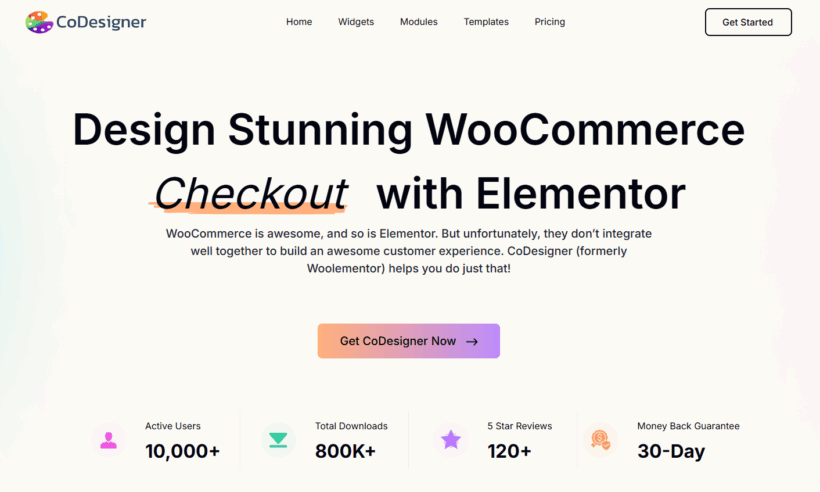
CoDesigner is the Elementor equivalent of WooBuilder Blocks. It adds 94+ WooCommerce widgets to Elementor along with pre-built templates for shop, product, cart, checkout and invoice pages. If you already use Elementor, it lets you stay in the same builder for every part of your store.
The free version on WordPress.org covers most of the product page widgets. The paid version unlocks the advanced templates and the cart, checkout and invoice builders.
What it does well
- 94+ Elementor widgets covering product pages, shop pages, cart and checkout.
- Substantial free version on WordPress.org - enough to redesign most product pages without paying.
- Live preview as you edit, so you see the customer-facing result in real time.
- Pre-made templates for common product page layouts.
Where it's less suitable
- Elementor only. If your site uses Gutenberg, Divi or another builder, WooBuilder Blocks is a better fit.
- Adds Elementor as a dependency if you don't already use it - more weight on the page than needed for small stores.
- Advanced cart and checkout customization requires the Pro version.
4. CartFlows
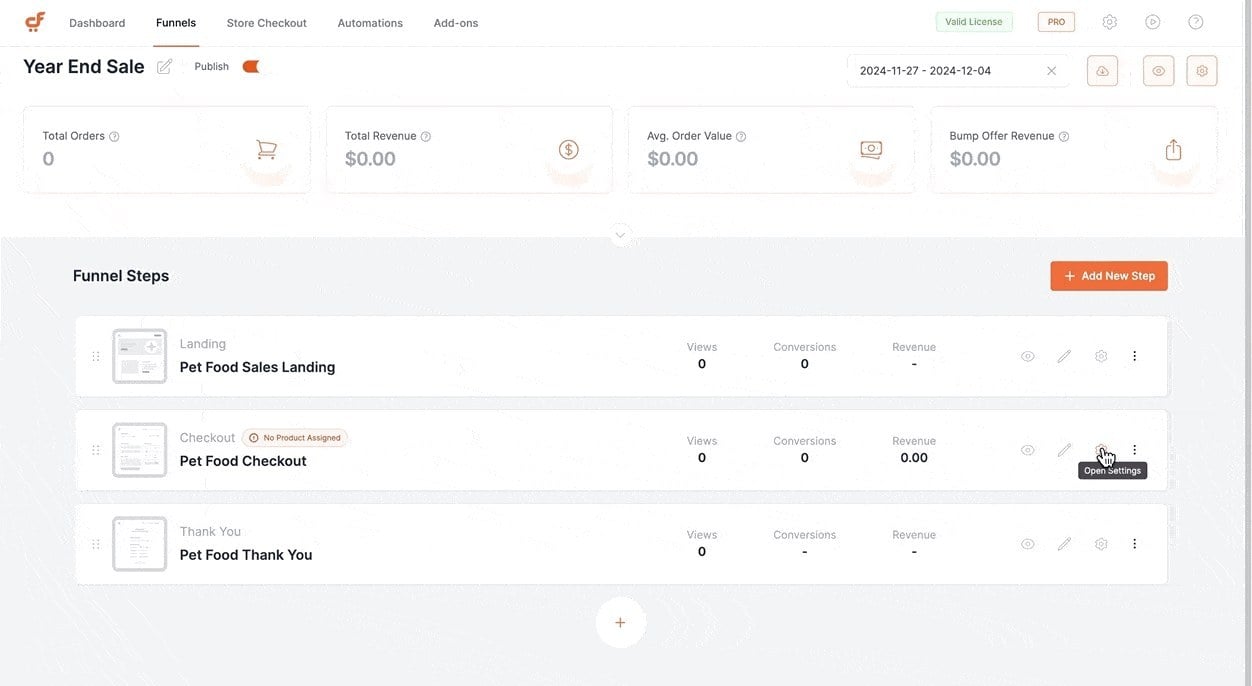
CartFlows takes a different angle from the rest of this list. Where most plugins customize the product page itself, CartFlows builds a sales funnel around it - landing page, product, order bump at checkout, post-purchase upsell, then thank-you page - and links the steps together. It pairs naturally with whichever plugins you've used to customize the product pages themselves.
If your product pages already convert and you want to grow average order value, CartFlows is the next plugin to add.
What it does well
- Pre-purchase order bumps - tick-box offers at checkout customers can accept in one click.
- One-click post-purchase upsells, no re-entered payment details.
- A/B testing across offers, page layouts and copy.
- Works with Elementor, Divi, Beaver Builder and Gutenberg.
Where it's less suitable
- Focuses on checkout, upsells and the post-purchase journey rather than the product page itself.
- Best features (one-click upsells, advanced A/B testing) need the Pro version.
- Adds complexity. A simple shop probably doesn't need funnels.
5. WooCommerce Product Tabs

Our WooCommerce Product Tabs plugin lets you add unlimited custom tabs to the product page without altering the rest of the layout. Use it to display specifications, instructions, size guides, downloads, FAQs, shipping info, or promotional content - all without cluttering the main product description.
You can add tabs to every product on the site, or selectively to specific products, categories or tags. Each tab supports text, images, audio, video and shortcodes, so you can drop in a Google Map, a downloadable PDF, or a list of related products.
What it does well
- You can add unlimited extra tabs with full WYSIWYG editing.
- Tabs support per-product, per-category and per-tag visibility, so they only appear where they're relevant.
- You can pick a horizontal or vertical tab layout to match the rest of your theme.
- Drag-and-drop reordering lets you reshuffle tabs without touching the code.
- Each tab can have a custom icon.
Where it's less suitable
- It adds tabs only and doesn't change the layout of the rest of the product page.
- If you want a deeper layout overhaul rather than extra organized content, a page builder is the better choice.
- A free WooCommerce Product Tabs plugin on WordPress.org handles the basics, while targeting tabs by category or tag is a paid feature.
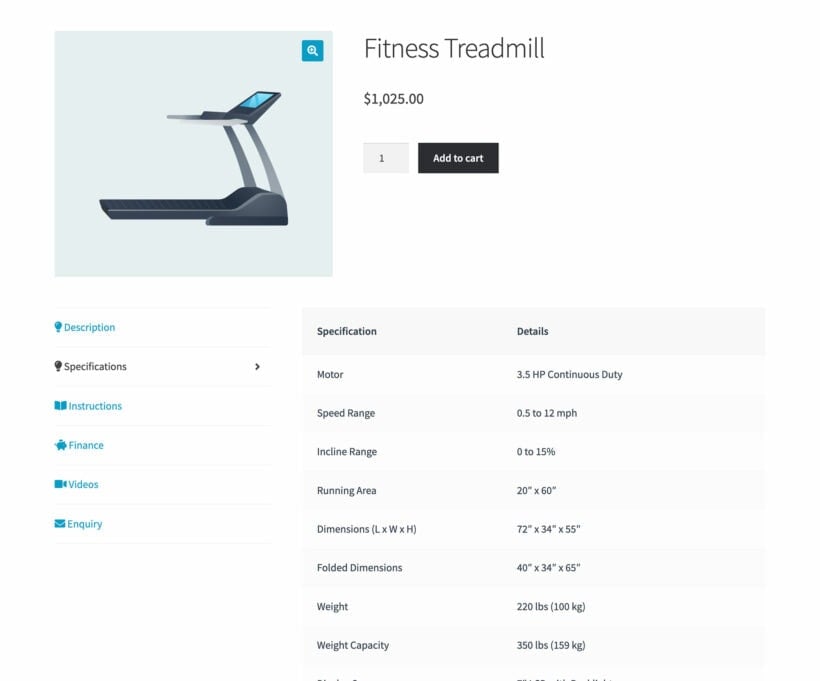
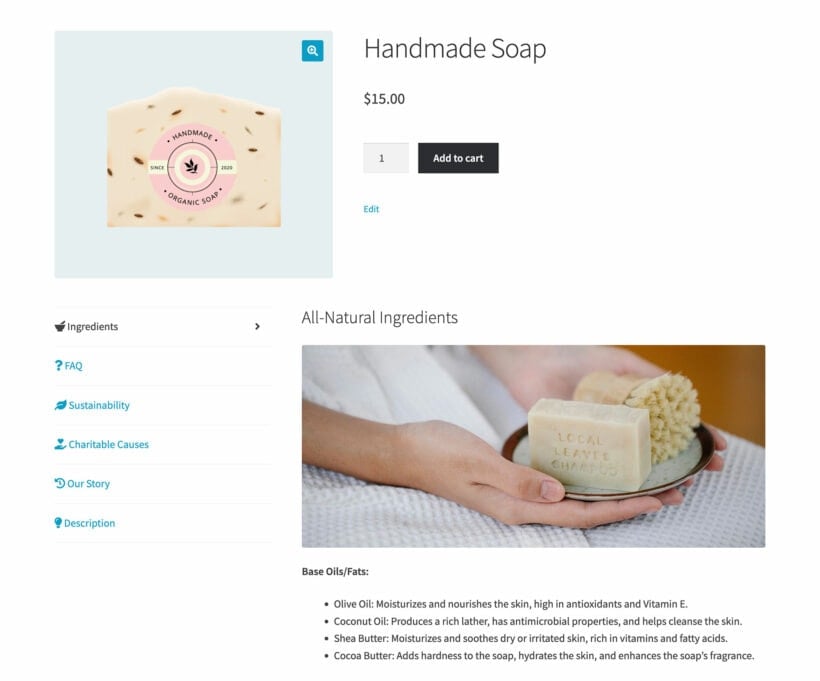
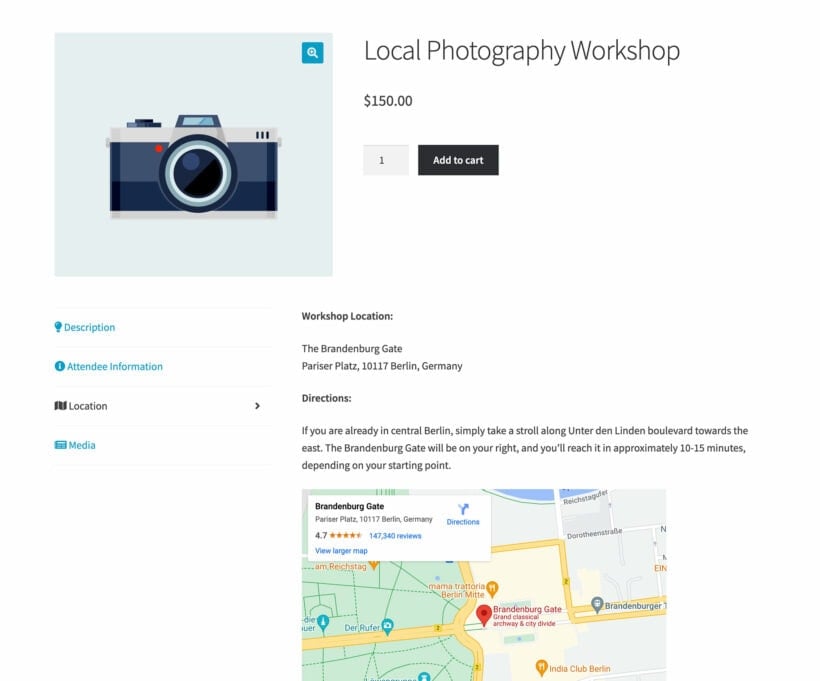
This plugin transforms the product page and allows you to pack in lots of information in a presentable, user-friendly way that's not intrusive. It's very easy to set-up and should you have an issue the support is excellent.
Emily
6. WooCommerce Shipping Calculator
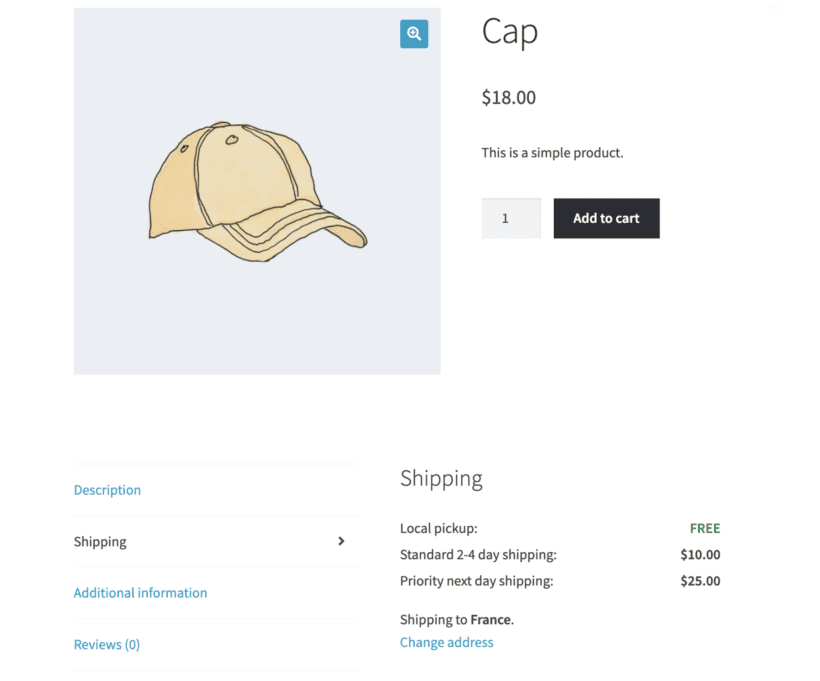
WooCommerce Shipping Calculator shows live delivery options and costs on the product page itself, before the customer adds anything to the cart. We originally built this plugin at Barn2 and sold it to Kestrel a couple of years ago. It still does its one job extremely well, and we recommend it for stores where shipping costs are a major part of the buying decision.
Shoppers expect to see delivery information before they commit, and burying it on the cart page costs you orders. This plugin moves the information to the product page where the buying decision happens.
What it does well
- The calculator shows all available shipping methods and costs on the product page itself.
- Zip code validation confirms whether you deliver to a customer's location before they add to cart.
- The setup wizard runs in under two minutes.
- The calculator automatically matches your theme's styling, with CSS overrides available for fine-tuning.
- It pairs cleanly with our WooCommerce Product Tabs plugin so you can show the calculator inside its own 'Shipping' tab.
Where it's less suitable
- It does one specific thing - delivery info on the product page. If your store doesn't depend on shipping cost transparency, you don't need it.
- There's no free version on WordPress.org.


7. WooCommerce Discount Manager

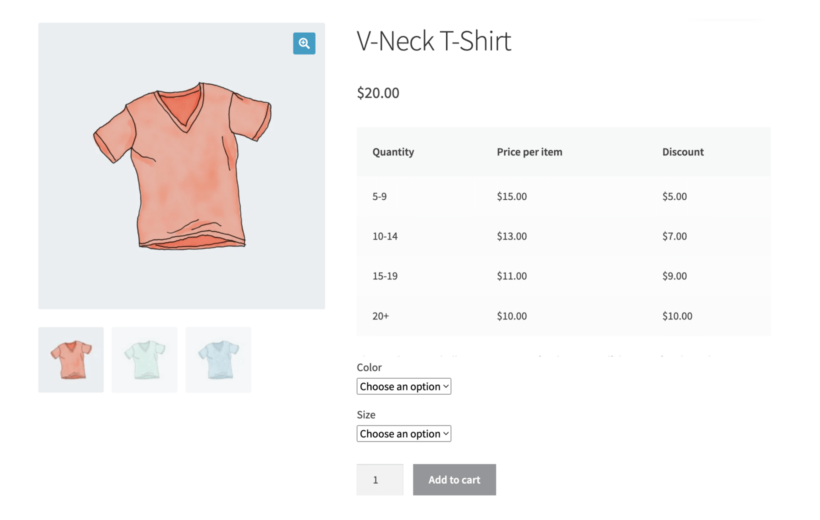
Our WooCommerce Discount Manager plugin takes another angle on product page customization. Where the other plugins on this list add fields or change layout, this one puts discount messages, promotional notices and bulk-pricing tables directly into the product page content. Customers see the offer on the page where they're deciding to buy, well before they reach the cart.
You can set up percentage discounts, fixed-amount discounts, BOGO offers, 'buy X for $Y' deals, quantity-based pricing tiers, WooCommerce role-based pricing, or cart-level discounts that kick in over a spend threshold. Each of these can show a custom notice on the product page so customers know to buy more, buy a bundle, or take advantage of a limited-time offer.
What it does well
- Multiple discount types: percentage, fixed amount, BOGO, 3-for-2, 'buy X for $Y', quantity tiers, role-based and cart-level.
- Configurable notices on the product page so customers see what they're getting before adding to cart.
- Bulk pricing tables that render directly in the product description, showing quantity tiers at a glance.
- You can schedule promotions to start and end automatically, which helps for Black Friday or end-of-season sales.
- Combines or excludes other promotions per discount, so you control whether discounts stack.
Where it's less suitable
- Its primary job is discount management, with the product-page display as one of several features. If you only want product-page customization with no discount logic, a page builder or Product Options is more direct.
I was looking for a plugin like this for several years. I have now been using it for over 6 months and love it. It has allowed me to discount an add-on without discounting the product.
Ted Goeltz
8. Customer Reviews for WooCommerce

Customer Reviews for WooCommerce upgrades the default review section into a fuller conversion tool. You get reviews with photos, a Q&A section under every product, automated review-reminder emails after delivery, and integration with Google Shopping that pushes your star ratings into Google search results.
The free version on WordPress.org is enough for most stores. The Pro version adds aggregated review forms, WhatsApp review invitations, and a fuller review management dashboard.
What it does well
- Automated review-reminder emails go out after delivery, with a configurable delay.
- A Q&A section sits on every product page so customers can ask questions and other customers (or you) can answer.
- Google Shopping integration pushes your star ratings into Google search results.
- You can import and export reviews, which helps when migrating between stores.
- The free version covers most stores' needs.
Where it's less suitable
- It enhances the reviews section only. It doesn't add fields, layout changes, or anything else outside the review experience.
- The most useful automation features (aggregated review forms, WhatsApp invitations and advanced review management) sit behind the Pro version.
9. YITH WooCommerce Request a Quote
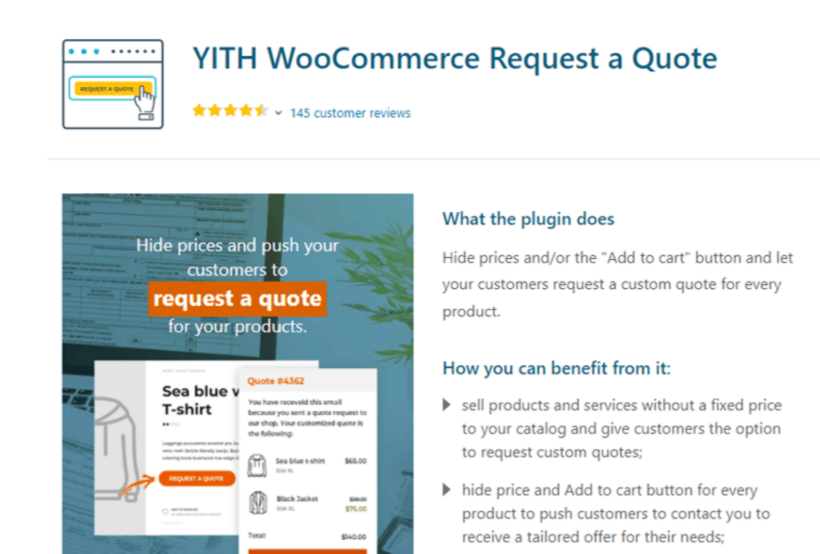
YITH WooCommerce Request a Quote replaces the 'Add to Cart' button with an 'Add to Quote' button on whichever products you choose. Customers add products to a quote request a quote list instead of a cart, fill in their contact details, and submit a request for you to follow up on. It's the right plugin for B2B stores where pricing is negotiated, or wholesale stores that don't want public prices.
You can hide prices entirely from non-logged-in customers and re-show them after login, useful if you sell to both retail and trade audiences from the same site.
What it does well
- You get per-product, per-category control over which products use the quote button versus the cart button.
- The plugin can hide prices and 'Add to Cart' buttons from non-logged-in users when you need to.
- It's variation-aware, so customers can request quotes for specific variations of variable products.
- The quote request list works alongside the standard cart, so you can offer both flows on the same store.

Where it's less suitable
- It's single-purpose - it handles quote requests and nothing else.
- The most useful features (custom email templates, advanced form fields and expiration on quotes) need the Pro version.
- Quote management is separate from WooCommerce orders, so you keep track of two systems instead of one.
10. WooCommerce Customizer

WooCommerce Customizer is a free, lightweight plugin that lets you change WooCommerce's default text and labels without writing any code. It adds a tab to your WooCommerce Settings page with a list of common overrides. You can change the 'Add to Cart' button text, the product description tab heading, the sales badge text, the number of products per page, the related products title and more.
It's the right plugin when you want quick text tweaks across the store and nothing more - no custom fields, no layout changes, just plain-English overrides of the strings WooCommerce ships with.
What it does well
- It's completely free.
- It's lightweight, with a small footprint and no impact on page load.
- It covers the most common text tweaks: button labels, tab headings, badges, and the products-per-page count.
- No code is required.
Where it's less suitable
- The scope is very narrow. It changes text and labels and nothing else - no fields, layouts, or customer-facing functionality.
- If you want to do more than rename buttons, you'll outgrow it quickly.
Which WooCommerce product page customization plugin should you use?
For most stores the answer is more than one of them, picked by what you need to change. Here's how to decide:
- If you sell configurable or personalized productsWooCommerce Product Options covers the configurator and pricing logic without rebuilding the layout. See our full guide to configurable products in WooCommerce for setup.
- If you want to rebuild the layout from scratchWooBuilder Blocks for Gutenberg sites, CoDesigner for Elementor sites.
- If you need to organize specs, FAQs or downloads into tabsWooCommerce Product Tabs handles this without changing the rest of the page.
- If shipping costs are a big part of the buying decisionWooCommerce Shipping Calculator pulls the delivery information forward onto the product page.
- If you run promotions or wholesale pricingWooCommerce Discount Manager displays the discounts directly on the product page where customers decide to buy.
- If reviews drive a lot of your conversionsCustomer Reviews for WooCommerce upgrades the default review section into a proper conversion tool.
- If you sell B2B or quote-based productsYITH WooCommerce Request a Quote swaps the cart for a quote request flow.
- If you want post-purchase upsells and order bumpsCartFlows wires up the funnel around your existing product pages.
- If you just need to rename a few buttonsWooCommerce Customizer does it for free.
Most stores end up running two or three of these together. WooCommerce Product Options plus WooCommerce Product Tabs is a common pairing - one adds configurable options, the other organizes information into tabs. A B2B store might add YITH Request a Quote on top. A discount-heavy retail store might add Discount Manager and CartFlows. Pick the combination that maps to what your customers really do on your product pages.
Frequently asked questions
How do I customize a WooCommerce product page without coding?
Install a WooCommerce product page customization plugin. Most of the plugins on this list add their features through the WordPress dashboard, without touching theme files or PHP. Our WooCommerce Product Options is a typical example - it lets you add custom fields, configurators and pricing logic from a settings panel inside WordPress, then displays the result on the product page automatically.
What is the difference between a WooCommerce customizer and a product page builder?
A WooCommerce customizer plugin (like the free WooCommerce Customizer on wordpress.org) changes store-wide settings - button labels, tab headings, products per page, the sales badge text. A product page builder (like WooBuilder Blocks or CoDesigner) lets you rebuild the layout of the page itself - choosing which elements go where, swapping in custom blocks, redesigning the structure. Customizers tweak; builders rebuild.
Can I edit the WooCommerce product page layout without changing the theme?
Yes. Page builders like WooBuilder Blocks and CoDesigner sit on top of your theme - they redesign the product page layout without modifying the theme files. Option plugins like our WooCommerce Product Options take a different approach: they add fields and configurators within the existing layout, so the theme's design stays the same and the extra functionality lives on top.
Can I use multiple of these plugins together on the same store?
Yes, and that's what most stores end up doing. The plugins on this list customize different aspects of the product page, so they're designed to coexist. WooCommerce Product Options plus WooCommerce Product Tabs is a common pairing. A wholesale store might add YITH Request a Quote on top. Just pick the combination that maps to what your customers really need.
Customize your product pages today
The default WooCommerce product page works fine for simple stores. For most growing stores, the product page customization plugins above let you add the customization you need without writing custom code. Combining two or three of them usually beats relying on a single one.
If you're starting fresh, WooCommerce Product Options is the broadest single plugin to install first. It covers configurable products, custom pricing and conditional logic on top of any theme. From there, layer in WooCommerce Product Tabs for extra organized content, WooCommerce Shipping Calculator if delivery costs matter, and WooCommerce Discount Manager if you run promotions. Page builders like WooBuilder Blocks or CoDesigner come in when the layout itself needs to change, and the third-party plugins on this list fill in specific gaps as you grow.