WordPress market share: how many websites use WordPress in 2026?


I’m writing this post to give you the latest WordPress statistics for 2026. I've done the research to provide the latest data on the number of websites using the WordPress CMS. You'll be amazed at how popular it is!
WordPress is the most popular content management system (CMS) in the world. Individuals and businesses of all sizes use WP to build websites, run blogs, and sell products online.
Keep reading for the latest statistics on WordPress market share compared to other CMS's and the whole internet.
Our video producer Sam also made a fantastic video on the topic, which includes some of the challenges facing WordPress right now.
WordPress market share 2026
According to W3Techs, around 42.6% of all websites on the web use WordPress. These include websites that run on a CMS, without a CMS, and custom-coded CMS's. This means that well over one-third of the entire internet runs on WordPress.
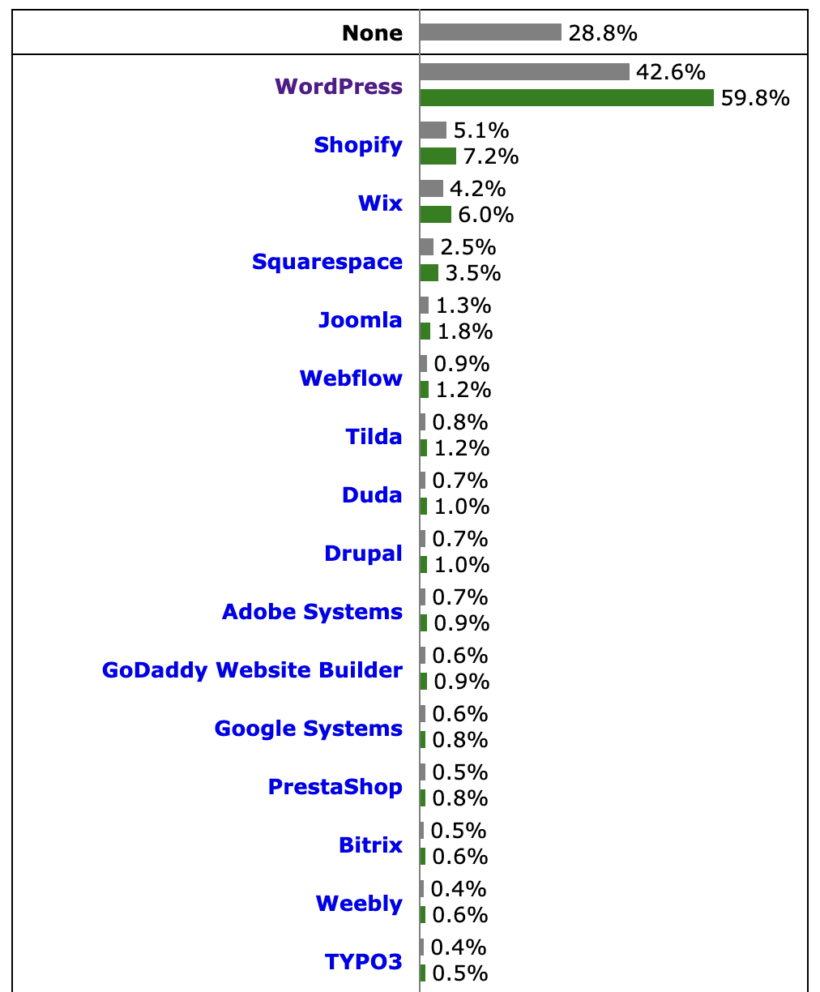
WordPress’s market share decreased to 59.8% to be specific – if you only consider websites running a known CMS. This includes websites running WordPress.com.
It’s easy to confuse WordPress.org (the open-source platform) with WordPress.com (a web hosting service). For those unfamiliar, WordPress.com is a commercial hosting service that uses a modified version of the WordPress CMS. WordPress.com is a simplified website builder that lets users create websites easily, whereas WordPress.org gives users full control over site customization. This means that users can install any theme or plugin they’d like on their website. For users looking to get the most out of these customization options, choosing reliable WordPress website hosting is essential to ensure better speed, security, and overall site performance.
It’s worth mentioning that WordPress.com is owned by the same company, Automattic Inc., that contributes to the WordPress.org project.
Comparing this number with other popular content management systems like Joomla and Drupal, WordPress doesn’t face any serious competition. Similarly, hosted site builders such as Wix and Squarespace are far behind WordPress in terms of their user base. Shopify is its closest competitor which powers only 5.1% of websites worldwide.
Number of websites using WordPress
As of 2026, there are about 1.34 billion total websites on the web. More than 522 million sites use WordPress. And, WordPress 6.9 has been downloaded more than 34 million times, the platform's usage continues to rise steadily.
WordPress lets you create your website easily and manage it from any computer. It enables users to build websites for businesses or blogs, allowing people to quickly take their ideas, products, or services online.

Among the many reasons for WordPress' popularity is the versatility it offers to users as a powerful content management system. This combines with the large community of WordPress web developers that offer support through online forums, tutorials, and self-help articles.
The WordPress ecosystem contains more than 61,000 plugins, 14,000 themes, and unlimited layout customization options. This means that WP can suit the needs of businesses of all shapes and sizes including corporate sites, blogs, membership sites, and online stores.
Growth of WordPress market share over time
Since it started being tracked, the data shows that WordPress’s market share has been consistently growing at around the same rate. Its total website market share was 27.3% at the start of 2017 which grew to 43% in January 2026. This means WordPress has experienced an increase of 15.7% in terms of total website market share.
Here are the exact figures representing WordPress market share growth by year based on data by W3Techs:
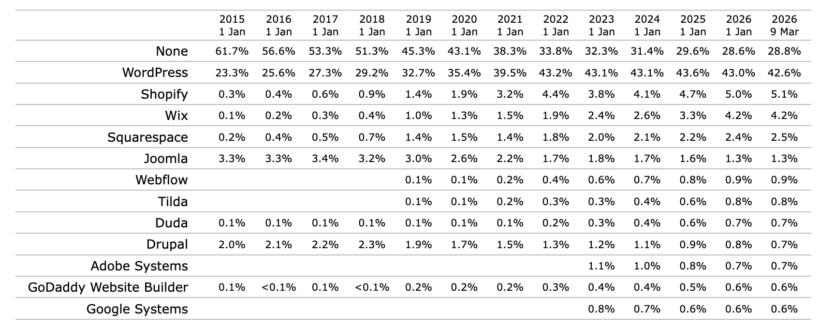
Five years ago, WordPress had a share of 39.5% among the top 10 million most visited sites on the internet. Since then, this number has grown to 43%, raising WordPress head and shoulders above its competition.
The main reason for WordPress's popularity is that it is flexible enough to match the needs of small, medium, and enterprise-level users. Users have the option to install the WordPress CMS and self-host their website or go with WordPress.com’s hosted solution to build their website or online store. This makes WordPress a flexible solution for businesses of all sizes.
Breakdown of WordPress market share by country
The WordPress CMS supports more than 70 languages which makes your content accessible to your site’s users across the globe.
Here’s a list of the top 5 countries based on WordPress usage in 2026:
- United States
- Germany
- United Kingdom
- Brazil
- France
In 2003, when WordPress was first built by Matt Mullenweg and Mike Little, it was only available in English. Since then, the number of supported languages has increased which has enabled users in other countries to use this platform to power their websites and online stores.
In the United States, around 16,644,731 sites run on WordPress, including the TED Blog, Reuters, The Next Web, The New Yorker, and Vogue. The U.S. has 44% of all known live WordPress-powered sites.
Germany, with 1,921,176 WordPress websites, is in second place and makes up 5.11% of all live WordPress-powered websites. The United Kingdom has 1,390,889 WordPress websites, Brazil has 1,062,796 websites, and France has 1,039,670 websites.
There are about 37,563,309 live websites in the world, and these top five countries not only account for a large portion of the active websites but also the top one million websites.
WordPress’ ecommerce platform: WooCommerce
Although WordPress started out as a blogging platform, it has become a major player in the ecommerce space. WooCommerce - a free WordPress plugin - is the world’s biggest ecommerce platform which itself is owned by the company behind WordPress, Automattic Inc.
WooCommerce makes up 8% of the top one million sites using ecommerce technologies.
According to BuiltWith, around 3.08% of the top one million websites use WooCommerce. For reference, that’s 8% of the top one million sites using ecommerce technologies. Keep in mind that WooCommerce’s market share is much larger for medium and high-traffic websites.
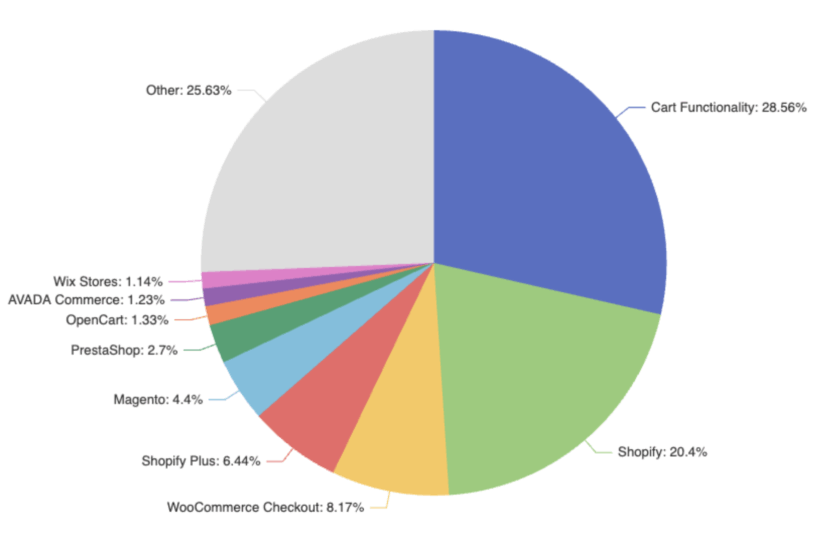
Find out the latest stats on the WooCommerce market share compared to other ecommerce platforms and WordPress ecommerce plugins.
The future of WordPress
WordPress isn't standing still. With AI reshaping how people build and manage websites, the platform is actively working to stay at the center of that shift rather than get left behind.
The WordPress AI Team is building what they call "AI Building Blocks" - technical foundations that allow users and developers to create powerful AI implementations within WordPress. The ambition is significant: by WordPress 7.0, any user - enterprise or blogger, developer or designer - should be able to access and build powerful AI features to aid their digital presence.
That release is almost here. WordPress 7.0 is scheduled for April 9, 2026, and will integrate the PHP AI Client SDK directly into core - meaning the infrastructure for AI features will simply be there by default, the way the REST API is there by default, without requiring any additional plugin installation.
On the commercial side, Automattic is moving fast too. WordPress.com now has a built-in AI Assistant that works inside your site - understanding your content and layout and taking action where you're already building, with no copy-pasting or prompt engineering required. And in March 2026, Automattic enabled AI agents including Claude and ChatGPT to create, edit, and manage content on WordPress.com sites through Model Context Protocol (MCP) integration. WordPress.org already have MCPs and I look forward to seeing more user-facing AI tools being built directly into core so that non-developers can use them too.
The challenges WordPress faces
That said, we need to be honest about the challenges, which are very real. Headless WordPress - where WordPress powers the backend but a separate frontend framework handles what users see - is growing in popularity among developers who want more flexibility. It keeps WordPress in the picture and helps it stay relevant to some extent, but changes its role from a complete platform to more of a content engine behind the scenes.
For me, the bigger question is what AI-assisted website creation does to WordPress's dominance long-term. More and more people are using AI tools to generate websites, sometimes without a CMS at all. If someone can describe a website to an AI and get a deployable result without ever touching WordPress, the traditional case for using it starts to look different. This isn't an immediate threat - WordPress's installed base is enormous and its ecosystem is deeply entrenched - but it's something we need to watch.
The bottom line
WordPress powers over 42% of the entire internet. That's not a number that unravels quickly. The platform has survived every "WordPress is dying" prediction thrown at it over the past decade, and its community, ecosystem, and sheer scale give it an enormous structural advantage.
The real question isn't whether WordPress survives - it's whether it adapts fast enough to remain the default choice for building on the web. The signs so far suggest it's taking that seriously, including the dedicated AI team, AI baked into WordPress 7.0 core, and Automattic's active MCP integrations. If WordPress successfully makes itself the natural home for AI-powered web experiences, its next decade could look a lot like its last one: dominant, growing, and hard to bet against.
16 Comments
Great insights in this post! It's fascinating to see how WordPress continues to dominate the market share. The growth trends and user statistics really highlight its importance in the web development landscape. I’m curious to see how it evolves in the coming years!
Thanks for reading and for sharing your thoughts!
It really is incredible to watch WordPress maintain its dominance while constantly evolving. With the continuous updates to the block editor and full-site editing, the landscape is shifting fast. It’s definitely going to be an exciting few years ahead for developers and users alike!
This report provides such insightful data into WordPress's growth and its ever-evolving market share! It's fascinating to see how it continues to dominate the CMS landscape. I'm curious to see how it will adapt to emerging technologies and trends in the coming years. Thanks for the informative post!
Hi there!
Thank you for your kind words! We are so glad you found the data insightful.
It truly is a fascinating time for WordPress. With the rapid rise of AI integration and the shift toward more "headless" architectures, seeing how the platform maintains its dominance while evolving to meet these new trends is something we are watching closely as well.
We appreciate you taking the time to share your thoughts and for being part of the conversation!
Best regards,
Barn2 Team
Great insights in the report! It's impressive to see how WordPress continues to dominate the market despite increased competition. I'm curious to see how they adapt to emerging trends and technologies in the coming years. Thanks for sharing!
Thanks for the kind words! It really is fascinating to see WordPress maintain its edge. With the rapid evolution of AI and the "block-everything" approach of Gutenberg, the next few years will definitely be a turning point for how the platform holds its ground.
Glad you found the report helpful!
Thank you for giving more significant information to WordPress users!
Hi Chandu! Thank you for your kind words! We're glad you found the information helpful. Our goal is to empower WordPress users with valuable insights and resources. If you have any questions or topics you'd like us to cover in the future, feel free to let us know!
I'm also a WordPress user and I have this question, I want to know how many websites use WordPress in 2022. now, here at this blog, I got all my answers this blog was really helpful for me thanks for sharing this with us.
Hi, Khizer. Thanks for your comment. I'm glad to hear you found the WordPress usage info you were looking for!
The percentage of websites using WordPress is given in comparison to others. But what is its relation with the MERN stack, how can I know this?
Hi, Marjuk. Thanks for your feedback! I'm afraid the sources we cited don't include any info about the MERN stack (which I understand is a variation of the MEAN solution stack, and so unable to comment about how its usage compares with WordPress.
A quick Google search for "mean stack vs wordpress" has these top results:
I hope this helps point you in the right direction. Cheers!
This article is very well explained, and it only reinforces the certainties I have in continuing to bet on WordPress, as the best tool for creating websites, I have been a developer for 10 years and I can say that there is no better platform.
Hi, Murillo. Thanks for your comment. I'm glad our article is helpful, and to hear that you share our confidence in WordPress as a platform. Cheers!
Great article. Would be interested in knowing if you have any idea about out of the total number of websites for non profits how many are powered using WordPress? Primarily looking for some insights on WordPress for Non profits.
Hi, Neeraj. Thanks for the kind words and for asking. I'm afraid the mentioned sources of our article don't have/provide such a demographic for non-profits and all I can do is apologize and hope you'll understand. I imagine that a significant number of non-profit websites are powered by WordPress, as the varied initial costs and continued development/maintenance of WordPress websites can be kept to a minimum and there are also a number of free options available for domain names, hosting, themes, and plugins.