Do WooCommerce review plugins slow down your store?


There are many factors that determine whether your store is lightning fast or slow as molasses. One of the most important decisions you make when building a new store is choosing which plugins you use to solve a problem.
With so many competing alternatives, especially for WooCommerce, it can be difficult to know what to choose.
One of the areas where you have to make choices is how to handle reviews. How will you send automated email requests? Will you allow photo and video uploads? Do you want AI features?
In this post, we'll compare five WooCommerce product review solutions head to head to see which one is fastest and which one is slowest. No two services or plugins are identical, so the feature sets vary. We didn't pay for the premium CusRev and ReviewX features, for example, so those solutions have comparatively few features compared with WiserReview and Reviewbird.
However, we aren't worried about premium features here. We're testing the base layer: how much does it cost you in terms of performance to display your reviews with each solution?
The competition we're testing head to head
We'll be comparing these five product review services:
Customer Reviews for WooCommerce (CusRev)
With over 80,000 installs and a 4.8 out of 5-star rating on WordPress.org, CusRev is perhaps the most popular product reviews plugin for WooCommerce. It has a free self-hosted solution as well as a paid hosted solution. For this study, we tested the free version.
WiserReview
WiserReview is a hosted SaaS (Software as a Service) that provides product review features for many ecommerce platforms. You create an account, import your reviews, and install its widgets on your WooCommerce site. Those widgets load from its servers and render your reviews, carousels, and other content.
ReviewX
ReviewX is a SaaS solution with a different approach. Reviews are managed through its WordPress plugin in your site dashboard but hosted on its servers. For this analysis, we tested the free plan.
Reviewbird
Reviewbird is a new product reviews SaaS for WooCommerce from the founder of CheckoutWC. Your reviews are hosted on its servers and rendered on your site with hosted widgets.
Yotpo
Yotpo is a hosted SaaS with various features, including product reviews. It provides services for many ecommerce platforms, including WooCommerce, at a premium price compared with the other offerings. We tested its limited free plan.
Testing conditions and methodology
We set up five identical WooCommerce websites on the same Linode, running the same stack:
- WordPress
- WooCommerce 11.0.1 loaded with 1,000 reviews over 17 products, except for Yotpo, which had 10 published reviews
- Kadence
- PHP 8.4
- Redis object cache
- WP Fastest Cache
- Cloudflare proxy with APO and HTML caching turned off
Testing scenarios included:
- Product page load time (TTFB)
- Store API Add to Cart (TTFB)
- admin-ajax.php Add to Cart (TTFB)
- Shopper journey from product page to Add to Cart and checkout
- WordPress admin load time (TTFB)
For each test, we loaded the resource, such as the product page or Add to Cart request, 10 times without recording. We then loaded it 24 more times, one after another.
Each timed load was a single GET request. We started the clock at the request and stopped at the first byte of HTML. The number for each service is the median of those 24 TTFB results.
The shopper journey uses a different methodology, which is described below.
Which WooCommerce product review solution is fastest?
In all of our tests except one, Reviewbird performed the best. The margins are pretty small, so a win isn't a slam dunk, but it was consistent.
None of the services were disqualifyingly slow on the frontend or general dashboard pages. ReviewX is quite slow when loading reviews in the backend, but that was outside the scope of our tests.
Which product review solution had the fastest product page load times?
In our product page test, we're looking at Time to First Byte (TTFB). This measures how long it takes for the server to start responding to a GET request on the product page.
This test was done with page caching turned off so that we could isolate exactly what additional work each plugin added to the product page request.
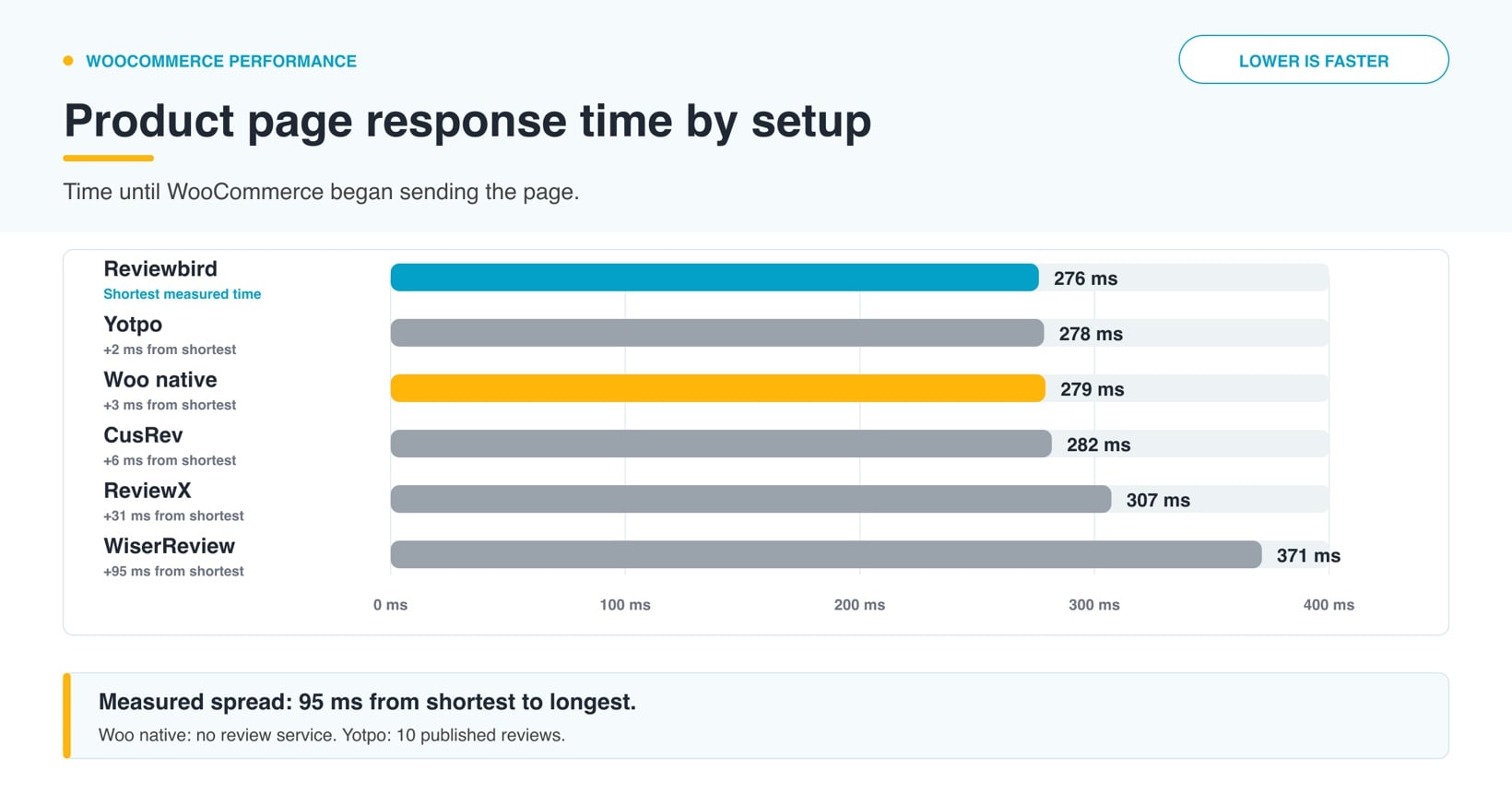
The total difference in load time between the slowest and fastest provider was 95 milliseconds. WooCommerce has to make quite a few queries to pull in review information. As a result, using a hosted service such as Reviewbird was faster by a few milliseconds than using WooCommerce reviews out of the box.
How does each product review service impact WooCommerce Add to Cart times?
Here again, we used TTFB as our measure. We wanted to know how long it took WooCommerce to add the item to the cart and start returning the response to the browser.
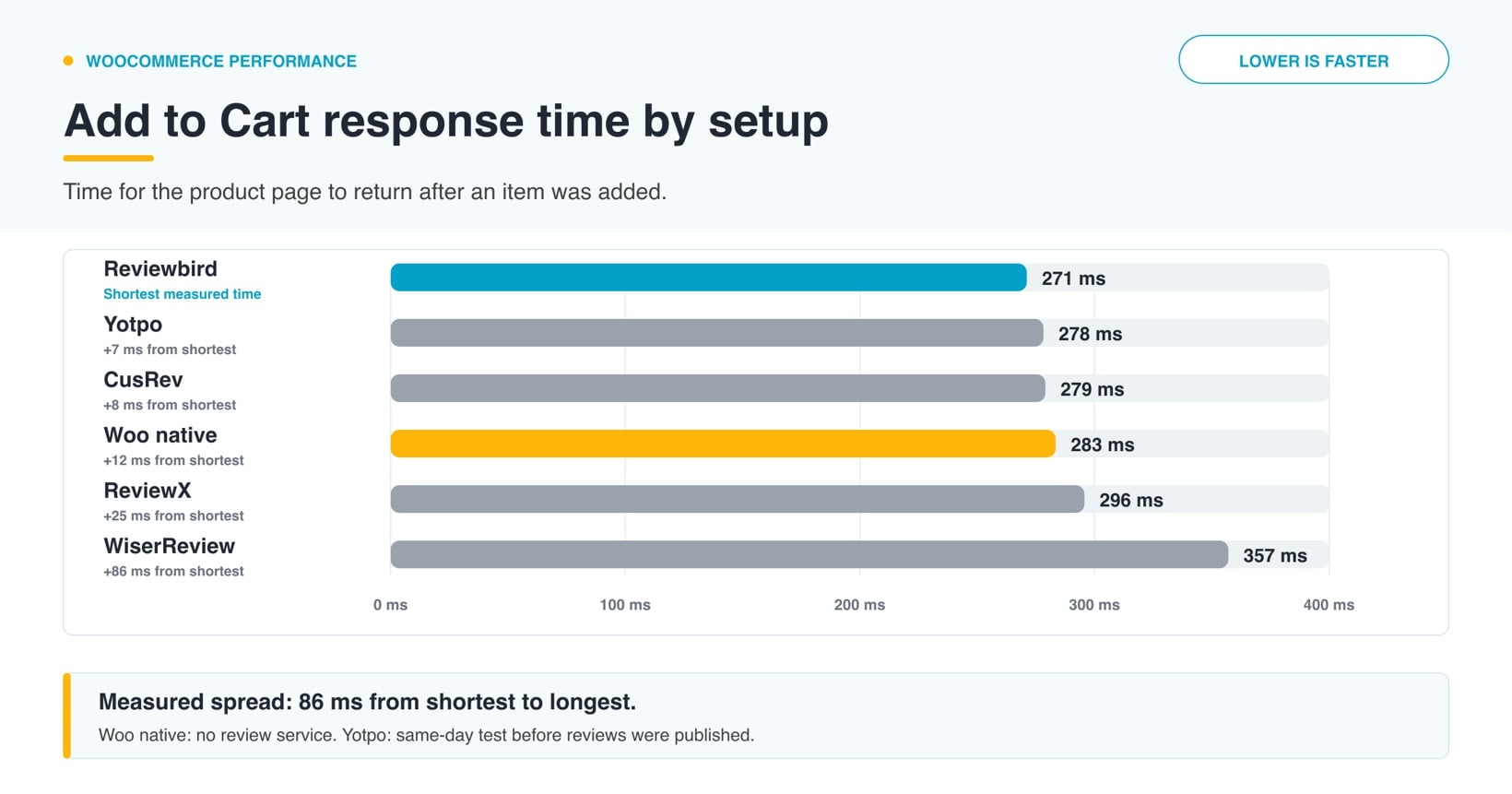
Reviewbird edged out the competition by a hair again in the Add to Cart test. Notably, WiserReview lagged behind by about the same 90 milliseconds, suggesting that something about its bootstrap affects all requests, not only the ones where reviews are displayed.
Overall, the times are pretty similar between the other services and not substantially different from native, out-of-the-box WooCommerce reviews.
How does each product review service affect WordPress admin performance?
A fast WordPress admin dashboard is, in some ways, the most important measure we can take. WooCommerce may serve a business's customers well, but people also use the dashboard every day to process orders and respond to customer service issues. They are often the most influential and the most sensitive to slow performance.
Obviously, frontend performance matters a lot. However, random shoppers aren't likely to complain, while your helpdesk probably will.
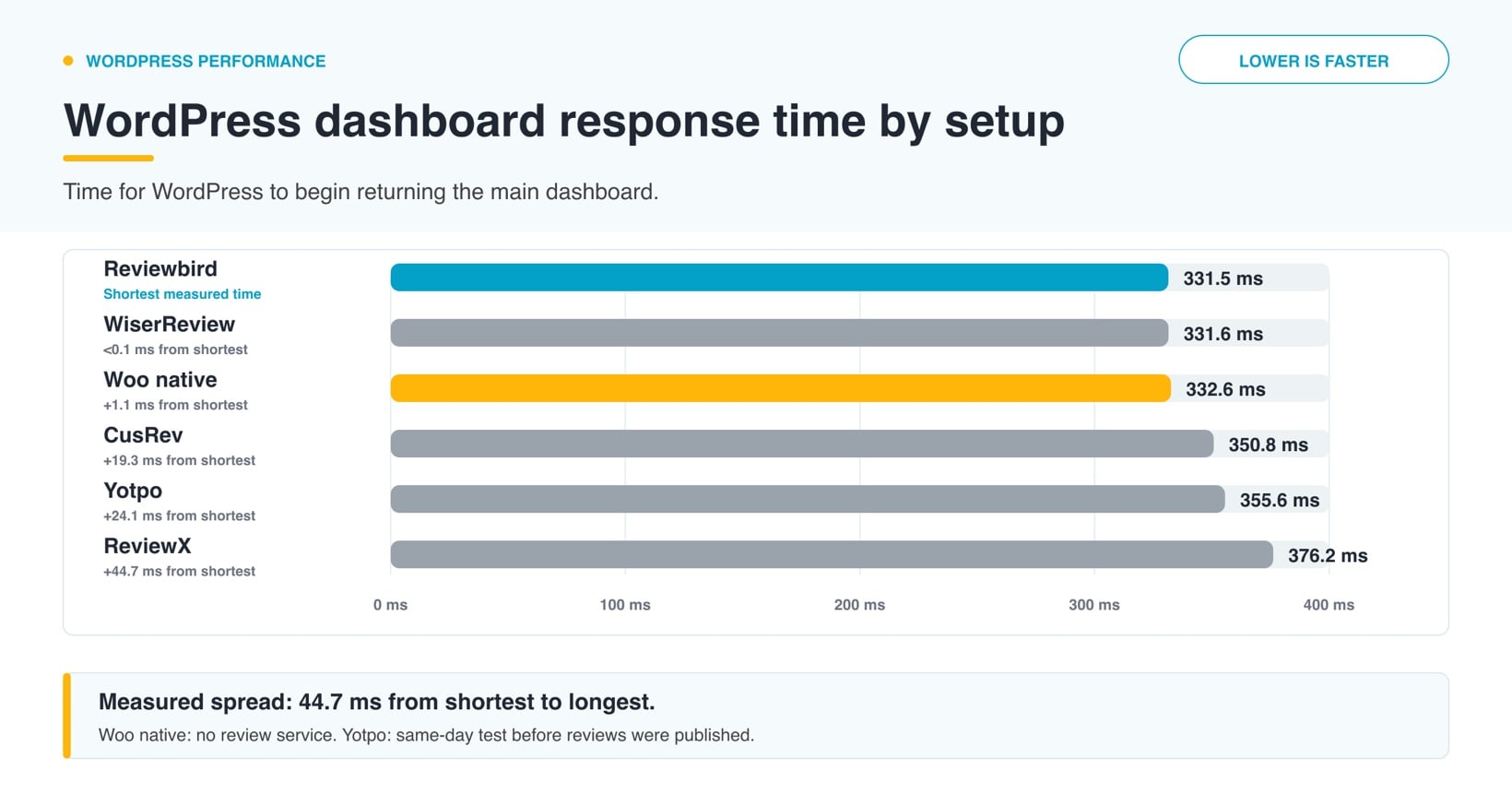
This test tells a slightly different story from the previous ones. Reviewbird wins again in a photo finish, by 0.1 milliseconds, and ReviewX adds a small amount of weight to the dashboard response time.
Measuring the full shopper journey
For this test, we used Playwright to automate the shopper journey. It loaded the product page, waited for the reviews to display, added an item to the cart, went to checkout, and adjusted the postcode while waiting for checkout to refresh. We did three runs per service, and the results are the average total time for each service.
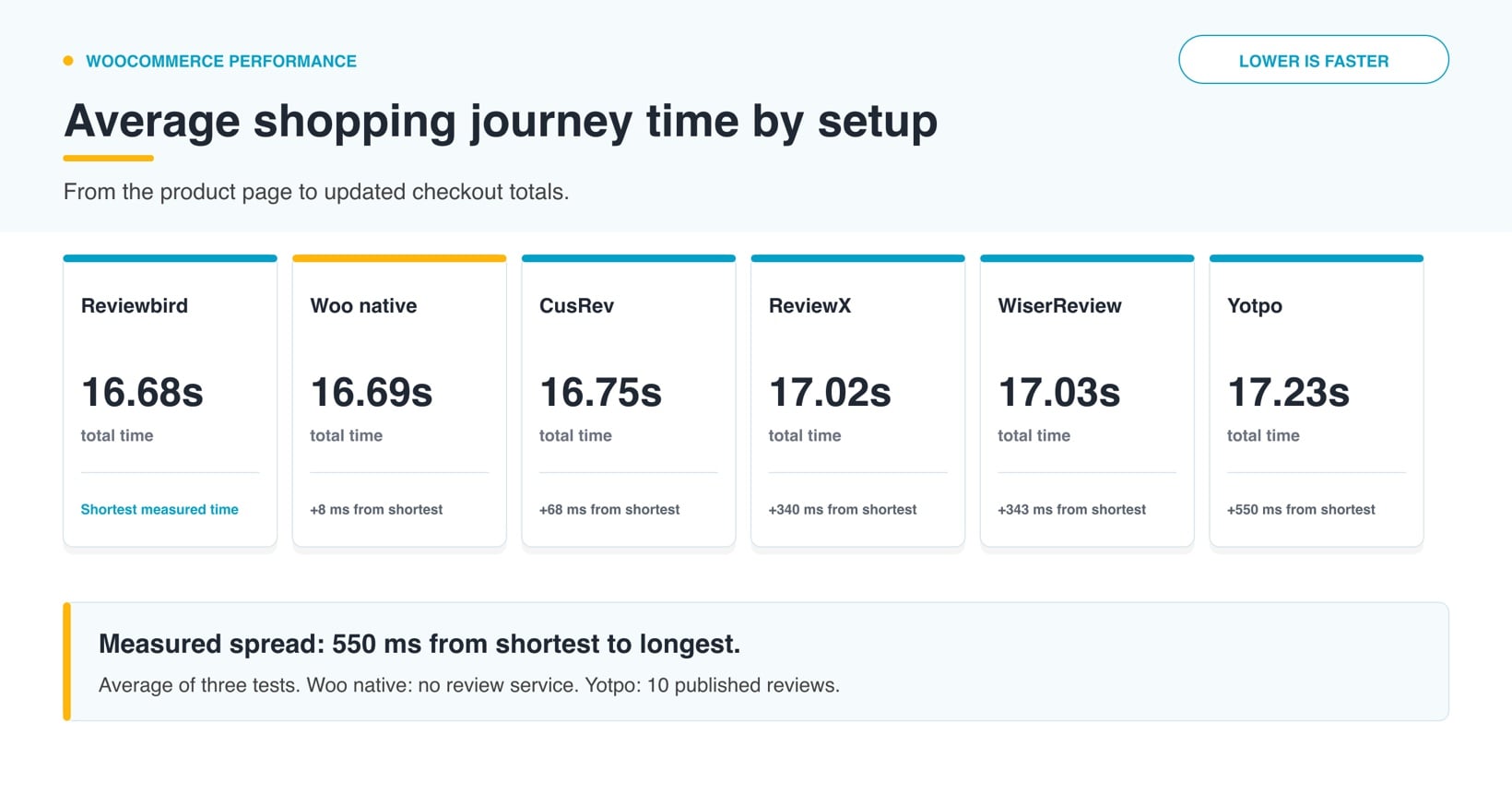
Reviewbird wins again by an even smaller margin of eight milliseconds, making this another statistical tie.
ReviewX and WiserReview lagged behind by about 340 milliseconds. Yotpo was 550 milliseconds behind Reviewbird. Given that this was a multiple-page sequence of actions, these are pretty negligible amounts of time.
What did the admin-ajax.php test show?
We mentioned above that we also tested Add to Cart requests using admin-ajax.php. However, the results are so similar that we felt an additional chart was not useful. Here are the raw times:
| Service | TTFB in milliseconds |
|---|---|
| CusRev | 227.163 |
| WiserReview | 229.194 |
| Reviewbird | 230.357 |
| Yotpo | 234.326 |
| ReviewX | 235.933 |
The total difference between the fastest and slowest services was about nine milliseconds, with CusRev taking the gold.
Which plugin or service should you choose for your WooCommerce product reviews?
Which service you choose is up to you. It isn't as simple as picking the fastest one, although faster is always better than slower.
If speed is all you care about, Reviewbird might be the best choice.
However, there is a broader issue here: everything in WooCommerce is cumulative. No one is running their store with just WooCommerce and one plugin.
That 90-millisecond delay added by WiserReview is not a problem by itself. In fact, most people won't detect a loading delay that small. However, imagine that you had 25 or 50 plugins and each one added 40 to 90 milliseconds of delay. That negligible result becomes a massive problem, potentially adding multiple seconds of delay to every Add to Cart request and checkout refresh.
That's a recipe for a lot of abandoned carts.
If you care about performance, make a good choice at every level of your store. Review every area of functionality, and choose a fast host that allocates the right resources for an ecommerce store. Our guide to WordPress speed optimization has more practical advice.
You can't have zero-millisecond load times, but if you choose well, you can have an extremely fast store. Fast stores sell more than slower stores, all else being equal.
4 Comments
The reminder that review plugins can affect more than just visible page speed is important, especially when automated email requests and photo or video uploads add extra processing. Comparing database queries, scripts, and third-party requests before choosing a WooCommerce review solution seems like the right approach.
Fair point! Behind-the-scenes review plugin features like media processing, heavy cron jobs, and bloat in wp_postmeta can silently drag down your database long before page load speeds show it. Profiling queries on staging is definitely the smartest way to choose the right WooCommerce review plugin. Thanks for your insights.
The reminder about automated email requests and photo/video uploads is especially relevant, since those features can add scripts and database queries beyond basic reviews. Comparing plugin assets, image handling, and how much loads on each page seems essential before blaming reviews alone for a slow WooCommerce store.
Hi Ivan, thank you so much for reading and sharing your thoughts! Evaluating the total impact on scripts, media, and page-specific loading is spot on, especially since those cumulative factors often slow down a store long before review queries themselves become a noticeable bottleneck.
Thanks again for contributing to the discussion. Cheers!