Why nobody can find your plugin any more


Over the past year, the leading WordPress plugin in each category has taken an increasingly large share of the market. This leaves all the other plugins struggling to be found. Changes in the way people search have pushed the existing winners even further ahead. Let's explore what happened.
Two things happened to search at once:
- Google began treating a small set of large sites as the authority on almost any question.
- AI assistants started answering questions themselves, and they tend to recommend the market leader.
Both reward the same thing - already being well known.
I wanted to know the impact of this on real plugin sellers, so I pulled a year of install data. Below is the research behind both changes, what they have done to plugin installs, and how it has all affected us at Barn2.
Two changes that did it
Google now prioritizes the biggest sites for almost everything
Producing better content than wordpress.org or woocommerce.com no longer lets you rank above them. Google reads scale and reputation as authority far more than it used to, leaving smaller sites trailing behind.
Glen Allsopp's Detailed put numbers on how far that goes. He analyzed 10,000 product review terms and found 16 media companies on page one for 85% of them. Those 16 own 588 brands between them, and they hold four or more of the top 10 organic positions in 1,584 of the results.
HouseFresh reviews air purifiers that it has personally bought and tested. Its Google traffic fell from about 4,000 visitors a day to 200 after the March 2024 core update. Gisele Navarro listed what outranks them now: Generic best-of lists from large publishers who never even tested the product.
All of this means that it's harder to rank in Google unless you're a huge site. However, ranking in Google brings less business benefits than it used to. Pew Research tracked 68,879 Google searches by 900 people in March 2025. When an AI summary appeared, people clicked a normal search result on 8% of visits. When it didn't, they clicked on 15%. Only 1% of those visits involved clicking a link inside the summary.
This shows that even if you did still rank at the top of Google, your traffic would still be down. So that's only part of the explanation. Of course, the other part is AI.
AI recommends the market leader
When you ask an AI for a plugin recommendation, it weighs install counts, reviews, and how much of the internet talks about a product. All of those point at whoever is already biggest, so those plugins get recommended far more than anyone else.
AIs sometimes recommend multiple plugins for the user to choose from. That's a better situation for smaller plugins, but even where this happens, the leader naturally appears far more often than other products.
You can see this from two 2026 studies:
- AIs pick the best-known brand when they can't tell products apartA well-known brand was recommended 100% of the time when every competing product had identical specifications. That held across GPT-4o-mini, Claude Sonnet and Gemini 3 Flash (research on brand bias in AI recommendations, 2026). That preference breaks as soon as something separates you: A 0.075-star rating advantage, a 7.3% price difference or 1.6 times the review count each beat the best-known brand. Brand recognition explained only 1.2% of how products were ranked.
- The top three brands took 48.6% of all recommendationsThis came out of a second study which covered five industries and 3,750 responses (Who Owns the AI Recommendation, 2026).
The changes to Google, coupled with the way that AI makes recommendations, has created a "winner takes most" effect in both WordPress and other industries.
How "winner takes most" affects the WordPress plugin market
I looked at the number of installs of WordPress plugins over the past few years and could see the above trends in action very clearly.
HTTP Archive crawls millions of sites every month and records which technologies each one loads. I extracted August 2025 and August 2026 from BigQuery and analyzed which plugins are running on WordPress sites. This allowed me to compare before-and-after data for 197 plugins over the last 12 months.
It turns out that your chances of growing at all depend on which of the following groups you're in:
- The biggest plugin in the category.
- The plugins in second and third place.
- Everybody who ranks fourth or lower.
What types of plugins are most affected?
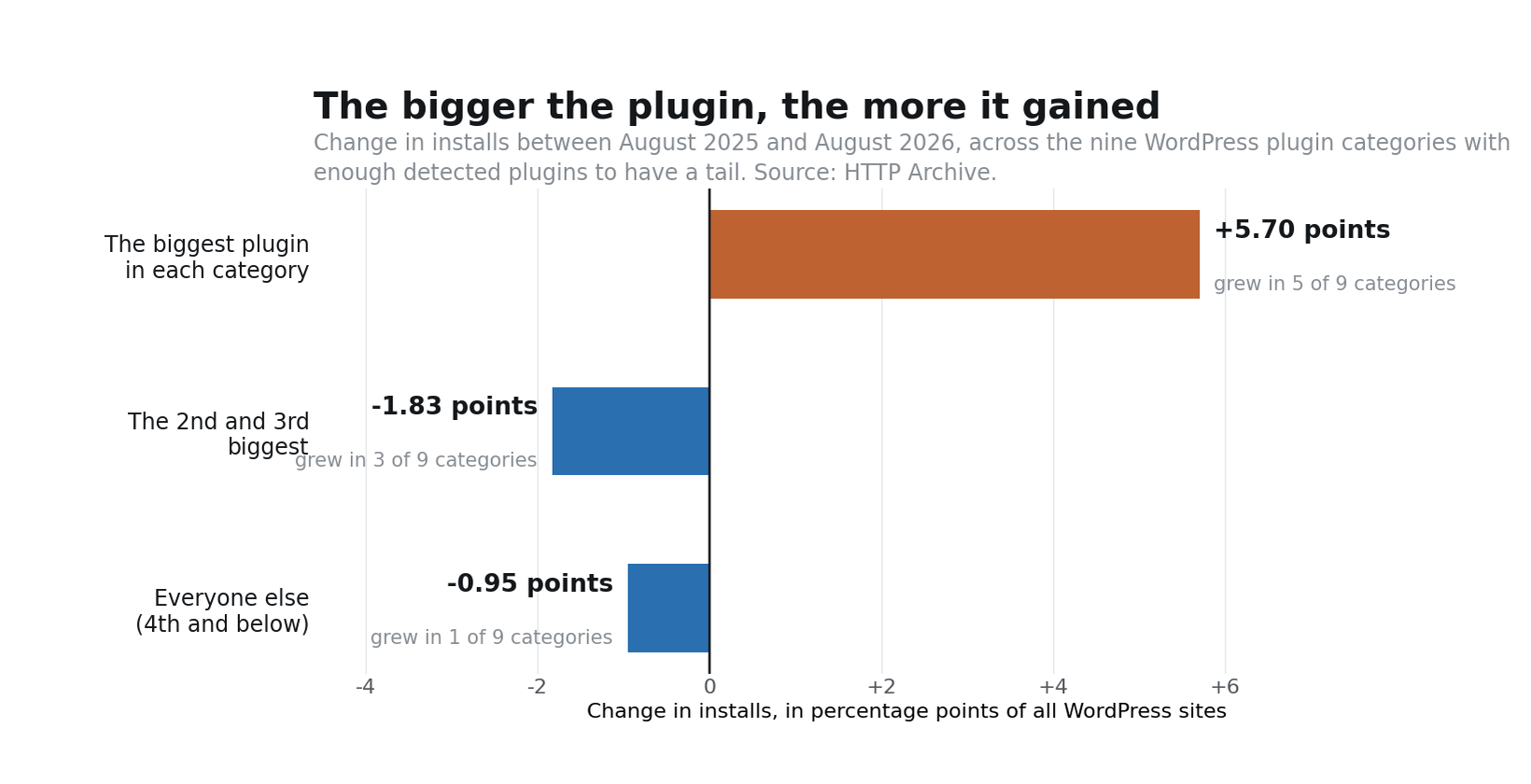
I also pulled the same data divided by the type of plugin. This shows that the "winner takes most" effect isn't even across all types of plugin. The biggest plugin grew in five of the nine categories. The second and third grew in three categories, and the smaller plugins only grew in one.
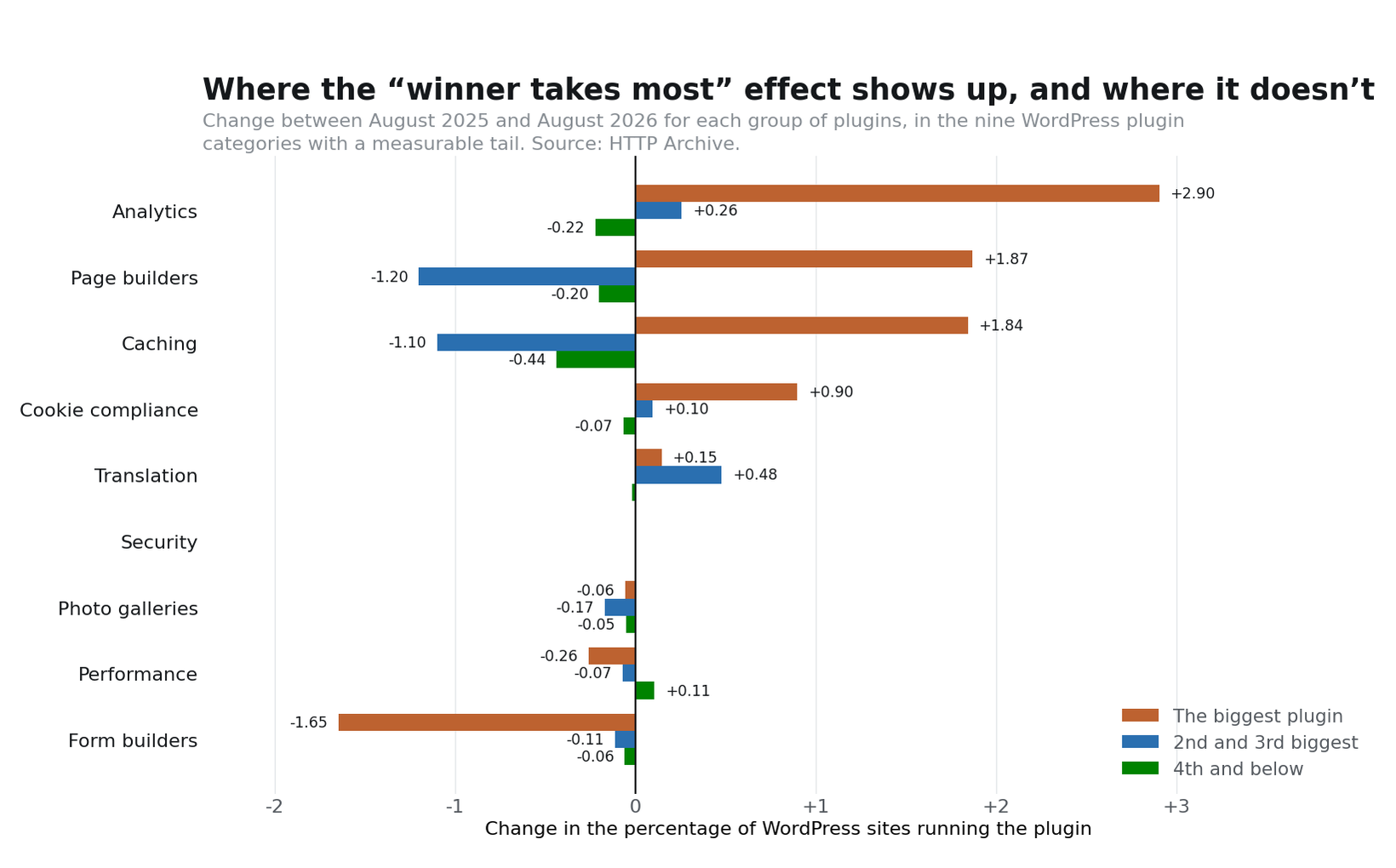
Add the nine leaders together and they gained nearly 6 extra installs for every 100 WordPress sites. Every other group lost installs over the same year. Note that my analysis only looked at the 197 most popular plugins, so the true effect on plugins too small to be featured will be even worse.
Analytics and page builders produced the biggest single moves. Site Kit went from 19.0% to 21.9% of all WordPress sites and Elementor from 30.8% to 32.7%. Take both of those out and the leaders still gain, so no single part of the market is carrying this on its own.
The growing categories give the clearest result. Five of the nine grew their total installs, and in every one of those five the top three plugins took 100% or more of the growth (over 100% means the plugins below the top three shrank while the category as a whole grew).
How this has affected Barn2
Let's use Barn2 as a real-life case study. We're a software company selling WordPress and WooCommerce plugins.
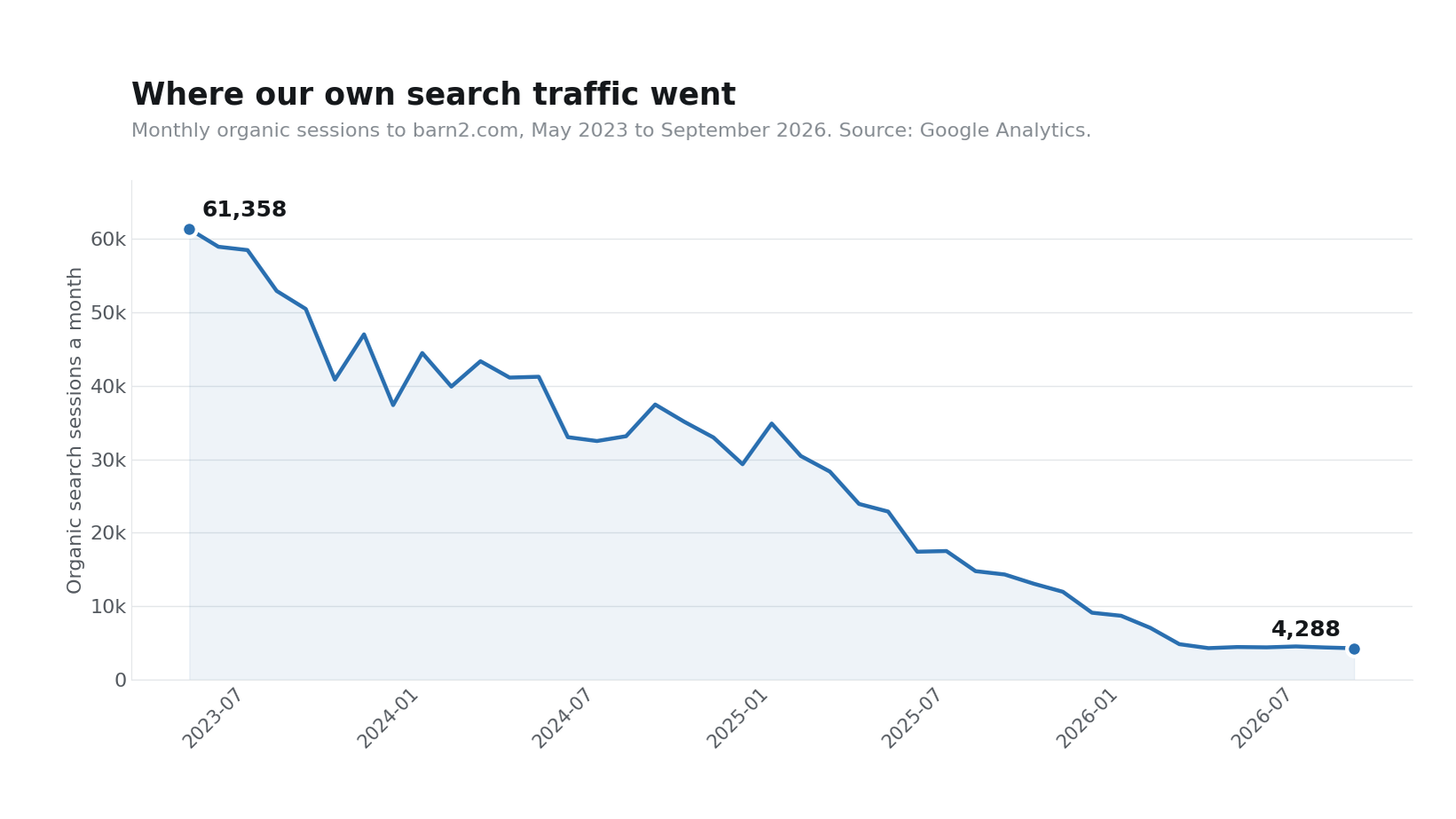
Since 2023, we've lost the vast majority of traffic to our site:
It isn't just Barn2
I talk to a lot of WordPress pr plugin companies and most of them are reporting the same changes. Paid Memberships Pro and GravityKit both agreed to share their traffic figures. Paid Memberships Pro sells membership software and has a large free plugin with 60-90k installs. GravityKit allows users to build apps powered by Gravity Forms.
Over the two years to September 2026, organic search traffic fell 83% at Barn2, 72% at GravityKit and 63% at Paid Memberships Pro.
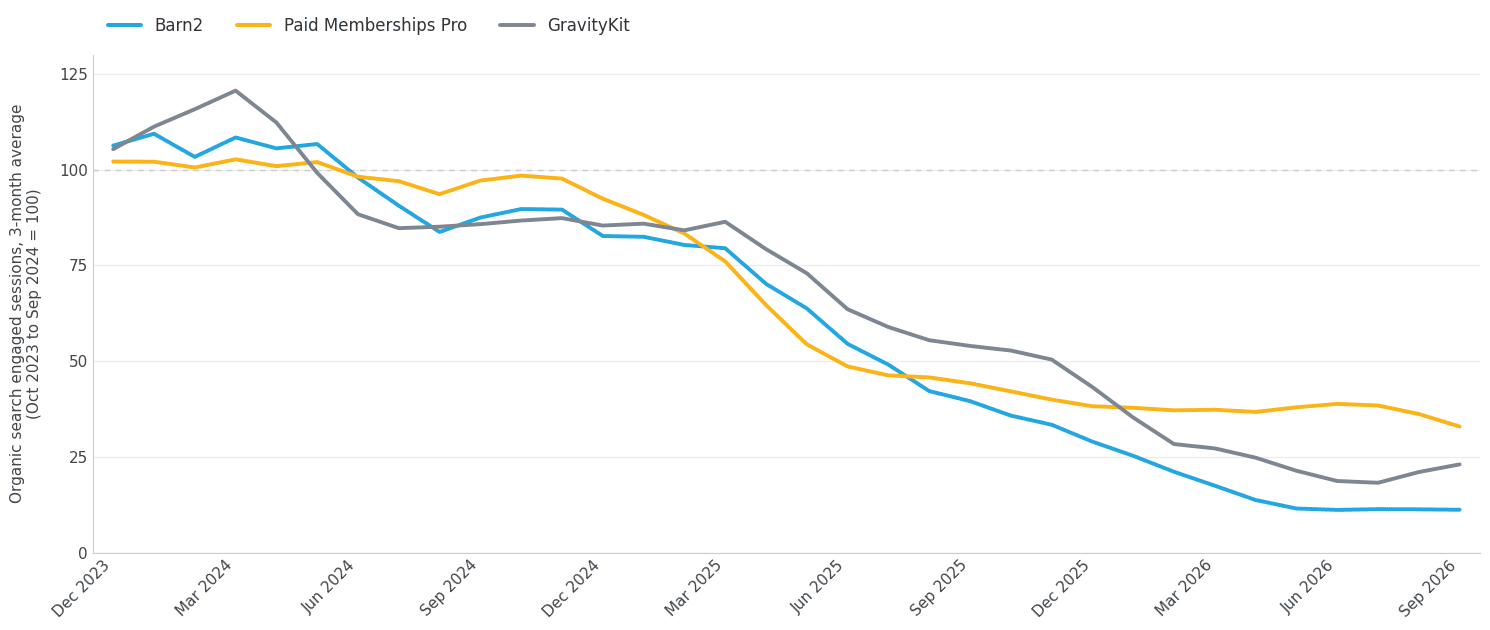
All three of us held roughly level through 2024 and then fell away from early 2025. We sell completely different products to completely different people, yet our traffic charts look the same.
Our traffic declined in several stages, which I will walk you through.
Stage 1: The rise of AI chat and AI overviews
Barn2 ranked in the top 10 for between 918 and 1,400 US keywords every month from January 2023 to February 2026. Traffic over those same months fell by more than 90%.
Our average ranking did not decline during this period. This shows that the decline was due to fundamental changes in search, not a ranking drop.
Stage 2: Lost rankings
This changed in March 2026 when our top-10 count dropped to 665, and by June it was 475.
All of this showed that the zero-click effect affected us well before any algorithm update did. A plugin business watching only its rankings would have seen nothing wrong for two years, when in reality their traffic was falling off a cliff. Surprisingly, the drop in rankings only accounted for a small proportion of the overall drop - the wider changes to search were much more significant.
This fits perfectly with the data about which plugins are growing and which aren't. As a medium-sized independent plugin company, we don't have any major plugins on wordpress.org and we're not on the woocommerce.org marketplace.
What still works?
Given the above, it's clear that the situation has fundamentally changed and small and medium plugin companies need to change too. But all is not lost.
Here are some things that I think we can do to stay strong.
Add unique features
Look again at what the brand bias study that I mentioned above found: The best-known product won every time their features were identical. It lost as soon as it differed on something the buyer cared about. Brand recognition only explained 1.2% of how products were ranked.
Smaller plugins can use this to their advantage. If yours does something the market leader doesn't, and somebody asks an AI for that exact thing, the AI has a reason to recommend you instead.
Build something that answers a question the leader can't. That means one (or more!) real feature nobody else has and which people search for, rather than a better version of a feature everybody already offers.
And once you've done that, make sure the world knows about it. This includes encouraging other sites to write about your products, as this can have a bigger impact than the biased information on your own site. It includes writing detailed documentation, producing YouTube videos - everything you can think of to raise awareness, whether that will train AIs or be noticed by real people.
Expand your marketing channels
I think the days of getting enough customers from search are over. Instead we need to expand into more future-proof areas of marketing. This might include:
- GEO (optimizing your site for AI) - This is worth doing, but don't expect it to bring the same results as SEO used to.
- Email marketing - This is an excellent one because you own the channel and can control your relationship with customers.
- YouTube - Most WordPress YouTube channels are down a similar amount to their organic content, but YouTube is still huge. Now AI answers the questions that YouTube used to. I think people will turn to it more for education. You need to consider how your products might fit into that.
- Direct relationships and partnerships - Deep integrations with other products such as hosting platforms, and lucrative partnerships with agencies that use your products on all their sites, are almost completely immune to the recent changes.
We need to focus on marketing channels that we own and have control over.
But none of this is a complete fix
I hope these tips help you to keep your plugin strong into the future. Realistically though, they may not fully win back the traffic or the sales you've lost. For example, the people asking an AI for one very specific feature are a small fraction of those who used to arrive from a how-to search. Not all plugins are well-suited to other marketing channels.
It's important to be realistic and put your efforts where they're likely to have the most impact. For example, this might be by pivoting your company in new directions or building different types of products that aren't threatened by the changes.
Where I got the data in this article
Every WordPress install figure here comes from HTTP Archive, which publishes its crawl under an Apache 2.0 license and costs nothing to query. I compared August 2025 against August 2026 on the fixed set of 197 plugins detected in both crawls, and expressed every count as a share of the WordPress sites in the same crawl. I also ran the same analysis over three years. The effect is slightly weaker per year over that longer window, which rules out a short-window fluke.
The three-group split uses the nine categories with at least five detected plugins. There are some limitations:
- Every number is a floorHTTP Archive crawls a site's homepage plus one interior page. A plugin that only loads on the page where it's used is undercounted, so real installs are higher than anything reported here.
- The detection library covers 204 WordPress pluginsSo the tail I can measure is the tail of plugins already popular enough for someone to write a fingerprint for.
The Barn2 traffic and ranking figures come from Google Analytics, Search Console and DataForSEO.
Final thoughts on a winner-takes-all plugin market
Over the past few years, things have fundamentally changed in the way that people find WordPress plugins. Both Google and AIs are pushing potential customers to the market leaders, and a huge proportion of sites are seeing massive declines to their traffic. The impact of this is evident from the fact that so many market leaders are growing while smaller plugins are shrinking.
This doesn't mean the situation is hopeless, however, it does mean that most plug in companies need to adapt and find opportunities that will help them stay strong well into the future.