Shopify sells clothes. WooCommerce sells everything you can't ship


While Shopify powers more ecommerce stores overall, its lead comes almost entirely from one industry: Clothing. The reality is that WooCommerce powers more stores than Shopify in 2/3 of the product categories I counted. I'll show you what 5.7 million stores sell and what I think WooCommerce should do about it.
Most Shopify vs WooCommerce comparisons count how many stores run on each platform. I've written one of those myself.
Someone on X then asked me a different question: "Do the two platforms attract different kinds of shops?" I thought this was an excellent question, so I used Store Leads to pull the product categories for 5.7 million live stores on both platforms.
I expected Shopify to lead in most categories by a small margin, as it has gained so much ground recently. However, it actually only leads in eight while WooCommerce wins the other 16. Nearly all of Shopify's advantage is clothing.
Keep reading to find out:
- The 16 categories where WooCommerce powers more stores than Shopify.
- Why WooCommerce leads on products you can't ship.
- The categories which Shopify's own rules push onto WooCommerce.
- What I'd like to see the Woo team, product makers and agencies do about it.
Shopify is a clothing platform first 👕
Here's how the two platforms compare across all 24 categories, with the ones where Shopify wins listed first:
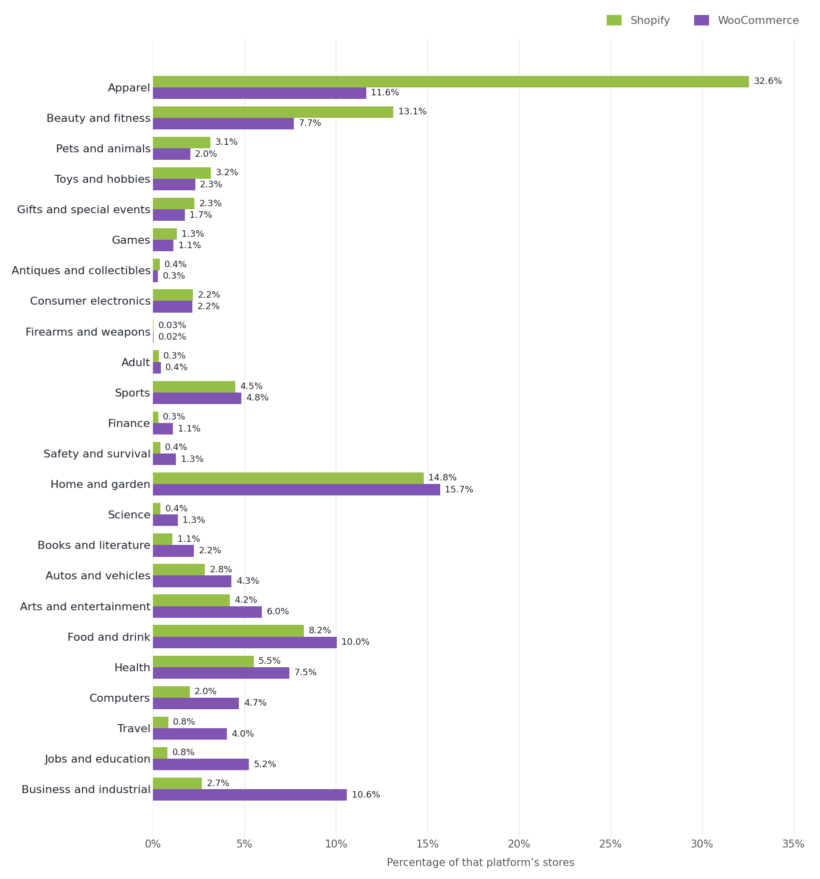
33% of Shopify stores sell clothing. On WooCommerce, it's just 12%.
Shopify leads in eight categories. Added together, it has 787,559 more stores than WooCommerce across those eight. Clothing accounts for 73% of these stores, and beauty and fitness for most of the rest. Apparel is more than twice the size of home and garden, which is Shopify's next biggest category at 15%. Shopify also leads on beauty and fitness, pet supplies, toys and gifts.
This all means that Shopify isn't the market leader across the board. Instead, it leads in some very specific categories, in which it absolutely dominates.
Take a moment to consider what all these products have in common: They're all small physical goods that arrive in a box.
Why Shopify dominates products that ship
A clothing store doesn't need lesson pages, instructor profiles or a booking form. It needs a catalogue, a cart and shipping labels. Shopify gives you all three straight out of the box, along with shipping rates, inventory and Shop Pay.
WordPress makes sense when the shop is one part of a bigger site. When the primary business is selling a catalogue of products and shipping them, WordPress adds nothing that Shopify doesn't already provide. And Shopify makes it easier to get up and running, with far less friction or confusion. You don't need to learn about the difference between WordPress and WooCommerce. You don't need to arrange your own hosting. It's not surprising that Shopify is so appealing for straightforward ecommerce stores.
But what about the categories where WooCommerce wins?
WooCommerce is the leader in 2/3 of categories
WooCommerce has a much more diverse user base and no flagship category at all. Its biggest is home and garden at 16%, then clothing at 12%, then business and industrial at 11%.
341,034 WooCommerce stores sell clothing, which is more than the whole of jobs and education. So clothing is big in WooCommerce too - but Shopify has 2.7 times more clothing stores.
Despite this, WooCommerce is the market leader in 2/3 of the categories I looked at. All of the categories that Shopify wins are consumer retail. WooCommerce leads in the other 16, giving it a much broader appeal.
Everything WooCommerce leads on is something you can't ship
Now let's break down the main categories where WooCommerce leads into sub-categories of the ones shown above. This shows us that it wins right across the service economy.
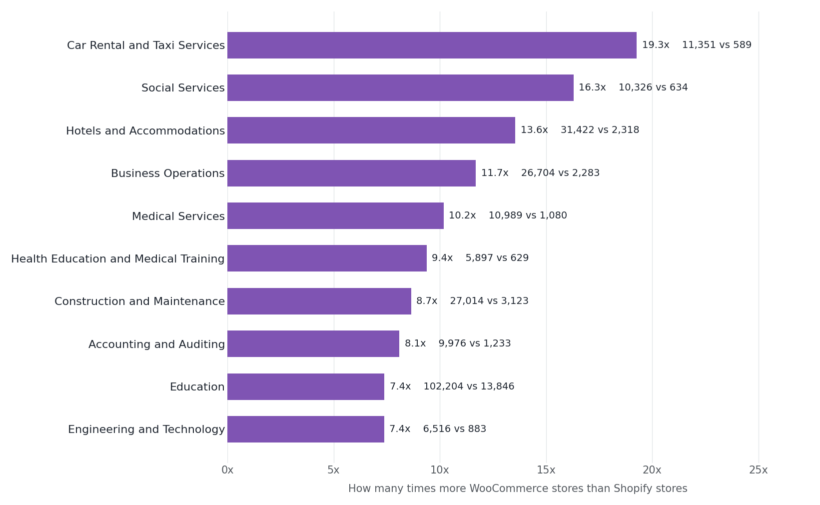
To break this down even further, four of those categories cover several kinds of business:
- Social services - Mostly therapists and counsellors.
- Business operations - Consultancies, recruiters and corporate training.
- Education - Driving schools, language schools and safety certification.
- Engineering and technology - Technical consultancies and CAD suppliers.
Those ten categories power 242,399 WooCommerce stores between them, compared to 26,618 on Shopify. WooCommerce is 19 times more popular than Shopify for car rental and taxi firms, at 11,351 stores vs. 589. Heavy machinery, which is mostly mining and construction equipment, uses WooCommerce seven times more often than Shopify.
Most of these aren't standard ecommerce businesses. For example, people don't tend to add a digger to their cart and pay online. Instead, they request a quote and then take it offline.
Related to this, the average WooCommerce store lists fewer products than Shopify. 38% list five products or fewer, vs. 19% on Shopify. The median WooCommerce store has 16 products, compared to 31 for Shopify. For a large share of them, the shop is a checkout added to a site that was already doing something else.
Why WooCommerce suits service and non-standard businesses
WooCommerce is a WordPress plugin, so people add a shop to a site that already has pages and a blog. For example, a driving school needs lesson pages, instructor profiles, a blog and a booking form that takes payment. A clinic needs treatment descriptions, practitioner bios and an appointment system. Both of those are content sites first and shops second.
WordPress does the content side much better than Shopify, and adding WooCommerce and a bookings or membership plugin turns it into a business that can take money. Of course, Shopify has booking and membership apps too. However, it doesn't have a sophisticated content management system underneath them, so the site remains a shop with some pages attached.
As a result, products that need features like selling services and running courses are normal on WooCommerce and less common on Shopify.
Shopify makes some products hard to sell
Depending on which parts of the platform you use, Shopify has rules for what you can and can't sell:
- The Shop channel - Shopify's shopping app won't list cannabis, drugs, medication, weapons, adult content or age-restricted goods like alcohol and tobacco. Your own store can still sell them.
- Shopify Payments - The payment processors behind it refuse CBD, gambling, pharmacy and adult products. Merchants who lose it have to find their own gateway.
- Managed Markets - The cross-border service won't ship CBD, alcohol, drugs, weapons or rental products. It covers international orders only.
While Shopify does let you sell these items, merchants lose a lot of the benefits such as Shopify's payment processing, its marketplace or its cross-border shipping. This removes much of the reason to use Shopify, pushing companies to self-hosted platforms, of which WooCommerce is the clear leader. Naturally, this causes WooCommerce to lead in those categories too.
The consequences go even further than this. Whenever Shopify restrict a new category, there's lots of controversy because merchants in that industry are forced to migrate to another platform like WooCommerce (or at least find a new payment gateway on Shopify, which they often seem reluctant to do). The fact that Shopify can change the rules like this puts off merchants in categories that might feasibly face restrictions in future. For them, WooCommerce is the most future-proof option.
What the restricted categories look like in the data
These are the differences in the categories that Shopify restricts:
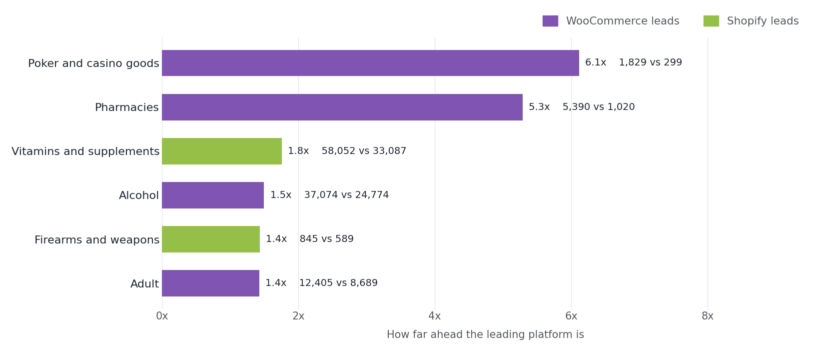
Shopify's rules don't explain the full difference, because it still leads on vitamins and supplements and on firearms and weapons.
I think that shipping explains the rest. The two categories where WooCommerce is furthest ahead are gambling and pharmacy, which don't ship products to customers. The categories where the gap is closest are alcohol, adult products, vitamins and firearms, which do require shipping.
This fits with our earlier finding that Shopify is stronger in categories that involve shipping physical products, and this sometimes outweighs factors that often put people off using Shopify.
What the WooCommerce world should do with this data
As we have seen, Shopify is the clear market leader in clothing. It also leads among the biggest stores by traffic, which I covered in my market share post. WooCommerce's strongest categories are services, bookings, courses, professional firms and industrial supply. This creates an opportunity to grow WooCommerce in the areas where it has the most potential.
For the Woo team
- Lead the positioning with the categories where WooCommerce is already the bigger platform, instead of the generic "start selling online" framing that invites a Shopify comparison.
- Commission high profile case studies from the sectors in the data such as driving schools, clinics, training providers, equipment dealers and hotels.
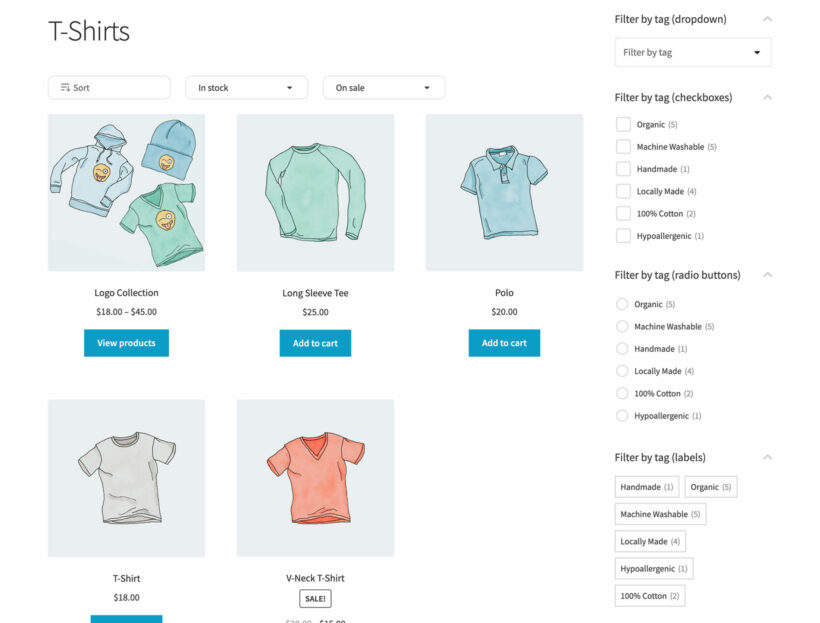
- Fix the sample data. WooCommerce ships 25 demo products, 15 of which are clothing. This leads to plugins using those products on their demos, wrongly implying that clothing is the main use case.
For plugin and product makers
- Change your demo content. Show a course catalog, a hire fleet or a parts list with quote buttons.
- Follow your own install base. Look at what your customers run before you design the next feature.
- Build for quoting, booking, hire periods, bulk pricing and trade accounts. Those are the categories where WooCommerce has the most stores.
For agencies and freelancers
- Pitch the sectors WooCommerce already wins: Professional services, education, travel, construction supply and healthcare.
- Sell the content site and the checkout together. These clients need both.
For developers
- Stop benchmarking against Shopify's product-catalog workflows. A WooCommerce site with 16 products and a booking calendar has different bottlenecks from a store with 5,000 SKUs.
- Treat variable pricing, availability and quote flows as core work rather than edge cases.
What's behind the data
The figures come from Store Leads category data covering 5.7 million live stores, made up of 2,810,251 Shopify stores and 2,929,071 WooCommerce stores where at least one category is recorded.
The two platforms are nearly the same size in this data, so the category counts compare directly. WooCommerce's lead in 16 of them is a lead in absolute store numbers, not a bigger share of a smaller platform.
Shares are a percentage of that platform's stores in this data. A store can sell products in more than one category, so the total may not add up to 100%.
There are two limits on the data:
- I pulled 24 top-level categories, so a handful of smaller ones aren't counted.
- Product counts cover 93% of the Shopify stores and 74% of the WooCommerce ones, so treat those two figures as a comparison of the stores where a count exists.
Which platform fits what you sell
So what's my advice for merchants in light of this data? Here's how I'd choose an ecommerce platform, based on what you sell:
- You ship a physical product - Either platform works. If it's clothing, beauty or pet supplies, then Shopify has the most stores in those categories but they're both valid options.
- You sell time, bookings, courses or quoted jobs - Choose WooCommerce. It powers more stores in these categories than Shopify does, and is far superior for the additional content you'll need in addition to the checkout.
- You sell something that a hosted platform might ban in future - Self-host your store, e.g. with WooCommerce.
Shopify has more stores wherever the product ships in a box. WooCommerce runs the driving schools, the clinics, the hire fleets and the training providers. Its own demo products are still mostly clothing.
If you're weighing up the two platforms, I've also written about the real reasons to use WooCommerce over Shopify.