Do you really need Shopify Plus for B2B?


Native Shopify B2B is now on every paid plan, but it's complex and hits hard limits fast. This guide compares Shopify B2B alternatives, from lightweight apps to full platforms like WooCommerce.
For years, the Shopify wholesale debate was simple. You either paid for Shopify Plus or you pieced together a stack of apps. Then on April 2, 2026, Shopify rolled out native B2B features to all paid plans.
That sounds like the problem solved itself. In practice, it didn't. The native tools are powerful, but they're also fiddly to set up. The new 3-catalog cap and the long-standing 25-discount limit create a clear ceiling. Most merchants searching for Shopify B2B alternatives now do so for a different reason.
This guide walks through four paths. The first is sticking with native Shopify B2B. The second is adding a lightweight app like Barn2 Bundles & Bulk Discounts. After that come the bigger moves: upgrade to Plus, or migrate to a B2B-first platform. I'll cover when each one makes sense.
Why merchants seek alternatives to native Shopify B2B
The April 2026 update unlocked the basics for everyone. Company profiles, three custom catalogs, volume pricing, and net payment terms all come included. That removed the cost barrier. It did not remove the complexity.
I find that most merchants run into one of these issues quickly:
- Native B2B requires a chain of objects: customer, then company, then location, then catalog. Setting up a single wholesale buyer takes real time.
- The 3-catalog cap applies across all your B2B markets combined, not per market. Three wholesale tiers fills the limit instantly.
- Catalog assignment on non-Plus plans goes through Shopify Markets, not directly to a company. That breaks down for customer-specific pricing.
- Shopify's 25-discount limit still applies, which caps how many promotions you can run.
- There's no self-service registration flow, so every wholesale application lands in your admin as manual work.
The only native way past these limits is Shopify Plus at around $2,300 per month. That's the trap. And it's not even a great solution because you're still stuck with the overly complex company/market/catalog structure.
For a full walkthrough of how native B2B actually works, read our guide to Shopify's native B2B features. It covers the setup process and where the gaps appear in practice.
How to handle B2B without the native headache
Many merchants discover their "B2B" need is just bulk pricing. They don't need company hierarchies, payment terms, or sales rep portals. They just want different prices for buyers who order in volume.
If that's you, you don't need to wrestle with native B2B or pay for Plus. A lightweight Shopify wholesale app handles it cleanly.
Option 1: Shopify B2B bulk pricing app
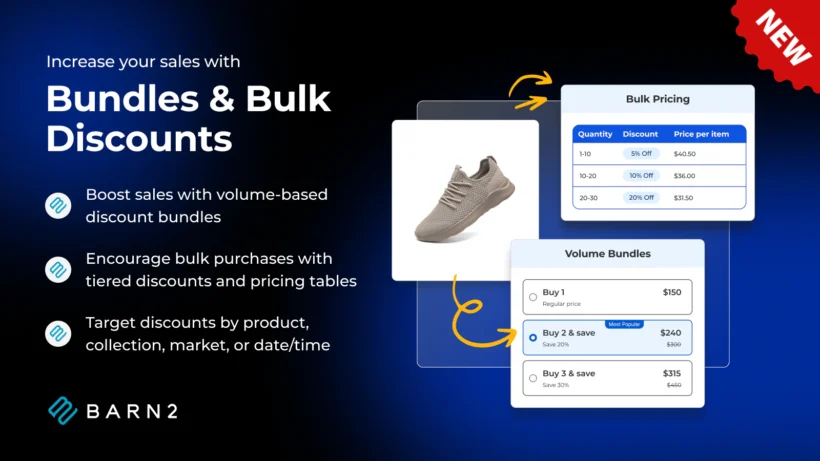
Barn2 Bundles & Bulk Discounts adds unlimited tiered pricing and volume bundles to any Shopify plan. No Plus upgrade required.
Here's what it handles:
- Unlimited pricing tiers by quantity, with no cap on rules.
- Volume bundles for grouping products at a discount.
- A drag-and-drop priority system so discounts don't stack wrongly.
- Market targeting to apply different pricing to different regions.
- Campaign scheduling for time-limited wholesale promotions.
- Revenue tracking per discount rule, so you can see what works.
- Bypasses Shopify's 25-discount limit, which matters as your wholesale catalog grows.
To be clear about its scope: this is a discount app, not a full B2B platform. It doesn't handle customer portals, net payment terms, or company account management.
That said, it suits two situations really well. The first is brands offering volume discounts to everyone, or to a tagged customer group. No separate B2B catalog needed. The second is merchants who need bulk pricing today, while evaluating a bigger platform move.
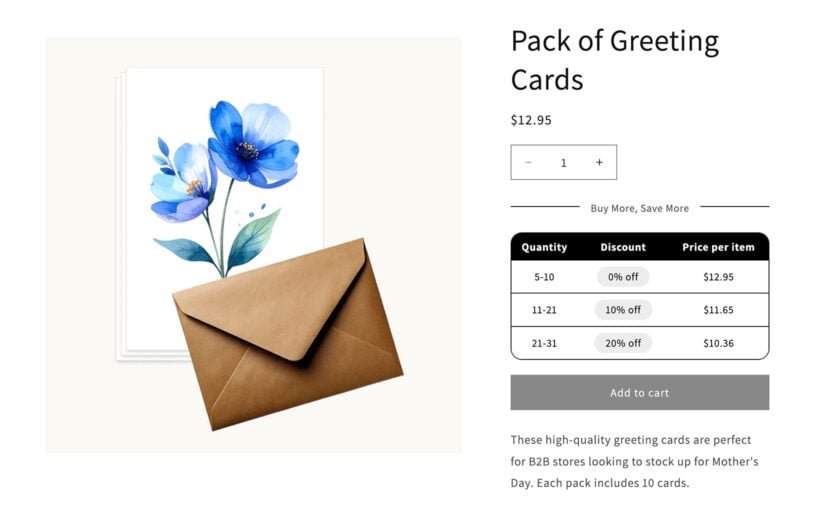
For example, a DTC brand with some wholesale buyers can set up tiered pricing in under an hour. Six to eleven items at 10% off, twelve or more at 15% off. No code, with a live preview as you build it.
For detailed setup, read our Shopify wholesale guide.
"Adding discounts is simple, and the live preview is a great touch. Perfect for non-technical users as well. Highly recommended!" - Perfect Black Tees
Pricing: free for the first 50 orders per month, then paid plans from $24.99/month.
Option 2: Shopify B2B overlay
SparkLayer takes a different approach. It adds a full B2B layer on top of any Shopify plan. That covers wholesale pricing, payment terms, ordering rules, and customer account management.
This is the right fit when you need more than bulk pricing. Customer-specific price lists, net-30 terms, and self-service buyer portals are all part of it. It also gets you past the 3-catalog cap without paying for Plus.
A distributor managing 30 wholesale accounts with different pricing agreements and net payment terms would be a natural fit. SparkLayer handles that without a Plus upgrade.
Plans start from $49 per month.
Top 5 Shopify B2B alternatives
If you've decided to leave Shopify entirely, here are five platforms worth evaluating. Each one suits a different type of business.
1. WooCommerce
WooCommerce is a free, open-source WordPress plugin. It offers full customization through a huge plugin ecosystem. You also own all your data, hosting, and costs.
For B2B specifically, WooCommerce plus a few dedicated plugins delivers Plus-level features at a fraction of the price:
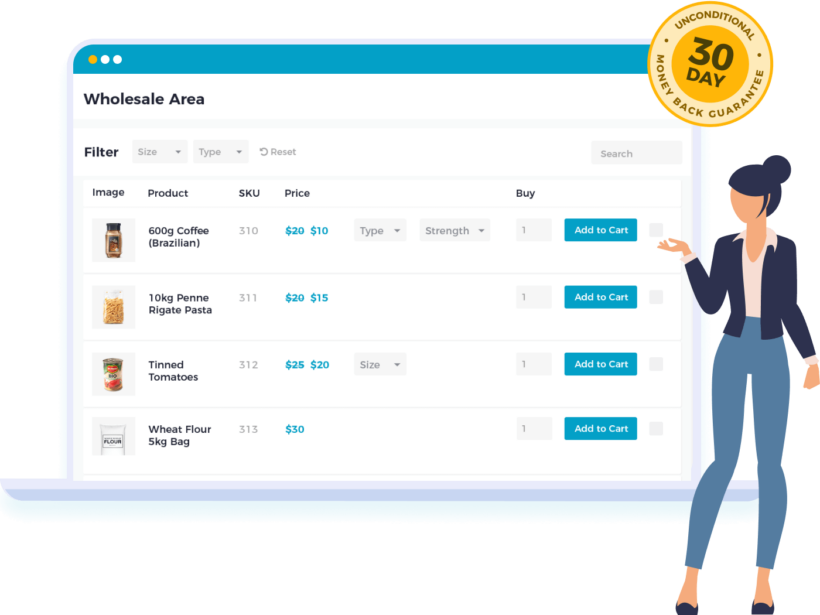
- WooCommerce Wholesale Pro for role-based pricing, customer-specific discounts, wholesale registration with approval workflows, bulk ordering, and private B2B areas.
- WooCommerce Product Table for fast bulk ordering with one-page order forms.
- WooCommerce Discount Manager for tiered pricing and volume discounts.
WooCommerce is self-hosted, which means you control hosting, security updates, backups, and data. That needs moderate WordPress familiarity or some developer help for setup. I recommend Kinsta for hosting, which is what we use ourselves.
On cost, a WooCommerce setup runs roughly $3,500 to $10,000 per year. Shopify Plus starts at around $29,000 to $38,000 per year. For most small to mid-market wholesale operations, the numbers favor WooCommerce heavily.
There are also no platform transaction fees, ever. As order volume grows, that saves real money.
For setup guidance, read our guide to building a WooCommerce wholesale site. Also worth a look: our roundup of the best WooCommerce B2B plugins.
2. BigCommerce B2B edition
BigCommerce B2B Edition is the closest direct competitor to Shopify Plus in the SaaS space. It includes native B2B features such as customer groups, custom price lists, quote management, and purchase order workflows.
The standout advantage is no platform transaction fees on any orders. For brands processing significant B2B volume, that creates real savings compared with percentage-fee platforms. Strong built-in features also reduce app dependency, which keeps the stack cleaner.
BigCommerce suits hybrid businesses that want one platform handling both DTC and B2B. Pricing is available on request, with general guidance suggesting it starts around $1,000/month.
3. Adobe Commerce
Adobe Commerce is an enterprise-grade platform built for complex, large-scale operations. It supports bespoke pricing workflows, custom checkout experiences, and advanced catalog management.
This platform suits businesses with extensive product configurations, multiple customer tiers, and custom quote workflows with approval chains. A large distributor managing complex catalogs for different customer segments is a typical fit.
Adobe Commerce is generally aimed at businesses with annual ecommerce infrastructure budgets above $250,000. Pricing is available on request, with annual license fees starting around $22,000 and scaling with revenue.
4. OroCommerce
OroCommerce is purpose-built for B2B. Out of the box, it covers corporate accounts, custom pricing, RFQ management, and multi-organization setups. These are core features, not add-ons.
The built-in CRM removes a separate integration, and workflow automation handles approvals and quoting natively. You can configure flexible workflows, personalized catalogs, role-based permissions, and multi-website management.
OroCommerce does need dedicated developer resources for setup and ongoing maintenance. It's built on Symfony, so PHP experience is required. A typical fit is a wholesale distributor with five warehouses and a NetSuite ERP needing real-time inventory sync.
Pricing is quote-based, depending on your business requirements.
5. Oracle NetSuite Commerce
Oracle NetSuite Commerce is a unified cloud platform that integrates ecommerce directly with ERP. It removes data silos between sales, inventory, financials, and CRM without third-party middleware.
It supports both B2B and B2C from a single instance, with custom pricing, account hierarchies, and customer-specific catalogs. Real-time sync across order management, inventory, and financials is a core capability.
This platform makes most sense for mid-market to enterprise businesses already using NetSuite ERP. As a standalone ecommerce solution, it's not cost-effective.
Licensing covers a core platform fee, optional modules, and per-user costs, plus a one-time implementation fee. General guidance suggests ecommerce-related costs of $1,500 to $3,000 per month on top of the base ERP license.
What about industry-specific platforms?
The platforms above offer broad flexibility. However, if you operate in a specific vertical, two narrower options are worth checking.
NuORDER targets fashion and apparel wholesale, with showroom experiences and line sheets built for that industry. Sana Commerce specializes in ERP-integrated B2B for manufacturers already running SAP or Microsoft Dynamics.
| Platform | Best fit | Pricing range | Transaction fees | Native B2B features |
|---|---|---|---|---|
| WooCommerce | Small to mid-market businesses wanting control and lower costs | ~$3,500-$10,000/year | None | Requires plugins for role-based pricing, bulk ordering, and private B2B areas |
| BigCommerce B2B Edition | Hybrid B2B + DTC brands wanting SaaS simplicity | From ~$1,000/month | None | Customer groups, price lists, quotes, purchase orders |
| Adobe Commerce | Large enterprises with complex catalogs and workflows | From ~$22,000/year | Varies | Advanced pricing workflows, custom checkout, multi-tier catalogs |
| OroCommerce | B2B-focused companies with complex operations | Quote-based | Varies | CRM, RFQ system, role-based pricing, workflow automation |
| Oracle NetSuite Commerce | Mid-market to enterprise needing ERP integration | ~$1,500-$3,000/month + ERP | Varies | ERP sync, account hierarchies, real-time inventory and financials |
Choosing the right path for your business
Before committing to any platform, work through these questions:
- What's your annual B2B revenue, and how many wholesale accounts do you manage?
- Do you need payment terms, credit management, and customer portals, or just bulk pricing?
- What existing ERP or PIM systems need to integrate with your ecommerce platform?
- What internal technical resources do you have, including developers or non-technical staff?
- What does the three-year cost of ownership look like, including license fees, implementation, transaction fees, and app subscriptions?
I find that most merchants asking about Shopify B2B alternatives fall into one of three groups. The first is DTC brands with occasional bulk buyers who need bulk pricing, not a full B2B platform. The second is dedicated wholesale businesses with dozens of accounts needing customer portals and payment terms. The third is enterprise operations requiring deep ERP integration and complex approval workflows. Each group has a different right answer.
The biggest mistake I see is merchants assuming they need to switch platforms. Often, all they actually need is a better discount setup. Get clear on what "B2B" really means for your business first.
Katie KeithFounder and CEO
Get your Shopify B2B store running today
The right platform is the one that fits your actual requirements. Test with real products and real customers before committing to any migration. Free trials exist for a reason.
If bulk pricing is your main need, you don't need to leave Shopify or upgrade to Plus. Bundles & Bulk Discounts handles volume discounts, quantity breaks, and tiered pricing fast. No platform migration required.
2 Comments
It's interesting to see how Shopify is evolving, but I'm still finding the native B2B features a little limited when it comes to things like custom quoting and tiered pricing for larger accounts.
That’s a great point! While Shopify’s native B2B features have definitely come a long way, many merchants still find that "out-of-the-box" setup hits a wall when dealing with complex enterprise needs.
Custom quoting and flexible tiered pricing are exactly why many B2B stores still look toward dedicated apps to bridge those gaps. We’ve found that the ability to negotiate unique pricing for larger accounts is often the "make or break" factor for wholesale success.
Are there any specific quoting features you’ve found missing in the native setup? We’d love to hear more about your experience! - Nikki