How to come up with new product ideas for your ecommerce store 💡

Coming up with new product ideas that actually sell is part listening, part research and part testing. I'll walk through a six-step process I use to go from a vague hunch to a validated product, with less guesswork along the way.
Nearly 30,000 new consumer products are introduced each year and most flop. The pattern is usually skipping the research and validation work before the launch, not bad ideas.
In this guide, I'll cover the full ideation process: how to mine customer feedback for unmet needs, where to find inspiration outside your own data, how to brainstorm variations of products you already sell, how to validate demand before spending money on production and how to launch in a way that gives you room to learn and adjust. I'll point out which WooCommerce features and plugins make each step easier as I go.
Let's start with the people most likely to tell you what to sell next.
Step 1: Understand your customers and market
Great product ideas don't come out of nowhere. They're built by listening to the people already engaging with your brand. If you're looking for your next bestseller, your current audience is probably handing it to you.
Customer feedback is where unmet needs, frustrations and wishlist features come up first, hidden in support tickets, mentioned in passing on social media or buried in a review. Three places to mine for product opportunities:
Read customer reviews and comments
Peer-reviewed research puts the failure rate for new fast-moving consumer goods at close to 49%. The way to push your odds the other way is to understand the buyer's actual needs before you commit to building anything.
Reviews and comments are unfiltered feedback from people who already pay you. Two specific patterns to look for:
- Pain points. If you sell blenders and the same complaint keeps appearing ("the blender works, but cleaning it is a hassle"), you've found a product brief. Sell a blender that's easier to disassemble.
- Gaps your competitors haven't filled. Customers will often spell out what a product is missing. "I wish it worked offline" or "I wish it came in a smaller size" is a free piece of market research.
The best new products solve a problem the buyer already named.
Analyze customer support tickets
What customers won't put in a public review, they'll often put in a support ticket. Tickets are where the friction shows up: material quality, ease of use, sizing accuracy or fit with other tools.
Look for the same complaint appearing repeatedly. If three customers in a month say a product is too heavy, that's a complaint. If thirty say it, that's a product idea.
Ask directly
Reviews and tickets are passive. To get specific answers, ask.
Surveys work well if you mix the question types. Don't only ask about problems. Also ask:
- Wishlist questions. "If you could design the perfect [product], what features would it have?" tells you what people want but aren't getting.
- Buying-decision questions. "What makes you try a new product?" tells you what would actually get the new idea bought.
Use SurveyMonkey or Typeform to collect responses. Keep at least a couple of questions open-ended so you get the wording customers use themselves.
For a faster read on a single decision, run a social media poll. Instagram and X both have native polls, so if you're stuck between two product directions, ask your audience to pick.
Check your existing data
Look at your bestsellers and ask why they're doing well. Is it the price, the material, the problem they solve or the audience they attract? Once you know what makes a product work, you can extend the line with new sizes, new colors, premium versions or accessories that pair with it.
A top-selling water bottle, for example, can become a product line: matching cleaning brushes, replacement lids, insulated sleeves and a larger version for athletes.
If you're not already tracking customer behavior beyond order data, WooCommerce analytics tells you which products people view, abandon and return to. That's a clue layer above what's selling, telling you what people are interested in but aren't quite ready to buy.
Step 2: Find inspiration outside your store
Your own data and customer feedback will only get you so far. To spot ideas your audience hasn't asked for yet, you have to look outside.
Social media platforms
Instagram, TikTok and Pinterest are where new products go viral before they hit mainstream search. A few minutes scrolling the trending tags in your category will surface products that didn't exist six months ago.
Pinterest is particularly strong for home decor, gifting, hobby and craft categories, and millennial women still make up around 70% of Pinterest's user base. If that's your audience, the Pinterest trends report is a good monthly read.
Online marketplaces
Amazon, Etsy and AliExpress will expose you to thousands of products you don't currently sell. Sort by bestseller or trending within your niche and look at what's moving. Browsing established marketplaces is also a good way to spark broader what to sell online ideas if you're still deciding which direction to take the store.
This is also a sanity check. If a product idea you're considering has thirty established sellers on Amazon with a thousand reviews each, the category is proven. If it has none, the category may not exist for a reason. Both are useful signals.
Wholesale-only directories like Wholesale Central and Tradekey show you what suppliers are pushing into retail right now. That's an early indicator of what'll be on store shelves in six months.
Competitor websites
Your product idea doesn't have to be new. It has to be a better version of what someone else is already doing.
Checking competitor releases is some of the cheapest research you can do. New product launches, "new in" pages and recently-added categories all tell you where they're betting next. If multiple competitors land on the same niche within a few months of each other, the niche is real.
Customer communities and forums
Find the forum, subreddit or Discord where your audience hangs out and read. Hobby gear, gaming accessories, baby products and fitness equipment all have active communities where customers talk freely about what they buy and what's missing.
Reddit alone has more than 350 million weekly users across 100,000 active subreddits. The format is unfiltered: people don't soften criticism the way they would on a brand's own social channel.
Trend-tracking tools
Google Trends and Trend Hunter both surface emerging product categories. Google Trends is the obvious one, showing you whether interest in a topic is growing, flat or already past its peak. Trend Hunter aggregates emerging consumer products across categories and is useful when you want to see what designers and brands are launching, not just what customers are searching for.
The mistake is treating trend data as a buy signal on its own. A trend tells you something's growing, but it doesn't tell you whether your store is the right place to sell it. Pair trend research with the customer insight from Step 1.
Step 3: Brainstorm and create ideas
Most store owners jump straight to brainstorming. After Steps 1 and 2, you have actual customer language, competitor moves and trend data to work from. The brainstorming step turns all of that into concrete product concepts.
Mind mapping
Start with a central concept and branch out into related ideas. The branches are where the work happens.
If your category is skincare and you've noticed customers shifting toward sustainability, the central node is "sustainable skincare". The branches are the concrete products: zero-waste solid moisturizer bars, biodegradable face wipes, refillable serum bottles and recycled-glass packaging. The mind map turns a vague trend into a list of testable product ideas.
Think about variations of what you already sell
Around 70% of new products are variations or improvements of existing ones. The Dyson vacuum is the textbook example: not a new category, just a better version of one that already existed.
This is where WooCommerce stores have a structural advantage. Product variations let you list a base product with size, color, material or style options without creating a separate listing for each one. New variations are often the lowest-risk way to test a product idea because you're using inventory and a listing you already have. If you display them as conditional variations then you don't even need to worry about cluttering up the product page.
For a more structured way to brainstorm variations, the SCAMPER model is a useful checklist:
- Substitute. What materials, components or processes could you swap for something cheaper, more sustainable or higher-quality?
- Combine. What if you combined two products into one? Bluetooth earbuds were earbuds plus Bluetooth. The combination outsold either parent product.
- Adapt. How can you tweak the product for a different use case or audience?
- Modify. Which feature could you amplify to add more value? Make it bigger, smaller, longer-lasting or lighter.
- Put to another use. Bubble wrap started as wallpaper. The reframing of an existing product for a different use is often where the new market is.
- Eliminate. Strip features out and see if the simpler version is the better product. Most software starts this way.
- Reverse. Change the order of steps or invert the assumption the product is built on.
Bundle and upsell what's already working
If you have products that sell well individually, the next product idea might be a combination of them. Bundling complementary products creates a new SKU without manufacturing anything new, because you're packaging existing inventory.
A laptop store doesn't need to invent a new accessory to grow average order value. Pair the laptop with a power bank, noise-canceling headphones and a notebook and the bundle becomes its own product. The same logic powers product add-ons at the cart and post-purchase upsells.
The trick is to design the bundle around a customer use case ("everything you need for working from a cafe") rather than around your inventory ("things we have in the warehouse"). A use-case bundle is a product idea. An inventory dump is just a discount.
Customization and personalization
McKinsey research finds that 71% of consumers expect personalized interactions from brands. The simplest way to give them that is to let them configure the product themselves with engraving, monogramming, name printing, color choices, custom messages or even letting them build the product from scratch.
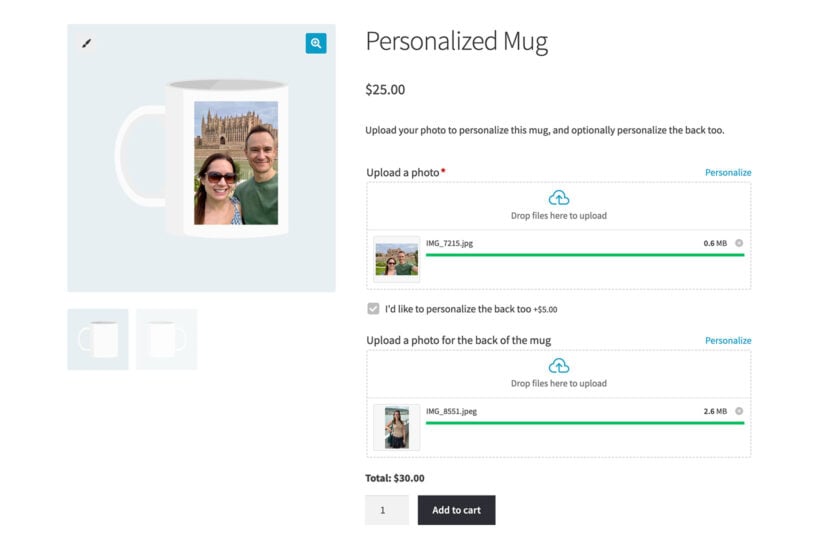
A few concrete ways personalization can become a new product line:
- Engraving and printing. Letting the customer add a name, date or message to jewelry, glassware, watches or leather goods turns a generic item into a gift. Each variant carries a price uplift the customer is happy to pay. Adding custom text fields to WooCommerce products is one of the fastest ways to add a new product line without holding new stock.
- Configurable products. Let the customer build the item: a subscription box where they pick the contents, a desk where they choose the wood, legs and dimensions, or a phone case with their own photo. A product configurator turns one product page into hundreds of unique variants.
- Live preview. The harder the customization, the more important it is for the customer to see what they're buying before they hit Add to Cart. Live preview tools show the customer's input on the product image in real time, whether that's engraved text on a bracelet, a name on a mug or a monogram on a wallet. It's the single biggest lift to conversion on customizable products in my experience.
Personalization is also a category I've written about extensively because it's a strong fit for WooCommerce stores looking to add a new product idea without adding new inventory. Stores selling custom phone cases, personalized mugs, engraved jewelry or made-to-order prints all use the same underlying mechanic: a base product, a few customer-supplied inputs and a price uplift per option.
Step 4: Validate your ideas before you build
The next step is to validate the idea before you spend money producing it. Validation is where most enthusiastic launches go wrong, because the founder is excited, skips this step, builds inventory and then can't sell it.
A few practical ways to test demand without committing to a full production run:
Ask potential customers again
A social media poll on a specific product idea is faster than another round of surveys. "Would you buy [product] with [feature] for around $X?" with a yes/no option will tell you within a day whether the idea has legs.
Email surveys to existing customers are slower but more reliable. Existing buyers have already proved they'll pay you for something, so their answer is closer to a buying decision than a stranger's.
Run a pre-order campaign
A pre-order campaign is one of the most honest forms of validation. Instead of asking if someone would buy, you're asking them to pay (or commit to pay) before the product exists. The conversion rate on a pre-order page is the cleanest demand signal you can get.
I've written a separate guide on setting up pre-orders in WooCommerce with the specific plugins and configurations to use. A landing page with a Pre-Order button (or a Join the Waitlist button for digital products) is enough to start.
Start a crowdfunding campaign
If you want validation and funding in one step, run a campaign on Kickstarter or Indiegogo. The average crowdfunding campaign success rate is around 22%, which is high enough to be worth attempting if your category fits. Physical products, design-led items and hobbyist niches do best.
The bar is higher than a pre-order: a crowdfunding campaign needs a video, a clear pitch and a community willing to share it. The payoff is that a funded campaign gives you both the cash to build and a list of early customers who already believe in the product.
Small-batch testing
If pre-orders and crowdfunding aren't a fit, produce a limited quantity and see how fast it sells. The number you produce can be guided by the pre-order or waitlist signups from the previous step, so you're not guessing.
For digital products like courses, templates or subscription boxes, limit the number of slots in the first cohort and watch how quickly they fill.
The point of validation is to give the market a chance to disagree with you before you spend the money, not to confirm what you already believe. If the validation step says no, that's the cheapest "no" you'll ever get.
Step 5: Make sure it's practical
A validated idea still needs to be a product you can realistically build and sell. Before you commit, work through the production math.
Production costs and feasibility
Build a simple spreadsheet with every cost on one side and the planned retail price on the other. The cost side should include raw materials, manufacturing, packaging, storage and shipping. The retail side should include payment processing fees, marketplace cut (if you sell on Amazon or Etsy) and your own marketing cost per sale.
The gross profit is what's left. If the margin is thin, work through the supplier list. Quotes vary widely between manufacturers, and a 10% cost reduction on the supply side often makes the difference between a viable product and one you'll regret six months in.
Shipping and storage
Bulky products with high shipping costs are the most common reason a "great idea" becomes a "bad business". Get a real shipping quote by weight, dimensions and destination before you commit. Transport costs vary widely by region, and shipping to developing markets can cost twice as much per dollar of trade as shipping within developed ones.
Storage is the same calculation. A product that needs climate control, fragile-handling or a large warehouse footprint eats your margin in fixed costs the customer never sees.
The point of this step is to make sure the unit economics work at the volume you actually expect to sell, not to kill the idea over a single cost line.
Step 6: Launch and learn
Launching the product is the start of the work, not the end of it. The first six weeks after launch is where you'll learn what you got right and what you'll need to adjust.
Seed the product before launch
Start dropping hints about the product months before the launch date. Behind-the-scenes posts, design progress and "we're working on something" teases all build anticipation without explicit promotion.
Consumer goods take around 13 months on average to bring to market. You have plenty of time to seed an audience that's ready to buy on day one. By the time you launch, the audience should already know what's coming and roughly when.
Start small
Launch with limited stock based on the demand signal from your validation step. Limited stock does two things at once: it caps your downside if the launch underperforms and it creates legitimate scarcity if it overperforms. Either way you learn faster.
An introductory price for the first batch (the same way Steam and console publishers run pre-order pricing) gives early buyers a reason to commit and gives you a clean cohort to measure against later, full-price buyers.
Gather feedback and adjust
Treat the first 30 days post-launch as a feedback collection exercise, not a sales exercise. Respond to every comment, email and support ticket. Patterns surface quickly: which features get praised, which get questioned, which get ignored entirely.
If one feature draws repeated praise, lead with it in your product page copy and ads. If one feature draws repeated complaints, fix or remove it before the next batch. The cheap time to adjust the product is now, not after you've ordered 5,000 units of v1.
Promote strategically
You don't need a big paid-ads budget to land a launch. Most of the lift comes from channels you already own:
- Email list. Email your existing list multiple times during launch week, not once. The first email gets opened by 25% of your audience; the rest of the launch awareness comes from emails two, three and four.
- Social posts. Two posts a day during launch week, then taper. Repeat content beats one-and-done.
- Content marketing. Write a blog post about a problem your product solves, not the product itself. People searching for the problem land on the post and discover the product.
- Niche influencers. A creator who has 5,000 engaged followers in your exact niche will usually convert better than a generalist with 500,000 followers across all categories.
The launch is also a good moment to add complementary offers to the buying journey. Frequently bought together recommendations on the product page and post-purchase upsells at checkout both turn the launch into more than a single-product event.
Start creating your next product idea today
Coming up with a profitable product is a deliberate process, not a matter of stumbling on a market gap and rushing to production. The work is: listening to your customers, looking outside your store for inspiration, brainstorming variations of what already works, validating demand before you build, checking the unit economics and launching with enough room to learn and adjust.
The store owners I've seen do this well treat ideation as a habit, not a project. Every quarter, they look at what their customers are asking for, what competitors are launching and what the trend data is saying, then decide whether the next idea is a variation, a bundle, a personalized version or something genuinely new.
For more context on where to look next, I've put together a separate guide on running pre-order campaigns, and I'd also recommend looking at subscription box models as a way to turn a single product into a recurring revenue stream. Either is a good next step once you've got a validated idea ready to launch.