The 10 best plugins for Gravity Forms in 2026

Gravity Forms does far more than collect form submissions once you add the right plugins. I've compared 10 of the best Gravity Forms add-ons, with the real pros and cons of each, including free and premium options.
Part of what makes Gravity Forms such a powerful form builder is its extensive library of add-ons, both free and paid.
I'll cover the 10 best Gravity Forms plugins here, organised by what they help you do, from displaying entries and generating PDFs to taking payments and automating your workflow. For each, I'll explain the gap it fills, who it suits, and where it falls short.
Quick verdict: the best Gravity Forms plugins
In a hurry? Here are my top picks by use case.
- Best for displaying entries GravityView turns form submissions into front-end directories, tables and listings.
- Best for creating PDFs Gravity PDF generates invoices, certificates and contracts from entries, with a free core version.
- Best for approval workflows Gravity Flow adds multi-step approvals and is now built by the Gravity Forms team.
- Best for connecting to other apps the official Zapier add-on links your forms to thousands of apps without code.
- Best free add-on the Connector for Gravity Forms and Google Sheets sends entries straight to a spreadsheet at no cost.
Evaluating these Gravity Forms add-ons
I chose these plugins on a few practical factors. I looked at how actively each one is maintained, what real users report in reviews and support forums, the gap it fills in Gravity Forms, and whether the price matches the value.
Most come from the two biggest names in the ecosystem, GravityKit and Gravity Wiz, plus Gravity Forms’ own official add-ons, with a couple of strong independent options where they earn a place. This list of the best Gravity Forms plugins is grouped by the job each plugin does rather than ranked, because they solve different problems.
Comparing the best Gravity Forms plugins
Here is a side-by-side look at what each plugin does, whether it has a free version, and where the pricing starts.
| Plugin | Best for | Free version | Price from |
|---|---|---|---|
| GravityView | Displaying entries on the front end | No | $79/year |
| GravityImport | Importing entries from a CSV | No | From ~$69/year |
| Connector for Google Sheets | Sending entries to Google Sheets | Yes | Free; Pro from $59/year |
| Gravity PDF | Generating PDF documents | Yes | Free core; paid extensions |
| Fillable PDFs | Filling existing PDF templates | No | From $180/year |
| Gravity Flow | Approval and workflow automation | No | From $99/year |
| GP Populate Anything | Dynamic field population | No | Gravity Perks from $59/year |
| Gravity Forms Zapier add-on | Connecting forms to other apps | No | With GF Pro ($159/year) + Zapier plan |
| Gravity Forms payment add-ons | Taking payments | No | With GF Pro ($159/year) |
| Gravity Forms User Registration | Registering WordPress users | No | With GF Elite ($259/year) |
What are Gravity Forms add-ons?
These “add-ons” are WordPress plugins that add new features to Gravity Forms. Some add-ons allow Gravity Forms to integrate with third-party applications, while others help improve the form building experience.
Some are free community plugins; others are premium tools from dedicated companies. The ones you need come down to what you want your forms to do, whether that is displaying submissions publicly, taking payments, or automating what happens after someone hits submit.
The best Gravity Forms plugins for displaying and managing data
1. GravityView

GravityView is a popular add-on for Gravity Forms. Normally, Gravity Forms submissions are just for the administrator's use and aren't displayed on the front end anywhere. GravityView takes the data submitted by your website visitors and lets you display it in new ways.
This plugin allows you to display, edit, export, search and filter Gravity Forms entries from the front end of your website. GravityView also allows users to edit entries that they create directly from the front end.
Using GravityView, you can build directories, job boards, databases, and other applications on top of Gravity Forms. Featuring a drag and drop builder, with a range of customization options, GravityView allows you to launch a new app in minutes (all without writing a single line of code!).
You can add power to GravityView through one of the many available extensions, such as “Advanced Filtering” which allows you to filter the entries in a View using conditional logic.
Pros
- Drag-and-drop builder turns entries into directories, job boards, tables and member databases, all without code.
- Secure front-end editing lets users update their own submissions, with search, filtering and CSV export built in.
- The most established tool for this job, certified by Gravity Forms and maintained for over 10 years.
Cons
- No free version, and it needs a paid Gravity Forms license underneath, so you pay for two products.
- Views can slow down on very large entry sets without database indexing and caching.
- Independent reviews are thin, so you are largely trusting the vendor’s own testimonials.
2. GravityImport

While Gravity Forms allows you to export entries from your site, there’s no way to import entries. GravityImport solves this problem by giving you the ability to import entries to Gravity Forms from a CSV file.
After uploading the file containing your entry data, all you need to do is map the columns in your CSV file to the correct fields in Gravity Forms.
GravityImport allows you to import your entries to an existing form, or create a new form during the import process! This makes it easy to migrate forms and entries from different form plugins.
GravityImport also integrates with the Gravity Forms User Registration add-on, allowing you to import users to your website!
Pros
- Imports entries from a CSV into an existing form, or creates a new form during the import.
- Pre-import validation scans your rows and flags bad emails, wrong date formats and non-numeric values before anything is saved.
- Certified by Gravity Forms and handles large migrations from WPForms, Ninja Forms or Formidable with no row limit.
Cons
- Premium only with no free version, so there is no risk-free way to test it beyond the 30-day refund.
- No public rating or install count to judge it by.
- Messy or inconsistent source data can still cause failed or mis-mapped imports.
3. Connector for Gravity Forms and Google Sheets
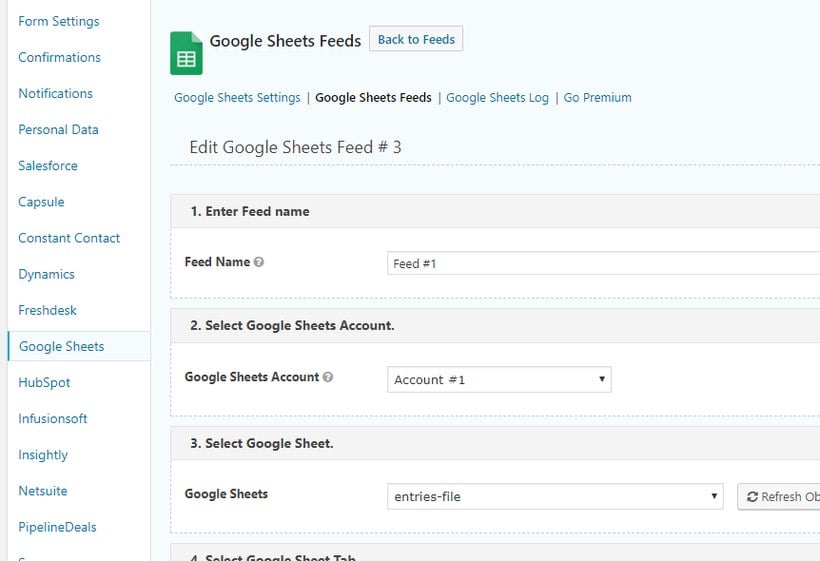
Connector for Gravity Forms and Google Sheets by CRM Perks is a free plugin that allows you to easily send Gravity Forms data to Google Sheets. After connecting your Google account, all you need to do is select a Google Sheet and map your form fields to the correct columns.
Google Sheets is a flexible spreadsheet and data management platform. By connecting your forms to Google Sheets, you can:
- Keep a backup of all your form data
- Send data to Google Sheets for further processing and analysis
- Make form data available without having to grant Admin access to your website
- And much more!
The “Connector for Gravity Forms and Google Sheets” is one of the best free Gravity Forms plugins, so be sure to check it out in the WordPress plugin directory.
Pros
- Free and genuinely useful: sends each form entry straight to a Google Sheet on submission.
- 4.7 stars from 64 reviews and over 3,000 active installs on WordPress.org.
- A built-in log lets you resend any failed or missed entry to the sheet with one click.
Cons
- The free version is one-way only, from form to sheet, with no two-way sync.
- Phone-number and file-upload fields are paywalled in the premium version.
- Reviewers mention an intrusive upgrade banner in the admin and occasional OAuth token errors.
4. Gravity PDF
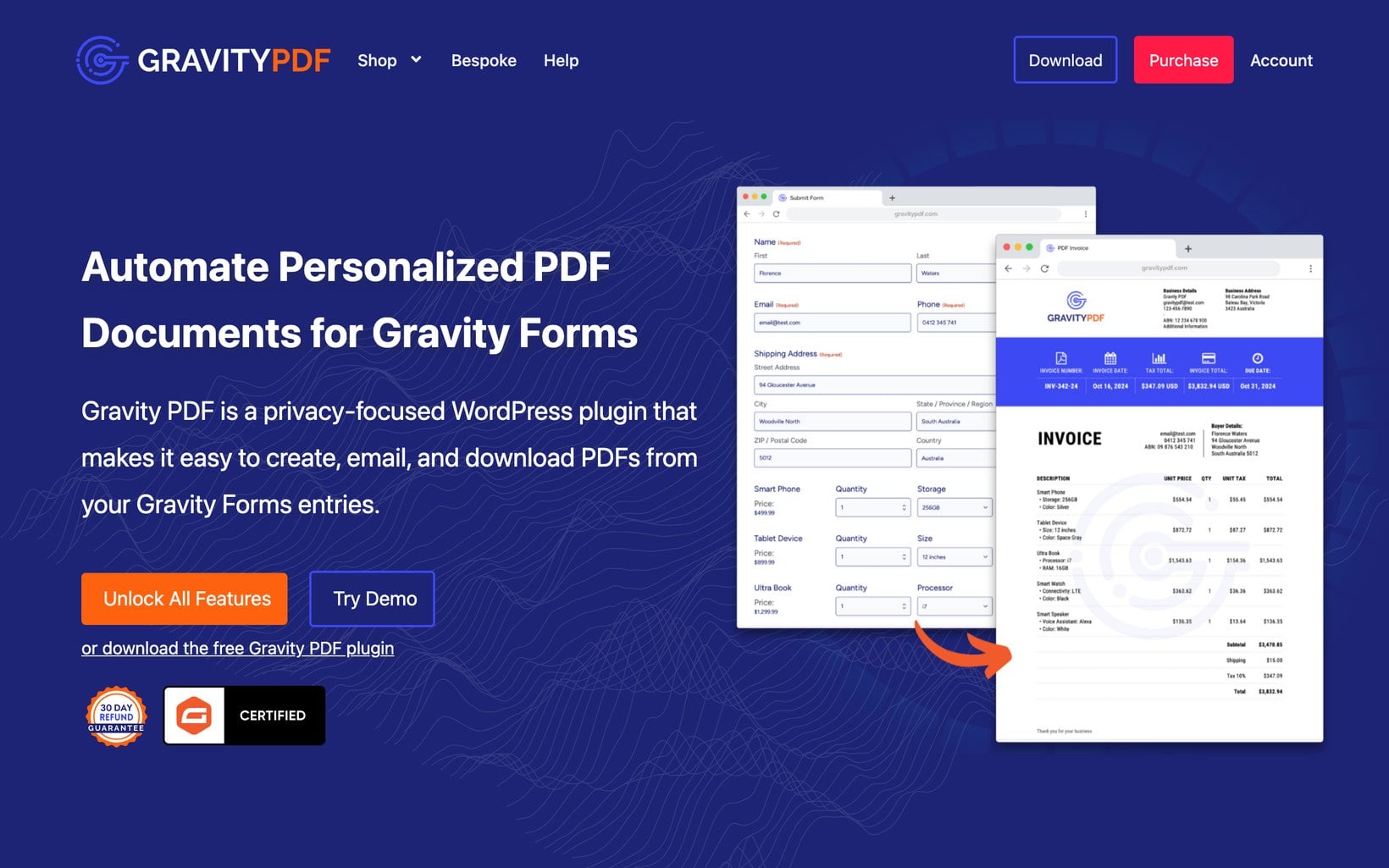
Gravity PDF is the most popular way to turn Gravity Forms entries into PDF documents. When someone submits a form, it can automatically build an invoice, certificate, receipt or contract and email it or offer it as a downloadable PDF.
The free core plugin has over 20,000 active installs and a 4.9-star rating on WordPress.org, so you can start without spending anything. It ships with four templates, and you can style your own with HTML if you need a specific layout. Everything is generated locally on your own server, with no third-party service, rate limits or per-document fees.
If you collect data that needs to end up as a formatted document, Gravity PDF is usually the first add-on I would install.
Pros
- Generates polished PDFs (invoices, certificates, contracts and receipts) automatically from each entry.
- Free core plugin with over 20,000 active installs and a 4.9-star rating, so you can start at no cost.
- Builds documents locally on your server, with no third-party service, rate limits or per-PDF fees.
Cons
- Designing custom templates beyond the built-in ones means working with HTML, or buying an extension.
- Advanced features like bulk generation, watermarks and a previewer are paid add-ons.
- It builds new PDFs from templates, so it cannot fill an existing fillable PDF the way Fillable PDFs can.
5. Fillable PDFs
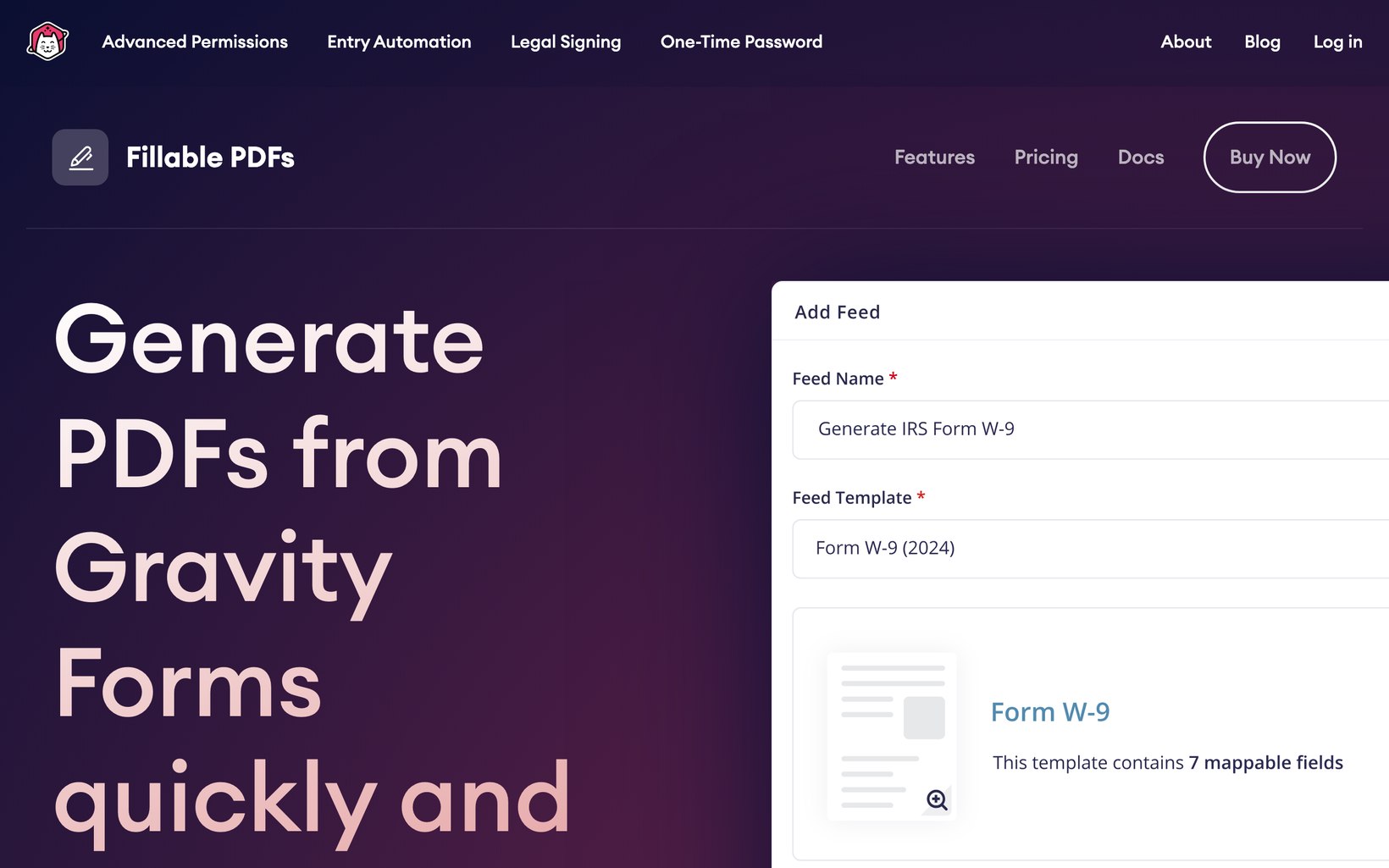
Fillable PDFs from CosmicGiant is a helpful plugin that allows you to generate PDFs from Gravity Forms. When a user fills out and submits a form, a PDF is created automatically.
With minimal configuration, you can extend the capabilities of Gravity Forms’ notifications to attach and send generated PDFs wherever you need them to go.
The plugin also allows you to display a download link on the form confirmation page. This makes it easy for users to get a PDF with the information they submitted. All generated PDFs are stored locally on your website, protecting your user’s privacy. You can also lock down generated PDFs, restricting access with password protection.
In addition to generating PDFs, CosmicGiant’s plugin helps you easily convert any PDF into a Gravity Forms form!
Pros
- Upload an existing fillable PDF, such as a government or HR form, and map your form fields to it visually with no code.
- Can also turn any PDF into a Gravity Form, which Gravity PDF cannot do.
- Stores generated PDFs locally and can lock them with password protection.
Cons
- Relies on CosmicGiant’s cloud service to generate documents, unlike fully server-side tools.
- No free version and no public reviews, so you are trusting the 30-day money-back guarantee.
- At $180 a year it is pricey for a single feature, and document signing is a separate paid add-on.
The best Gravity Forms plugins for automation, payments and users
6. Gravity Flow

Gravity Flow allows you to create custom workflows and business processes using Gravity Forms. Using Gravity Flow, you can automate manual workflows, leading to improved efficiency and better outcomes.
When building your workflow, you can choose from over 40 different action steps, such as approvals, rejections, reverts, and assignments. You can also use conditional logic to build custom interactions based on parameters that you set.
In 2022, RocketGenius (the company behind Gravity Forms) acquired Gravity Flow in a move to consolidate Gravity Forms’ position as the number 1 form builder for businesses and web professionals.
This acquisition means that Gravity Flow will see further integration into the Gravity Forms product suite!
Pros
- Builds multi-step approval chains and business processes with a visual, drag-and-drop builder.
- Offers over 40 action steps, including approvals, rejections, assignments and conditional routing.
- Now a first-party, certified add-on since Gravity Forms’ parent company acquired it in 2022.
Cons
- Paid only, and it cannot run without a Gravity Forms license underneath it.
- The four key extensions need the $299 Pro tier; the $99 Core license includes none of them.
- Performance on large sites was sluggish until the 3.0 rewrite in late 2025.
7. GP Populate Anything

From the wizards over at Gravity Wiz comes Populate Anything, a handy little “Perk” that makes a welcome addition to the toolbox of any Gravity Forms user.
“Populate Anything” allows you to populate form field choices and values with posts, users, taxonomies, terms, Gravity Forms entries, and databases. You can also filter choices based on data entered in other fields. This allows you to populate field choices dynamically as the user interacts with the form.
Populate Anything gives you a flexible way to create connections between your forms and other data sources.
Pros
- It pulls field choices and values from your existing posts, users, taxonomies and entries, so forms stay in sync with your live data.
- Lets you build dynamic, dependent fields that update as the user fills in the form.
- Part of Gravity Wiz’s well-maintained Gravity Perks library.
Cons
- Performance drops on large datasets; the docs recommend offloading big data to a MySQL table.
- Getting fast results on huge lists often means buying a second perk, GP Advanced Select.
- Premium only, sold through the Gravity Perks subscription rather than as a one-off.
8. Gravity Forms Zapier add-on

Zapier is a powerful automation tool that allows you to connect thousands of apps and automate your work across different platforms. Using the official Zapier add-on for Gravity Forms, you can connect your forms to over 4,000 third party applications!
This opens up a wide variety of options when it comes to managing your form-based workflows. After installing the Zapier add-on, you’ll be able to use Gravity Forms as both a “Trigger” and an “Action”.
Here are some examples:
- Send data to Google Sheets when a new entry is submitted
- Send a lead to Salesforce when a user submits your form
- Create a new form entry when a new row is created in Airtable
If you’re looking to improve the efficiency of your business and automate routine processes without writing any code, the Gravity Forms Zapier add-on is for you.
Pros
- Official first-party connection between Gravity Forms and thousands of apps.
- Use a form submission as a Zapier trigger to send data to a CRM, email tool, spreadsheet and more.
- No code required to wire up an automation.
Cons
- Two layers of cost: a Gravity Forms Pro license plus an ongoing paid Zapier plan for any real volume.
- Newer versions push a roughly one-Zap-per-form setup, which can multiply your Zap count.
- When a Zap breaks, support often sits with Zapier rather than Gravity Forms.
9. Gravity Forms payment add-ons

If you want your forms to take money, the official Gravity Forms payment add-ons are the native way to do it. Gravity Forms builds and maintains integrations for Stripe, PayPal and Square, so any form can become an order, donation or checkout form.
These add-ons handle both one-off and recurring payments, which means you can also charge for subscriptions and memberships. Because they are first-party, they work cleanly with the rest of Gravity Forms, including conditional logic and the User Registration add-on for paid signups.
Stripe, PayPal and Square are included with a Gravity Forms Pro license, while Mollie and 2Checkout need the Elite license. It is worth being clear that this is a way to take payments through a form, not a full store. For a product catalog with stock control you would still want WooCommerce.
Pros
- Official Stripe, PayPal and Square integrations turn any form into an order, donation or checkout form.
- Support one-off and recurring payments, so you can take subscriptions and memberships.
- Built and maintained by Gravity Forms itself, and included with the relevant license tier.
Cons
- You need at least a Gravity Forms Pro license ($159 a year) for Stripe, PayPal and Square.
- Mollie and 2Checkout require the top Elite license.
- It is a payment collector, not a full ecommerce platform; complex stores still need WooCommerce.
10. Gravity Forms User Registration add-on

The User Registration add-on for Gravity Forms allows you to register new users on your site when they fill out your form. The add-on works with any form. Simply add the registration fields and you’re good to go!
With the User Registration add-on, you can create user-friendly registration forms for your WordPress membership site or online community. You can also integrate your registration forms with other add-ons, including payment gateways, allowing you to charge users when signing up for a membership.
The User Registration add-on also integrates with BuddyPress, the popular community plugin for WordPress. When users fill out your form, their details will be populated on their BuddyPress profile.
Pros
- Registers new WordPress users automatically when someone submits your form.
- Works with any form and integrates with payment add-ons to charge a signup or membership fee.
- Populates BuddyPress profiles, which suits community sites.
Cons
- Locked behind the top-tier Elite license ($259 a year), even if registration is all you need.
- It only creates users; you need a separate plugin like Members for roles and content restriction.
- Background processing can occasionally fail on some hosts, creating an entry but no user account.
Which Gravity Forms plugin should you choose?
With so many add-ons available, the right choice comes down to what you need your forms to do. Here is how I would decide.
- To display submissions publicly as a directory, listing or table, use GravityView.
- For professional documents from entries, start with the free Gravity PDF, and choose Fillable PDFs if you must populate an existing official form.
- If your forms drive an internal process that needs sign-off, Gravity Flow handles multi-step approvals.
- If you are taking money, the official Gravity Forms payment add-ons cover Stripe, PayPal and Square.
- To connect forms to other tools, the Zapier add-on is the flexible option and the free Google Sheets connector is the simplest.
- For something more advanced, like an online quote calculator with dependent fields, GP Populate Anything is the one to reach for.
Frequently asked questions about Gravity Forms plugins
What is the best Gravity Forms plugin?
It depends on what you need. For displaying entries GravityView is the standout, and Gravity PDF is best for documents. For approval workflows, Gravity Flow leads. For a free starting point, the Connector for Gravity Forms and Google Sheets is the easiest option.
Are there free Gravity Forms add-ons?
Yes. Gravity PDF has a free core version with over 20,000 installs, and the Connector for Gravity Forms and Google Sheets is free on WordPress.org. Most premium add-ons still need a paid Gravity Forms license, which has no free tier.
Do I need a Gravity Forms license to use these add-ons?
Almost always, yes. Gravity Forms itself is a paid plugin with no free version, and every add-on here runs on top of it. Some official add-ons, like payments and user registration, are bundled into specific license tiers rather than sold separately.
What is the difference between Gravity PDF and Fillable PDFs?
Gravity PDF generates a new PDF from a template, which is ideal for invoices and certificates. Fillable PDFs takes an existing fillable PDF, such as a government form, and fills it in from a Gravity Forms entry. Sites that handle official paperwork tend to want Fillable PDFs; most others want Gravity PDF.
Add power to your website with Gravity Forms add-ons
There are hundreds of WordPress plugins that extend Gravity Forms, and the 10 best Gravity Forms plugins here are the ones I would recommend first in 2026. Each one fills a real gap that Gravity Forms core leaves open, from displaying entries on the front end with GravityView to generating PDFs, taking payments and automating your workflows.
If you are just getting started, two free options are the easiest way in. The free Gravity PDF plugin and the free Connector for Gravity Forms and Google Sheets both show what add-ons can do before you commit to a premium one. It also helps to start from well-designed forms, so the data you collect is worth automating in the first place.
2 Comments
I'm interested ini the GravityImport plugin you describe in this article but wonder if you have actually tested it or if, like me, you have only read about it. I usually stick to plugins in wordpress.org/plugins, and GravityImport is not there. I would appreciate any evidence you have about the effectiveness and safety of the GravityImport plugin.
Hi Michael, thanks for your thoughtful question! Yes, we personally test all the plugins we recommend on our site to make sure they work as described and provide real value. Our goal is to share reliable tools and insights that genuinely help the WordPress community.
GravityImport has been tested in our own environment, and we found it to be effective and safe to use with Gravity Forms. While it’s not listed in the WordPress.org repository, it’s developed by a reputable company that maintains strong coding and security standards.
I hope that helps!