Shopify vs WooCommerce market share: Who's really winning?


Every Shopify vs WooCommerce market share figure you've seen focuses on a specific group of ecommerce sites, and the results are wildly inconsistent. When you look at all the data, neither platform wins outright: Shopify is winning with the world's biggest stores, while WooCommerce leads across the whole web (probably).
At Barn2, we've published WooCommerce usage stats every year since 2017. And every year the published market share figures disagree with each other by a factor of four or more. For example, BuiltWith put WooCommerce at 8% of the top million ecommerce sites and Store Leads put it above 32% of all online shops, and I couldn't reconcile the two.
The two numbers don't need reconciling - you just need to understand them properly. Each source counts a different set of websites, and the answer to "who's bigger" changes depending on which set you pick. That's because Shopify leads for the biggest sites on the web, and WooCommerce leads for everything below them.
To write this post, I got deep into the data and what it really means. I discovered some surprising things, including:
- How the Shopify vs WooCommerce market share gap reverses between the biggest and smallest sites.
- Why the figures you read elsewhere disagree so badly.
- Exactly when WooCommerce started losing ground, and how fast.
- When Shopify is likely to take over and become the undisputed leader.
- How both platforms compare against other platforms like Magento, PrestaShop and Wix.
- Why a lot of WooCommerce sites aren't really shops at all, and what that does to the figures.
- Why you should ignore search data for market share, and how to use it to predict the future.
Shopify vs WooCommerce market share depends on which stores you count
Everyone speaks as if Shopify and WooCommerce are arch rivals, but maybe they're not even competing for the same slice of the web. I'll show you what I mean.
Shopify and WooCommerce market share measured on 5 separate levels
HTTP Archive crawls the sites in Google's Chrome User Experience Report every month and records the technologies it detects on each one. It also tags each site with a popularity rank.
This lets you look at the same data at five different levels of the web. And when you do this, the winner changes halfway down the list. Here's each platform's share of the sites crawled at each level, averaged over the 12 crawls to August 2026:
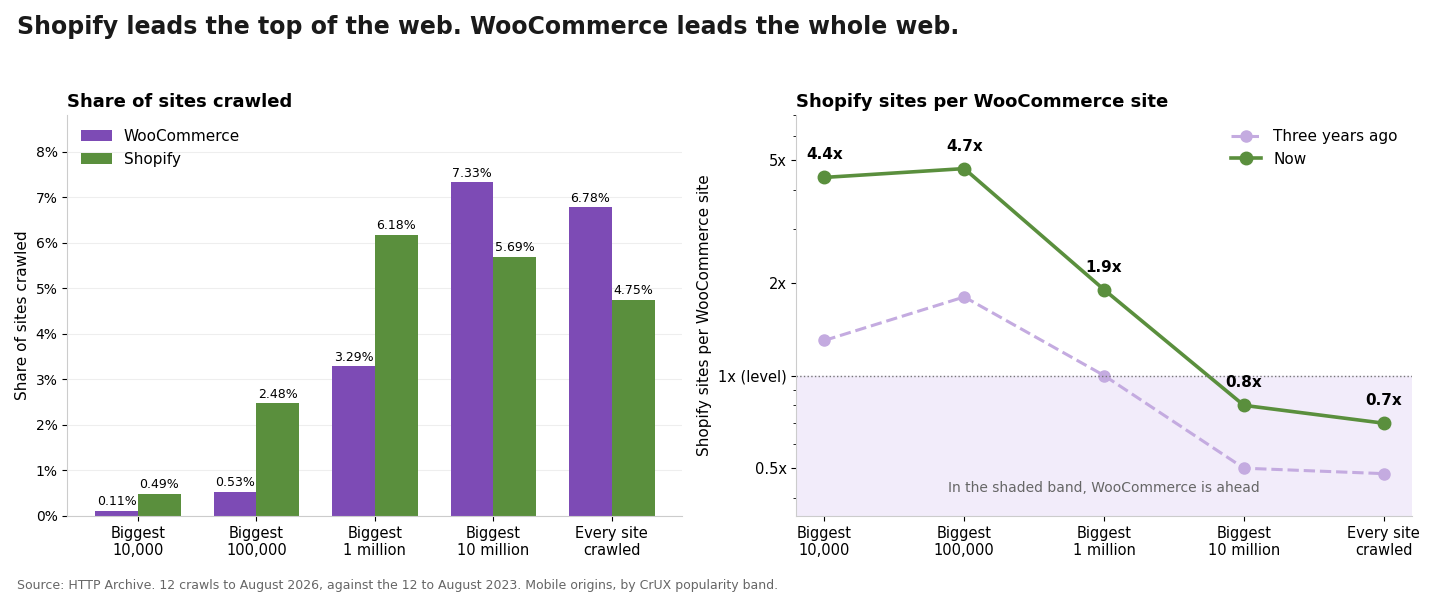
Don't like charts? Here's the data in a table instead:
| Where on the web Averaged over 12 crawls |
WooCommerce | Shopify | Who leads, and by how much | Three years ago |
|---|---|---|---|---|
| Biggest 10,000 sites | 0.11% | 0.49% | Shopify, 4.4 to 1 | Shopify, 1.3 to 1 |
| Biggest 100,000 | 0.53% | 2.48% | Shopify, 4.7 to 1 | Shopify, 1.8 to 1 |
| Biggest 1 million | 3.29% | 6.18% | Shopify, 1.9 to 1 | Level |
| Biggest 10 million | 7.33% | 5.69% | WooCommerce, 1.3 to 1 | WooCommerce, 2.0 to 1 |
| Every site crawled | 6.78% | 4.75% | WooCommerce, 1.4 to 1 | WooCommerce, 2.1 to 1 |
Shopify wins the top of the market by a wide margin. WooCommerce wins everything below it. This means that there's no one answer to whether Shopify or WooCommerce have the greatest market share. It entirely depends on what sample of the internet you're looking at.
That sounds simple enough, so why is the published data so contradictory?
Why no two published market share figures agree
The problem is that most sites publishing market share data don't say which part of the internet they're describing. It's not surprising that WooCommerce publishes data about the whole web while Shopify publishes data about the biggest sites - everyone emphasizes the data that benefits them. But we get the same problem on independent analyzes. Here are three widely read examples:
- Elementor writes that WooCommerce "powers over 28% of all online stores, making it the most popular eCommerce solution in the world". There's no source on the page and no definition of an online store.
- Hostinger says WooCommerce is "making up 33% of the total market share". The same page also says the plugin is "used by 20.7% of WordPress sites and 9.1% of all ecommerce stores on the internet". Which is it?
- WPBeginner quotes BuiltWith as putting WooCommerce on "28% of the top 1 million websites, followed by Shopify at 20%". Read literally, that puts nearly half of the biggest million sites on one of two shop platforms. HTTP Archive puts WooCommerce on 3.29% of them, so the 28% must be counting ecommerce sites rather than websites.
None of these are wrong on purpose: They're repeating a number from a reputable tech-detection service. What's missing is the sentence saying which sites each number covers, which is essential to allowing the reader to compare one figure to another.
Now that we know which sites each number describes, we can get a much deeper understanding of the current state of both platforms.
What's really happening to WooCommerce market share
WooCommerce grew steadily for years and then started declining a year ago.
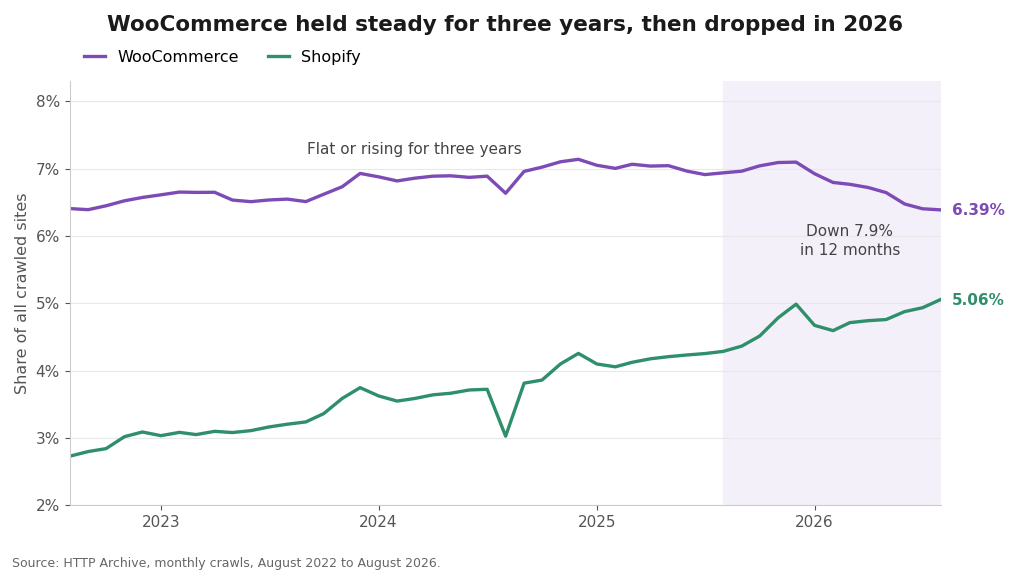
Comparing the same month each year, to rule out any seasonal effect, WooCommerce ran 6.55% of all crawled sites in August 2023, 6.63% in August 2024 and 6.94% in August 2025. It was still growing a year ago.
In August 2026 it's on 6.39%, its lowest reading since June 2022. That's a fall of 7.9% in 12 months, and it wipes out three years of gains.
Shopify has climbed steadily throughout. It ran 3.21% of crawled sites in August 2023 and 5.06% in August 2026, which is an all-time high and a rise of 58%.
WooCommerce still runs on far more sites than Shopify, but the size of the lead has narrowed:
- 2023WooCommerce led by 3.34 percentage points, or 2 to 1.
- 2025WooCommerce led by 2.65 percentage points, or 1.6 to 1.
- 2026WooCommerce led by 1.33 percentage points, or 1.26 to 1.
Most of that closed in the last year: The gap shrank by 1.3 percentage points between August 2025 and August 2026, against 0.7 in the two years before it. If it keeps closing at the recent rate, Shopify will overtake WooCommerce around the end of 2027. That assumes trend from the last 12 months continues.
How many WooCommerce and Shopify sites are there?
Market share can hide what's happening to the number of stores, so let's look at the number of sites. Unfortunately this is the hardest question of all, and every data source disagrees wildly.
Shopify doesn't publish a store count at all. Its annual report says only that it has "millions of merchants from more than 175 countries", and the quarterly results report revenue and sales volume rather than shops. BuiltWith detects 6.65 million live Shopify sites. HTTP Archive, which looks at a much smaller slice of the web, finds 450,309.
WooCommerce is easier to count but harder to interpret. WordPress.org reports 7 million active installs, which comes from WordPress sites checking in for updates, so it's close to a real census of installations. BuiltWith finds 6.44 million live sites running it, and HTTP Archive finds 568,489.
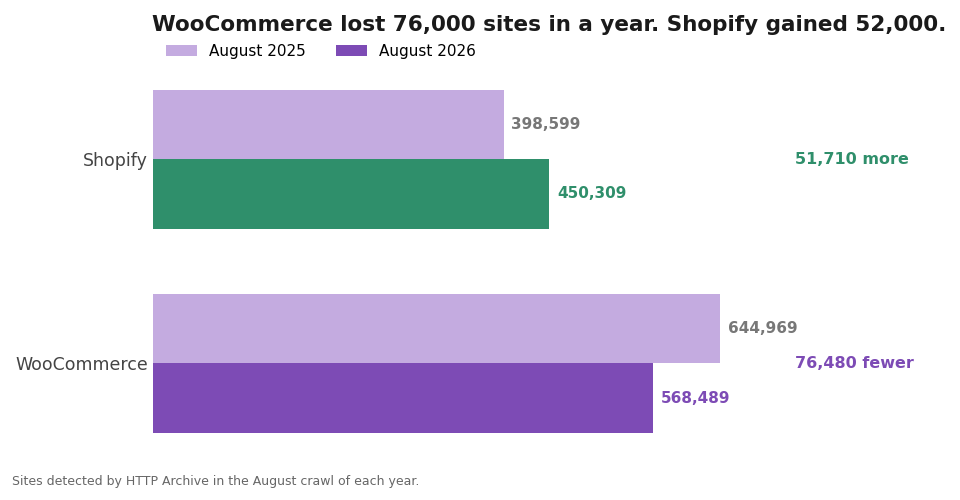
This means that WooCommerce lost around 76,000 sites in 12 months while Shopify gained around 52,000. To be fair, the number of sites that HTTP Archive crawled shrank 4.3% over the same period, so some of WooCommerce's fall is the dataset shrinking. However, a 4.3% smaller crawl doesn't come close to explaining an 11.9% drop in WooCommerce sites, and Shopify grew despite it.
Who's in the lead?
W3Techs surveys the top 10 million sites and puts WooCommerce on 7.9% of all websites against Shopify's 5.4%, a lead of about 1.5 to 1. Among the sites it identifies as ecommerce systems, WooCommerce takes 47.7% and Shopify 32.1%.
So two of the three sources put WooCommerce ahead, by 1.26 to 1 on HTTP Archive and 1.5 to 1 on W3Techs. BuiltWith is the only source I found that puts Shopify ahead of WooCommerce in terms of the number of sites.
The different numbers don't contradict each other; they just count different things. WordPress.org counts every installation that phones home, and BuiltWith counts every live site it can see anywhere on the web. HTTP Archive only looks inside its own crawl of about 8.9 million sites, so it sees a thin slice of both platforms. None of that is helpful when you're trying to draw conclusions!
Why WooCommerce's lead is smaller than it looks
Counting sites tells you how many websites exist that use a particular platform. It doesn't tell you how many are real ecommerce shops, and I think that gap is wider for WooCommerce than for Shopify. This makes WooCommerce's numbers look more impressive than they really are.
Shopify's business model openly runs on churn. Its 2025 annual report describes merchants joining in yearly cohorts. Growth from "merchants that remain on the Shopify platform", it says, "has more than offset decreases in revenues from merchants leaving the platform". The same section describes attracting merchants through "marketing programs and trial experiences". Plenty of people sign up, most don't make it, and the ones who do grow enough to cover the rest.
What happens when a store fails
A failing Shopify store costs the merchant money every month. The moment it's clear the business isn't working, canceling is the obvious move, and the store disappears from the web.
In contrast, a failing WooCommerce store costs almost nothing to leave running. The software is free and hosting is often a few dollars a month. As a result, many remain online for years despite not making any sales.
WooCommerce also gets installs from people who never wanted an online store. A lot of WordPress themes, particularly on marketplaces like ThemeForest, prompt buyers to install a list of "required" plugins, and WooCommerce is frequently on that list. People end up installing WooCommerce on sites that never plan to sell anything, simply because a theme asked them to - whereas nobody signs up for Shopify by accident.
Let's call this "The phantom-store problem" 👻
How many WooCommerce sites are real, active stores?
BuiltWith has measured this directly. It counts "WooCommerce Checkout" as a separate technology from WooCommerce because "Not all sites that have WooCommerce extensions use the eCommerce function of WooCommerce."
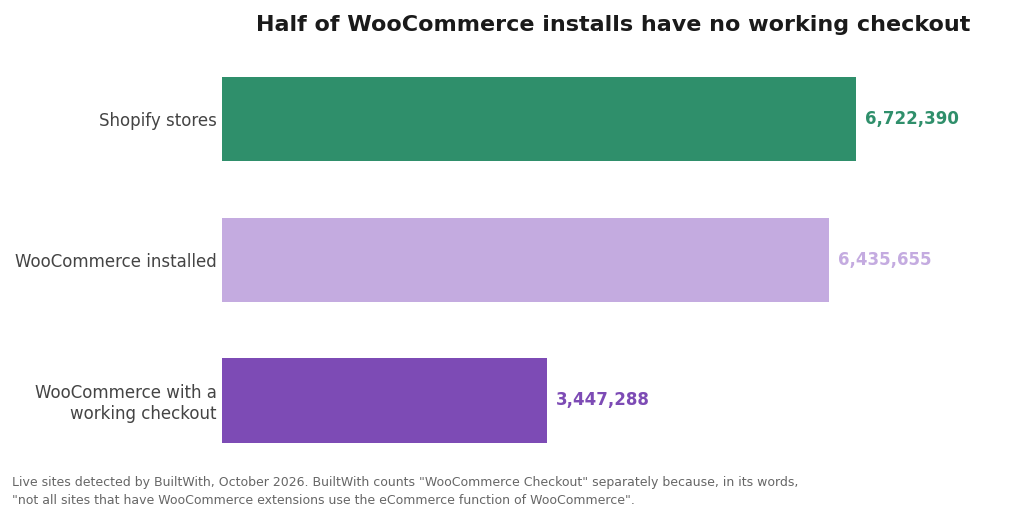
Of the 6.44 million live sites BuiltWith finds running WooCommerce, only 3.45 million have a working checkout. That's just over half.
However, there's one caveat before you draw a conclusion from this: BuiltWith applies this test to WooCommerce and not to Shopify 🤨
It's not fair to remove 46% of WooCommerce's sites and treat every live Shopify site as a working shop. While I'd expect the share of phantom stores to be lower on Shopify, nobody has measured it and I'm sure that not all Shopify stores are active. Until someone runs the same test on both platforms, there's no fair comparison to make.
Which is a very long-winded way of saying that we don't really know whether WooCommerce or Shopify runs on more sites.
The other ecommerce platforms aren't growing either
WooCommerce isn't unusual in declining; Shopify is unusual in growing. Measure every major platform over the same 12 months and none of the others have grown either:
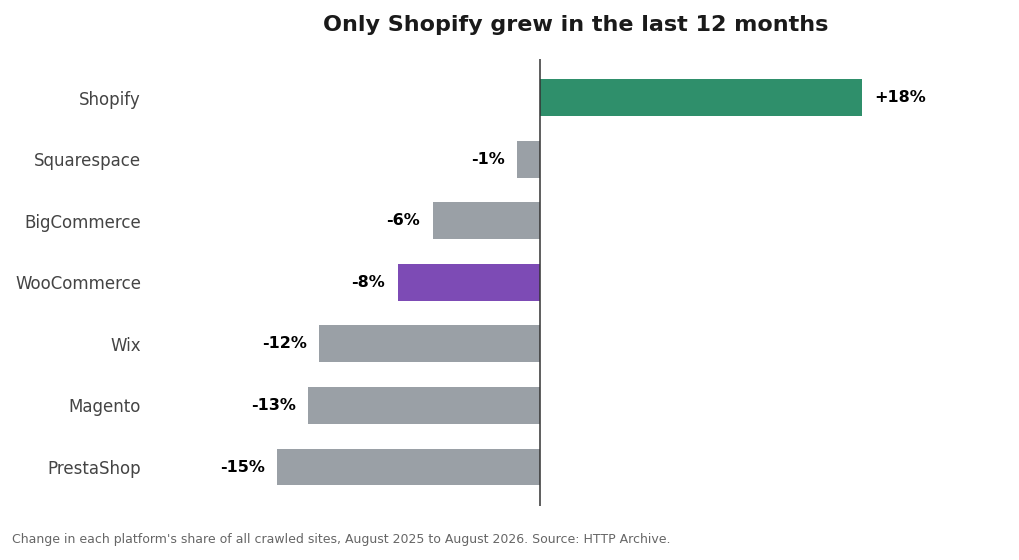
Here are the same figures as a list. This is the change in each platform's share of all crawled sites between August 2025 and August 2026:
- Shopify rose 18%.
- Squarespace was flat (-1%).
- BigCommerce fell 6%.
- WooCommerce fell 8%.
- Wix fell 12%.
- Magento fell 13%.
- PrestaShop fell 15%.
WooCommerce is in the middle of that list, and it's falling more slowly than Wix, Magento and PrestaShop. Anything under about 2% on that list is too small to call a direction, so read Squarespace as holding steady rather than falling. Across a wider set of 40 platforms, the self-hosted ones are falling about five times faster than the hosted ones. (I'll publish a more in-depth analysis of that soon.)
So this isn't a story about WooCommerce being in trouble while everyone else is fine. Every major ecommerce platform is flat or shrinking, and Shopify is the one taking the growth. A couple of much smaller platforms are growing from a low base, which I'll come back to another time.
What search data can and can't tell you
Plenty of articles measure ecommerce platforms using search data instead of counting real sites or market share. That gives you the wrong number because searches and sites measure different things: Most searches happen when somebody is choosing a platform or setting up their site, whereas a site exists after the choice was made.
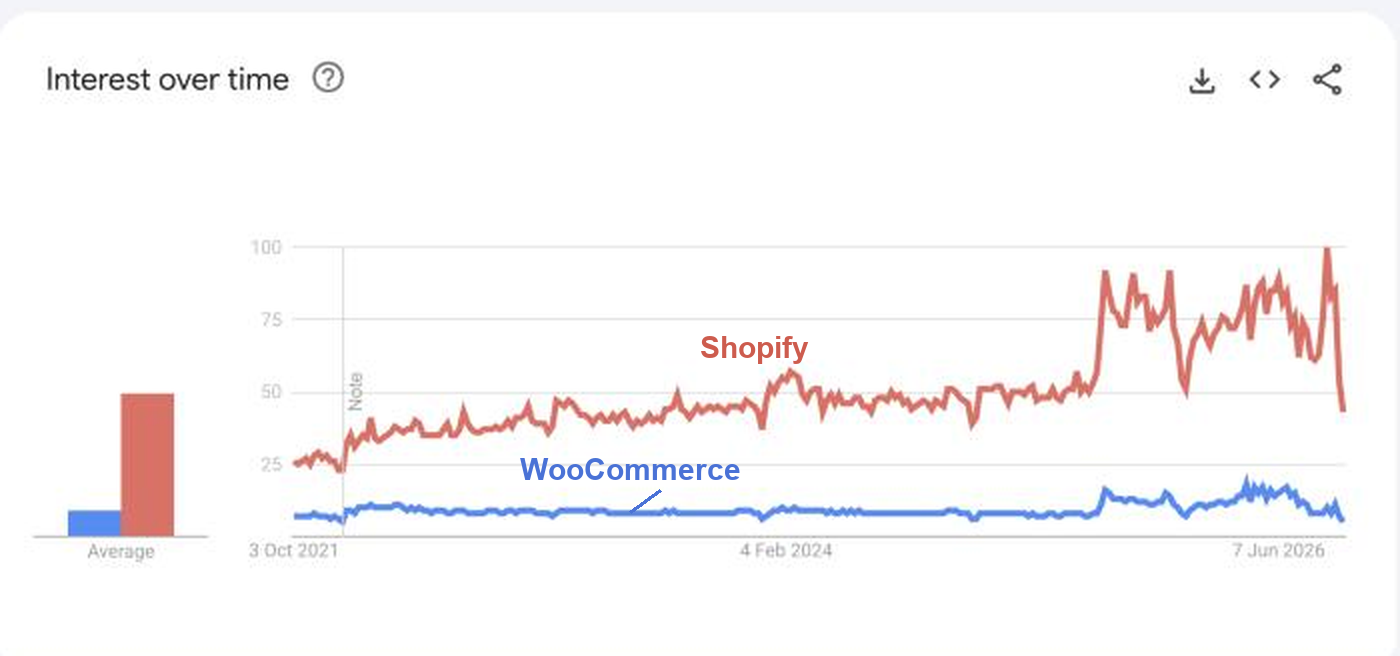
Searches for "woocommerce" have fallen by about 39% over three years. Over the same period its share of websites barely changed until 2026, which shows there's no direct relationship between how much a platform is searched for and how many sites run it.
If you use Google Trends to compare interest in WooCommerce and Shopify, you'll see that Shopify gets about five times as many searches. That seems strange given that most sources agree that WooCommerce powers more sites overall:
Search volume predicts the future 🔮
While there's no correlation between search volume and a platform's current size, you can use it to predict the future.
Searches for "woocommerce" started declining in early 2024. WooCommerce's share of websites carried on rising until the middle of 2025 and only started falling in late 2025. Put the two series side by side and they move together closely, with search running about 18 months in advance.
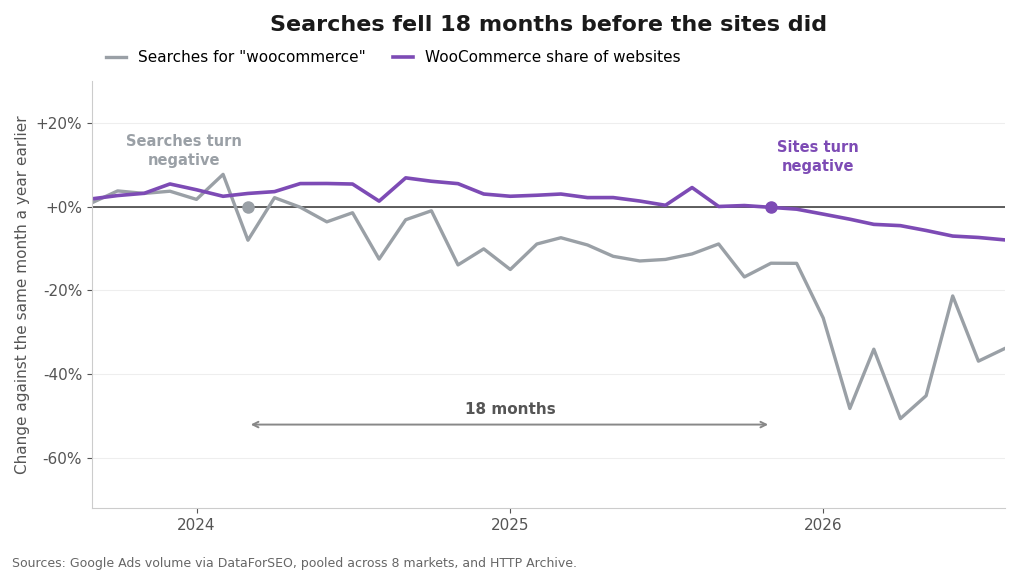
This shows that search volume is still useful - just not in the way that people typically use it. Instead, it shows what people are choosing now. These choices affect future growth and can be used to predict the likely market share approximately 1.5 years ahead.
How we measured Shopify and WooCommerce market share
Now for the boring-but-important bit, so you can fact check everything I've said. I've used four sources, and they each answer a different question. You're welcome to quote, chart or embed any figure here - please credit this article and its sources.
- HTTP Archive, for every trend and traffic bandIts free Tech Report and public data at
cdn.httparchive.org/v1/adoption, which need no account. Every month it visits a few pages of about 8.9 million sites and records the software it finds. I've used it for the trends because it counts what's running on a site today and never has to guess when it arrived. - W3Techs, as a second opinion on who leadsIt surveys the top 10 million sites, a different population from HTTP Archive's crawl. That makes it a useful check on the headline question, rather than a source for the trends.
- BuiltWith, for site counts and the checkout splitIt sees far more sites than either of the others, and it's the only source that separates WooCommerce installs from WooCommerce stores with a working checkout. Its historical data is behind a paywall, so I haven't used it for trends.
- Google Ads, for search volumeThrough DataForSEO, comparing the 12 months to August 2026 against the 12 months to August 2023.
One source I didn't use
I also checked Store Leads and decided against using it at all. It records the date it first saw software on a store rather than the date the merchant installed it, so a store it discovers today looks like a store that installed everything today. Its data about store counts is also very inconsistent, for example its own total for Shopify has been reported at 1.81 million, 2.45 million, 4.08 million and 752,000 at different points over the last year.
How to read the numbers
- The percentages are shares of all websitesNot shares of online shops. When I say WooCommerce is on 6.39%, that's 6.39% of every site crawled, shops and non-shops alike.
- "Biggest" means the most trafficThe bands come from Google's Chrome User Experience Report and rank sites by visitor numbers, not by revenue or catalog size.
- Trends compare the same month each yearUsually August 2023 against August 2026, because the crawl changes size through the year. The five-band table is the exception: It averages 12 crawls because each one bounces around too much to read individually.
Two things the crawl can't see
HTTP Archive only covers sites in Google's Chrome User Experience Report. To get in, a site has to be indexable and pass a minimum number of real visitors, which Google doesn't publish. So the smallest shops are missing from every HTTP Archive figure here.
It also visits a site's homepage and one other page rather than the whole site. That rarely matters, because both platforms load their own scripts on every page, but a store that hides the shop from logged-out visitors won't be counted. That's what a private store, wholesale or B2B plugin does, and those are more common in WooCommerce.
My verdict on Shopify vs WooCommerce market share
When you read a platform market share number, always look for the sentence saying which sites were counted. If there isn't one, then the data is meaningless and you shouldn't quote it anywhere.
The data is incredibly confusing, but if we bring everything together, I think these are the conclusions we can draw:
- Nobody can say whether Shopify or WooCommerce has the biggest market shareThat's because it depends what you count, and no complete dataset exists. Shopify clearly wins if you only consider the biggest sites. WooCommerce probably runs more sites overall, though phantom installs make it hard to tell for sure.
- Only Shopify is growingThis is clear, by any measure.
- The gap is closingShopify's growth means that even if WooCommerce currently runs on more sites, this will change - probably around the end of 2027.
I believe that both platforms have a bright future. Regardless of how Shopify is doing, WooCommerce is and will remain incredibly popular, and huge numbers of stores will continue using and thriving with it. I'd like to see the people building for WooCommerce accept that it attracts smaller stores and use this as a superpower, making it the best it can possibly be for the smaller stores that rely on it. If you're choosing between the two platforms, have a look at the pros and cons of Shopify next, or at five real reasons to use WooCommerce over Shopify.
Frequently asked questions about Shopify vs WooCommerce market share
Which has more stores, Shopify or WooCommerce?
WooCommerce, on two of the three sources that cover the whole web. HTTP Archive detected WooCommerce on 6.39% of crawled sites in August 2026 and Shopify on 5.06%, so WooCommerce leads by about 1.26 to 1. Restrict the count to the web's biggest 100,000 sites and Shopify leads by 4.7 to 1. However, there is reason to believe that WooCommerce's figures are artificially inflated. It runs on a lot of sites that aren't active ecommerce stores, either because the business has failed but their website is still online, or because a theme auto-installed it.
Is WooCommerce losing market share to Shopify?
Yes, and the fall is recent. Comparing the same month each year, WooCommerce ran 6.55% of crawled sites in August 2023, 6.94% in August 2025 and 6.39% in August 2026. Shopify has risen from 3.21% to 5.06% over the same three years. WooCommerce still leads overall, but its lead has halved and of the platforms compared above, only Magento and PrestaShop are falling faster.
Why do WooCommerce market share figures vary so much?
Because each source counts a different group of websites. A figure can describe all crawled websites, only sites detected as shops, or only the biggest million sites, and those answers differ by a factor of ten. Published figures rarely say which group they used.
Can you tell from this data when a store should move to Shopify?
No. Site-detection data measures web traffic rather than revenue, so it can't support any claim about a revenue threshold. Shopify only overtakes WooCommerce among the biggest million sites on the internet, which is far larger than the stores people usually have in mind. I can categorically tell you that WooCommerce does scale, so long as you have good hosting and infrastructure to support it.