WooCommerce is growing. Just not in English.


Everyone says WooCommerce is shrinking. However, I measured WooCommerce market share by country and found that it still beats Shopify in 14 of the 25 biggest markets - and strangely, not one of these markets speaks English.
When I look at market share figures for WooCommerce, they're always worldwide. The world is a big place and it would be strange for the same ecommerce platform to lead everywhere. I decided to break things down a bit further, which led to some interesting discoveries.
Keep reading to find out:
- The 14 markets where WooCommerce beats Shopify, and the 11 where it doesn't.
- Why I think non-English speaking countries prefer WooCommerce.
- What the split feels like from inside the community, on three continents.
- Whether WooCommerce can hold on to those markets.
WooCommerce market share by country
Every year we publish WooCommerce usage stats as one global figure. This time I used the same source and broke it down by country.
HTTP Archive crawls the sites in Google's Chrome User Experience Report every month, records the technologies it finds on each one, and tags each site with the country it's served from. As a result, you can ask what share of each country's websites run each ecommerce platform:
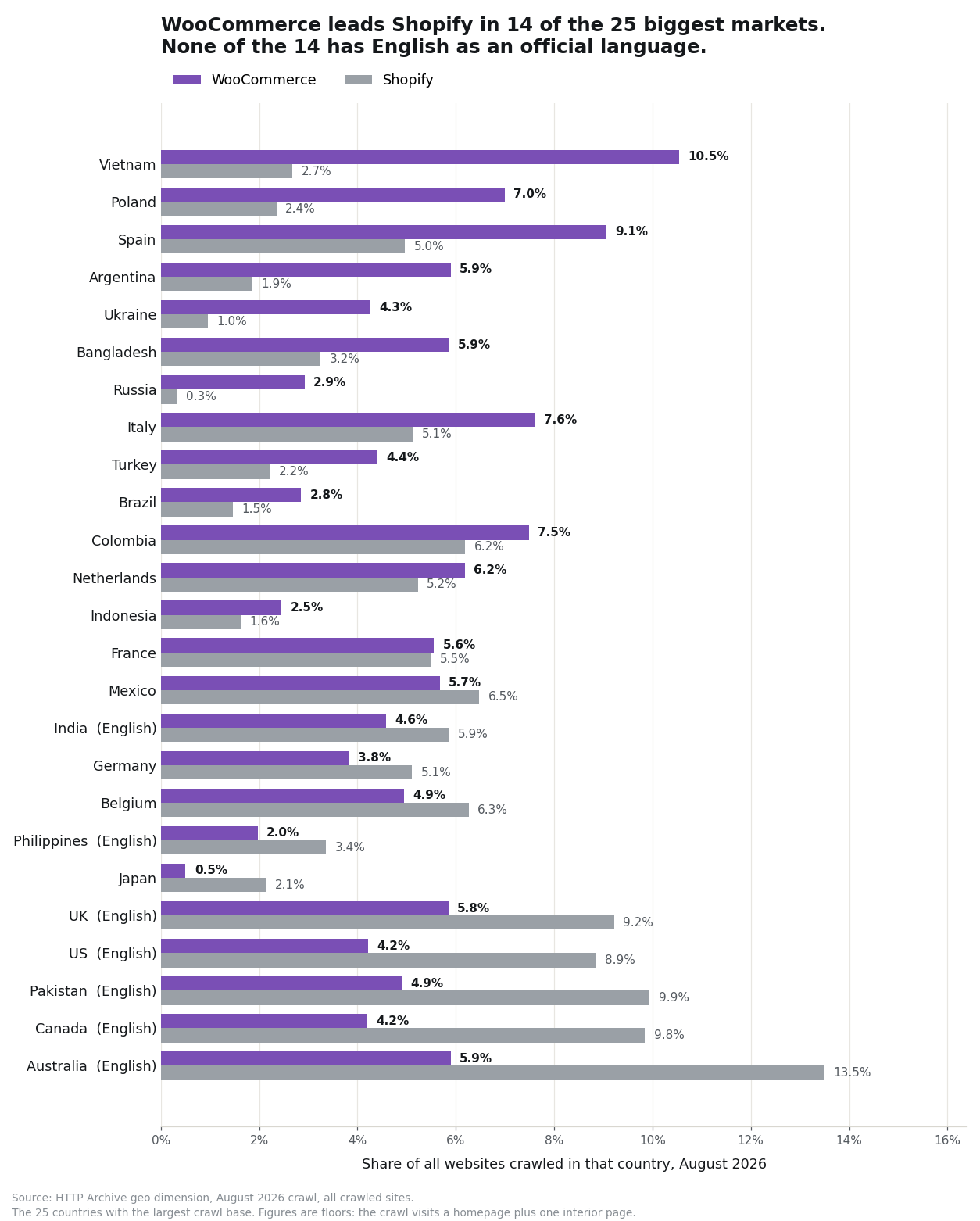
If you'd rather read the raw numbers, here's the same data as a table:
| Country | WooCommerce | Shopify | Who leads |
|---|---|---|---|
| Vietnam | 10.5% | 2.7% | WooCommerce |
| Poland | 7.0% | 2.4% | WooCommerce |
| Spain | 9.1% | 5.0% | WooCommerce |
| Argentina | 5.9% | 1.9% | WooCommerce |
| Ukraine | 4.3% | 1.0% | WooCommerce |
| Bangladesh | 5.9% | 3.2% | WooCommerce |
| Russia | 2.9% | 0.3% | WooCommerce |
| Italy | 7.6% | 5.1% | WooCommerce |
| Turkey | 4.4% | 2.2% | WooCommerce |
| Brazil | 2.8% | 1.5% | WooCommerce |
| Colombia | 7.5% | 6.2% | WooCommerce |
| Netherlands | 6.2% | 5.2% | WooCommerce |
| Indonesia | 2.5% | 1.6% | WooCommerce |
| France | 5.6% | 5.5% | WooCommerce |
| Mexico | 5.7% | 6.5% | Shopify |
| India | 4.6% | 5.9% | Shopify |
| Germany | 3.8% | 5.1% | Shopify |
| Belgium | 4.9% | 6.3% | Shopify |
| Philippines | 2.0% | 3.4% | Shopify |
| Japan | 0.5% | 2.1% | Shopify |
| UK | 5.8% | 9.2% | Shopify |
| United States | 4.2% | 8.9% | Shopify |
| Pakistan | 4.9% | 9.9% | Shopify |
| Canada | 4.2% | 9.8% | Shopify |
| Australia | 5.9% | 13.5% | Shopify |
WooCommerce leads in 14 of these 25 markets, and English isn't an official language in any of them. Seven countries on the list do have English as an official language, and Shopify leads in every one.
Vietnam is WooCommerce's strongest market anywhere, where it runs on 10.5% of every website crawled. Russia has the widest margin, at nearly nine to one. Shopify's biggest leads are in Australia at 13.5% against 5.9%, Pakistan at 9.9% against 4.9% and Canada at 9.8% against 4.2%.
Two explanations that don't work
When I discovered that WooCommerce is the market leader in more non-English speaking countries, I made some assumptions about why. It turned out that I was wrong about both.
It isn't wealth. Rank the 25 countries by GDP per head and by how far Shopify leads WooCommerce, and the two rankings correlate at +0.35. So richer countries do prefer Shopify slightly.
However, there are lots of exceptions. The Netherlands is the second richest country on the list at $67,465 a head, and WooCommerce leads there. Bangladesh and India are $2 apart at the bottom of the list, at $2,593 and $2,591 a head. They go opposite ways: WooCommerce leads in Bangladesh by nearly two to one, while Shopify leads in India.
It isn't Shopify Payments either. My second theory was that Shopify loses where merchants can't use its own payment processor and have to pay extra transaction fees on top.
However, the supported countries list rules that out. Shopify Payments covers Poland, Spain, Italy, France and the Netherlands, and WooCommerce leads in all five. It doesn't cover Turkey, Brazil, Indonesia or India, and Shopify leads in India anyway.
So it doesn't seem to be an economic reason. I suspect it's more likely to be cultural, and a reflection of where Shopify target their advertising.
What WooCommerce's country split feels like in the community
As we can see, WooCommerce has the biggest market share in countries whose first language isn't English. But what does that feel like from inside the WordPress community around the world?
I've attended WordCamp Asia, WordCamp Europe and WordCamp US several times in the last few years, and the atmosphere at the three is completely different. Interestingly, that difference lines up neatly with the market share data.

WordCamp US is increasingly negative. In some ways, that's not surprising - at WordCamp US 2024, Matt Mullenweg gave his infamous speech against WP Engine and the WordPress drama started. A lot of attendees, including me, felt betrayed that a WordCamp could be used that way.
This negativity has flowed over into every WordCamp US since. People still go, but visitor numbers are down more than at any other flagship WordCamp, and a lot of people still boycott the event on principle. Poor location choices for the last few years haven't helped, but I think it's much more than that.
People in the US often say that this reflects a negativity around WordPress generally. However, that argument doesn't hold up for people like me who also attend WordCamp Europe and WordCamp Asia.
WordCamp Europe is in the middle. It has a professional feel and people are positive, even if they'll privately admit their sales are declining.
WordCamp Asia has the biggest buzz around it. People there are actively enthusiastic and excited about the opportunity WordPress brings to their lives, and the drama is rarely mentioned.
The country figures turn out to match these observations almost exactly. Every market where WooCommerce still beats Shopify is a non-English one, and the markets where the mood is worst are the four where Shopify leads by the widest margins. Coincidence?
Will WooCommerce keep these markets?
Leading a market today and keeping it are two different things. So I checked how far ahead WooCommerce was three years ago in each of those 14 countries.
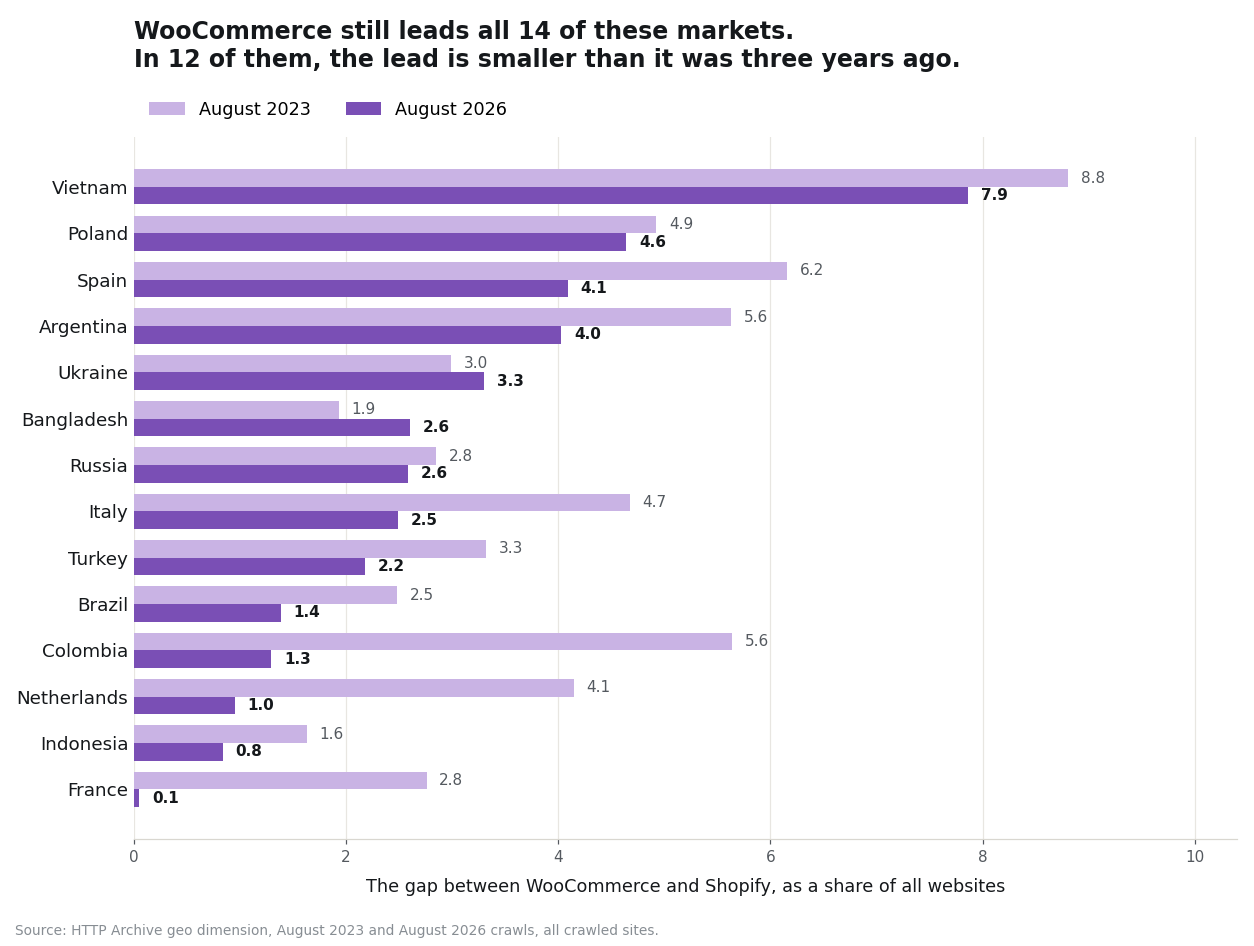
As you can see, WooCommerce's lead has declined in most of these countries. France is nearly gone: three years ago it ran 5.5% WooCommerce against 2.8% Shopify, and today it's 5.6% against 5.5%. The Netherlands has gone the same way, from 6.5% against 2.3% to 6.2% against 5.2%.
Shopify grew its share in 24 of the 25 countries over the same period. While it hasn't taken any of these markets off WooCommerce yet, it's closing in on nearly all of them. If that carries on, France and Indonesia are the two to watch and it's likely that Shopify will take over soon.
How I measured WooCommerce market share by country
Every figure here is reproducible, so here's how you can check the data.
- Site shareHTTP Archive's geo dimension, comparing the August 2023, August 2025 and August 2026 crawls. It's free, openly licensed under Apache 2.0, and anyone can query it.
- Which 25 countriesThe 25 with the largest HTTP Archive crawl base in August 2026. China is absent because the crawl barely reaches it.
- Always the same monthThe crawl shrinks every December, which lifts every platform's share for one month and invents peaks that aren't there. I compare August against August only.
- What the crawl missesHTTP Archive visits a site's homepage plus one interior page. It only detects what loads on those two pages. That might overlook some sites such as private stores but the majority can be detected from the homepage.
- Share, not raw countsHTTP Archive's crawl base shrank about 10% over this period, so raw site counts fall even where a platform holds steady. Everything above is a share of the sites crawled in that country, so that shouldn't affect the conclusions.
What WooCommerce market share by country means for your store
If you sell in Vietnam, Spain, Poland, Italy, Colombia, the Netherlands, Argentina, Bangladesh, Ukraine, Turkey, Russia, Brazil, Indonesia or France, then WooCommerce still runs on more websites than Shopify in your market. The people who are saying that Shopify is the biggest e commerce platform are probably in a completely different country to you.
Now we know that WooCommerce is strongest in markets that don't speak English, this highlights the importance of internationalizing your site. Build a multilingual WooCommerce store and get your multi-currency setup right. That way, people can access your store and your clients' stores wherever they are in the world.
If you sell in the United States, Canada, Australia or the UK, Shopify is already the market leader - and its lead is growing. While it's not there yet, Shopify is starting to catch up in the non-English speaking world as it becomes better-known worldwide. If you want WooCommerce to remain the leader in your country, then I recommend spreading the word about the real reasons to use WooCommerce.