The AI generation gap: why young people are skeptical


New technology almost always spreads from the young to the old, but we're seeing the opposite with AI. I wanted to understand the generation gap behind why so many young people are skeptical of it.
I spend a lot of time around other founders of companies like mine. AI comes up constantly, whether in my private mastermind group, on podcasts, or on social media. What strikes me is how completely, and how positively, my fellow Millennial and Gen X-ers have embraced it. Then I go home to my teenager, who rolls their eyes every time the subject comes up.
That contrast has been nagging at me. So I put the question to my followers on X: why are young people so skeptical of AI while older people are embracing it?
Why do you think young people are so sceptical of AI while older people are embracing it? It’s the opposite of what normally happens with new technologies 🙃
I’m sure that the threat to their future jobs is one factor, but it feels like much more than that.
— Katie Keith (@KatieKeithBarn2) May 27, 2026
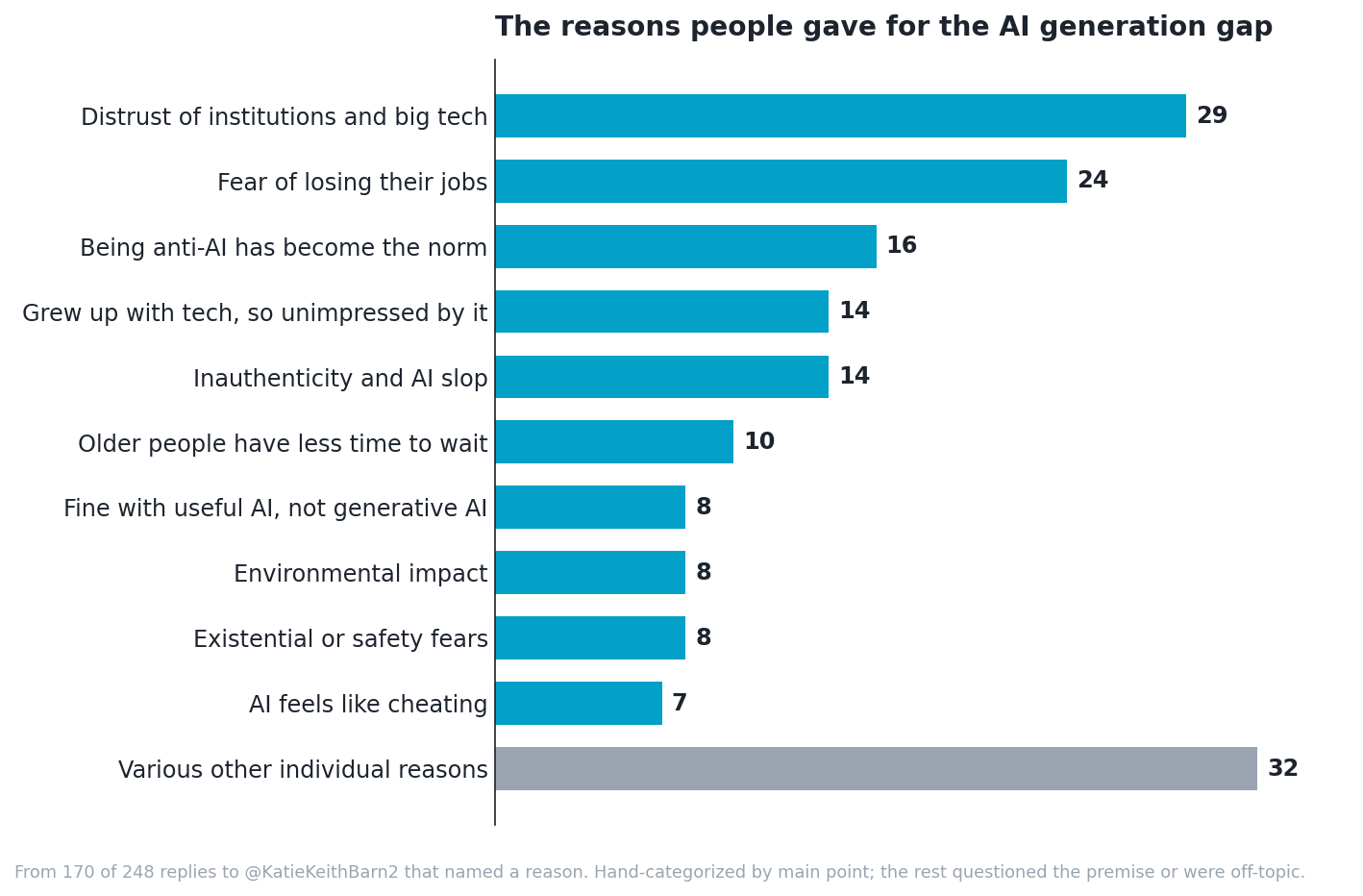
The replies kept coming - more than 250 of them - and they went deep into the issue. Before we get into it, here is the shape of what people said:
Embed this chart on your website:
First, is the generation gap even real?
The first thing some people did was push back on my premise, which is exactly what good replies should do. Several challenged the young-versus-old framing from both sides - a 50-year-old who hates AI, and a graphic designer of three decades who loves it. Others said the real divide is about knowledge or how deeply you have used the tools, not age.
As Blake Whittle put it, plenty of people picture AI as typing a question into ChatGPT, when in practice it can mean running several agents at once to handle a whole research project. Two people can both say they "use AI" and mean wildly different things.
I don't think this is representative tbh, but what I see is non-technical people embracing AI big time because it solves several problems simultaneously and doesn't threaten their ego or jobs
— Mario Peshev (@no_fear_inc) May 27, 2026
Let's be clear - any discussion about age will inevitably contain generalizations. Every generation has enthusiasts and skeptics, and people from both camps responded to my tweet. What I am describing is a tendency, not a rule, and the people who reminded me of that were right to.
A few pushed back with their own experience. Ajay D'Souza said the young people at his workplace have embraced AI in both their work and personal lives, and that he wishes he had those tools when he was starting out. Tavlean said the young people around him are weaving AI into their lives faster than anyone. So the divide I noticed may be sharper in my circle than in everyone's.
My own experience is that the Gen Z's I know all use AI as a tool, yet are deeply distrustful of it at the same time. Most only use the chat, while the tech founders I work with are integrating it more deeply into their workflows. Many young people have ideological objections to AI, particularly around topics such as AI in art, which I rarely see in Millennials and Gen X.
What surprised me is how few denied that a gap exists. Only a handful argued there is no generational divide at all. Almost everyone else accepted the gap and only disagreed about how wide it is, or what causes it.
This is supported by wider research. Gallup found that Gen Z's AI use has held steady while their skepticism has climbed, with growing worry about what AI does to their thinking, learning, and creativity. So the fair version of my observation is that young people have not refused AI, and many use it daily, but they do so with far more wariness than many older people.
The real divide is distrust, not technology

Of the people who accepted that there's an AI generation gap, the most common reason was not really about AI. It was distrust: of big tech, of institutions, of being sold the next big thing.
Kurt von Ahnen suggested that young people have watched older generations play by the rules and get burned, so of course they are wary. Anita made a related point: today's young people grew up online and learned early to be wary of scams, fake content, and data harvesting, so they question new technology by instinct. James Verkerk raised privacy directly, citing what companies do with the data they gather.
Close to this was a quieter idea that came up more than I expected: that being anti-AI has simply become the default position. Chris Huber offered the most human version of it, only half joking, that hating AI is now the cool thing to do. I feel this may well be valid. It could even be a direct response to older people's embrace of AI which, by definition, means that young people feel obliged to reject it.
I also wonder whether resilience is a factor. Older generations have already lived through major technological transitions like dial-up to fiber, rotary phones to smartphones, and checkbooks to contactless. Pew Research has tracked how each older generation steadily adopted the web, smartphones and social media in turn, so they have learned the hard way that you must either adapt or get left behind. As Brian Jackson put it, we already know that lesson, and plenty of people made similar points.
The fear of being replaced

The most obvious explanation came up early and often. A graduate stepping into a white-collar career has every reason to worry about a tool that can already do a chunk of an entry-level job.
Zeeshan made a point that stuck with me. Someone with ten or more years of experience is in a far better position to take advantage of AI than someone who has only ever known it. A senior person uses it to move faster, while a junior person fears being skipped over before they have built any expertise of their own.
If you are older and established, AI looks like leverage. If you are just starting out, it can look like the ladder being pulled up behind you.
The environment - louder online than in my replies
This one surprised me. If you spend any time online, you would assume the environmental cost of AI was the whole argument. However, it came up far less than I expected.
Only around eight people raised it as a main concern, well behind jobs and distrust.
Environmental concerns loomed larger among the high-profile founders who answered than across the thread as a whole, which is probably why it feels like a bigger theme than the numbers suggest.
When it did come up, it came up with feeling. Josh Kohlbach said the main thing he hears from young people is concern about the environmental impact, particularly data centers. He wondered aloud how much of that is just the news cycle. Marc Benzakein raised how those facilities affect local communities. Martin said simply that for him it comes down to climate impact. Ryan Logan framed a version of it as time horizon. After all, a young person has decades left on the planet and cares about protecting it, while an older person is more inclined to enjoy the convenience while they can.
Whether or not the numbers bear out the fear, the sentiment is real for the people who hold it. It just turned out to be a smaller group than the online noise had led me to expect.
The authenticity problem - AI is cheating
A theme I had not anticipated was the sense that using AI is a kind of cheating. Jason Coleman put it plainly:
Along with all of the other factors...
At least in my house, we took the lessons of the book "Grit" to heart and encouraged hard work over outcomes. AI seems easy and cheating to them.
— Jason Coleman 🤔💡💻💾 (@jason_coleman) May 27, 2026
Close to this is a deep distaste for content that feels fake or generic. Carl Hancock described how his Gen Z teenager can spot AI-generated writing, video, or audio instantly and rejects it as inauthentic:
It depends on what it is. When it comes to content creation, etc. I can tell you my Gen Z teen can sniff out AI generated content... be it written, video or audio... and doesn't like it. He thinks it's inauthentic and artificial.
— Carl Hancock 🚀🇨🇷 (@carlhancock) May 28, 2026
Andrew Hoyer said his Gen Z kids are choosing hands-on careers in engineering and mechanical fields, partly because there is so much fake content online. Matt Medeiros captured the aesthetic side of it with a parody of the now-familiar AI flyer look in which every business ends up with the same glossy, soulless design:
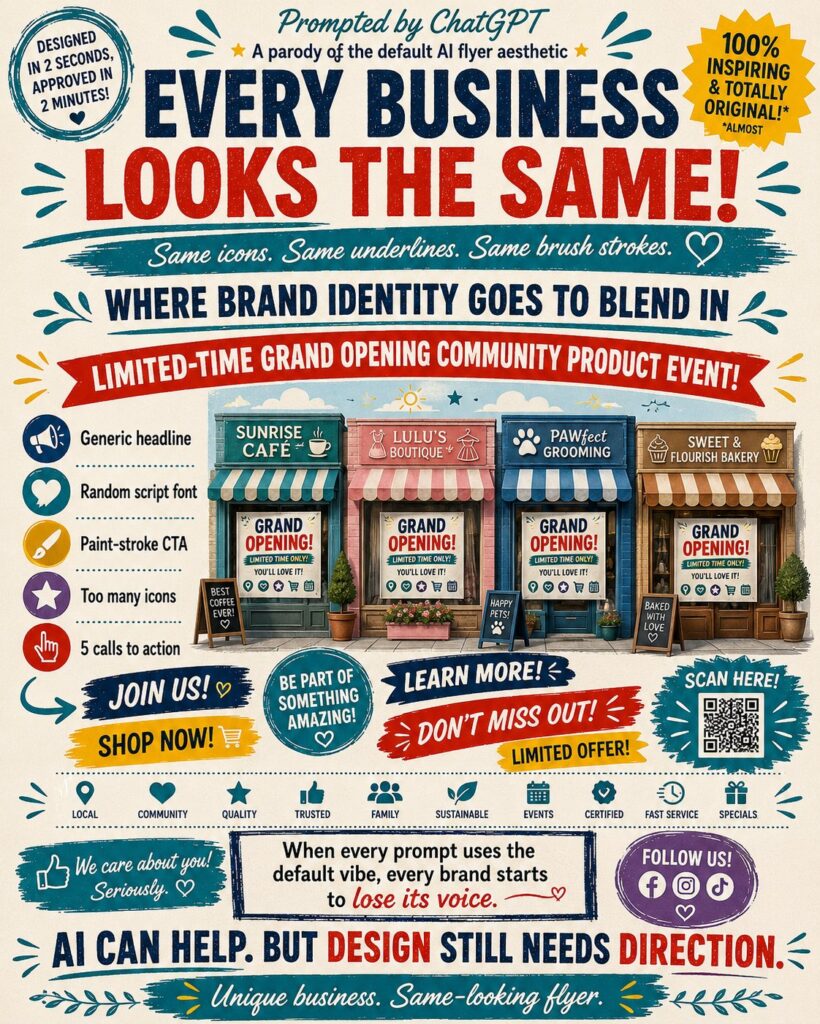
For people who grew up online, the flood of AI slop is incredibly off-putting. It is everywhere, and it all looks the same.
Personally, I'm incredibly sensitive to AI slop (especially on YouTube 😬). However, my response is that we need to work harder to train AI and use it wisely in order to get good results. For many younger people, the response is avoid AI for content production entirely.
Useful AI yes, generative AI no
One of the sharpest distinctions came from Lady Ali, who shared what her 15-year-old told her: she is fine with AI that detects cancer, but not with generative AI.
This is a crucial point and matches my own experience exactly. My teenager uses AI for plenty of things, yet holds strong opinions that image generators should not exist because of the threat those tools pose to artists. They are so sensitive to it that they even see AI where it cannot possibly be, including in the artwork on an old jigsaw which pre-dates AI.
In their eyes, the problem is narrower and more specific: they reject AI that takes paid work away from human creators.
So, is there really an AI generation gap?
 I asked about the generational AI divide expecting one clean answer, and ended up with a tangle of them. The big ones were distrust, fear for their jobs, the sense that being anti-AI is now the default, and the feeling that easy is the same as cheating.
The environment, which I assumed would top the list, sat lower than the online noise had led me to believe.
But overall, the majority of respondents agreed that the AI generation gap is real. While there will always be exceptions, a bigger proportion of younger people are deeply sceptical. This doesn't mean that they reject AI completely - plenty of people use AI every day and still hold real reservations about it. The gap is real, but it is narrower and more thoughtful than my original tweet implied.
I would love to know what you are seeing. If the young people in your life feel differently, or if you think I have the whole thing backwards, the conversation is still going on on the original thread. You can also comment below.