Creating a nonprofit board of directors: everything you need to know


A nonprofit board of directors is the small group of volunteers (and occasionally paid trustees) that gives a nonprofit its direction, sets its priorities and signs off on the big decisions. But how do you create one?
We do a lot of work with nonprofits because so many of them use our Document Library Pro plugin, and one common theme keeps coming up. Plenty of new founders register the entity, file the paperwork and start fundraising before they've thought seriously about who sits on the board. By the time the first audit lands or the first big donor asks for a list of trustees, it's a scramble.
So I'll cover what a nonprofit board of directors actually does, the three legal duties every board member signs up to, the standard officer roles (chair, vice chair, secretary and treasurer), how to build a board that doesn't drift, and a practical setup for keeping all the board's documents in one place that current and incoming members can actually find.
What a nonprofit board of directors is
A nonprofit board of directors is the governing body that holds legal and fiduciary responsibility for a nonprofit organization. Most US states require one as a condition of incorporation, and most countries with a charity register expect the same. The board sets direction, oversees finances and ensures the organization stays on mission. Day-to-day operations are usually run by paid staff (an executive director or CEO and their team) who report up to the board.
A typical board has between five and 15 members, with three to four officers and a wider pool of general directors. Most boards meet quarterly or monthly, with committees doing focused work in between.
Roles and responsibilities of a nonprofit board of directors
Board members agree to a long list of responsibilities the moment they accept the role. Most are unpaid, which means you're recruiting volunteers who will give real time and expertise. Be specific about what the role involves before they say yes - it sets the relationship up properly and weeds out anyone who isn't ready for the commitment.
The main categories of responsibility:
- GovernanceSetting organizational policies, approving the annual plan and overseeing the organization's overall performance.
- Financial oversightReviewing budgets, signing off on annual accounts and making sure the organization stays solvent.
- FundraisingSupporting fundraising efforts directly (giving money, opening their networks, attending events) and indirectly (approving the fundraising plan).
- Fiduciary responsibilityActing in the organization's best interests at all times and avoiding conflicts of interest.
- Strategic planningShaping the long-term vision, three-to-five-year goals and how the organization will get there.
- RepresentationBeing a public ambassador for the organization with funders, partners and the wider community.
A healthy board distributes these responsibilities across members based on their strengths. Don't expect every director to lead on fundraising or financial oversight - match the role to the person.
The three fiduciary duties every board member owes
Underneath all of the responsibilities above sit three legal duties that every board member personally owes to the organization. In the US these are well-established in case law; in the UK they map closely to the seven trustee duties set out by the Charity Commission. They are:
- Duty of care. Each board member must actively participate in decisions and apply reasonable judgment. Showing up, reading the board pack and asking real questions counts. Rubber-stamping decisions you haven't engaged with does not. Failing this duty can leave individual board members personally liable.
- Duty of loyalty. The organization's interests come first. If a board member has a competing personal or business interest, they must declare it and step out of the relevant vote. This is why every well-run board keeps a conflict-of-interest register.
- Duty of obedience. The board must act within the law and within the organization's own governing documents - the articles of incorporation, the bylaws and the mission statement. Drifting from the stated charitable purpose is a fast way to attract regulator attention.
These duties exist whether the board treats them seriously or not. The legal protection they offer the organization is real, and so is the personal liability they create for directors who ignore them.
Standard officer roles on a nonprofit board
The exact titles vary, but most nonprofit boards have four officer positions: chair, vice chair, secretary and treasurer. Together they form the executive committee, and they handle most of the work that happens between full board meetings.
Chairperson (or president)
The chair leads board meetings, sets the agenda with the executive director and acts as the organization's most senior volunteer. They're often the primary external face of the board - meeting major donors, signing partnership agreements and representing the organization in public settings. The chair also handles the executive director's annual review and is usually one of the signatories on the bank account.
Vice chair
The vice chair stands in for the chair when needed and takes on specific projects assigned by the board. In many nonprofits the vice chair is being groomed as the next chair, so the role is partly a succession plan. If your bylaws don't already define how vice chair to chair succession works, that's worth fixing before you appoint one.
Secretary
The secretary keeps the official record. That means minutes of every board meeting, attendance, votes taken, and copies of all governing documents (articles, bylaws, policies, conflict-of-interest declarations). In a small nonprofit the secretary often also coordinates board logistics - sending out the meeting notice, distributing the board pack a week in advance and confirming quorum.
Treat the secretary role as more than admin. Accurate minutes are your evidence trail when a regulator or auditor asks how a decision was made.
Treasurer
The treasurer chairs the finance committee, reviews monthly management accounts, presents the annual budget to the board and sits on the audit relationship. They don't do the bookkeeping - that's a paid staff or external accountant function - but they're the board's eyes on the numbers. A good treasurer flags problems early and translates the accounts into plain language for fellow directors who aren't finance specialists.
How to actually build a board that works
Most underperforming boards are a recruitment problem, not a process problem. A board of nine engaged people will outperform a board of 15 who attend meetings out of obligation. Three things make the difference.
Recruit for the gaps, not for who you know
Map the skills, networks and demographics already on the board. Then identify what's missing - usually some combination of finance, legal, marketing and brand identity, fundraising, the community you serve and lived experience of the issue. Recruit deliberately against that map. For the full process I use, see my guide to recruiting board members for your nonprofit.
Set proper term limits
A standard structure is two- or three-year terms with a two-term maximum. That gives each director long enough to be useful and short enough that the board refreshes regularly. Without term limits, the board ossifies and prospective new members can't see a way in.
Onboard properly
A new director who's handed a stack of bylaws and told "ask questions" will sit silently through their first six meetings. An onboarding pack - mission, current plan, last three sets of accounts, board roster with bios, schedule of meetings, conflict-of-interest form, expense policy - gets them contributing inside a month. Pair every new director with an existing board buddy for the first year.
Where most boards lose the thread: document chaos
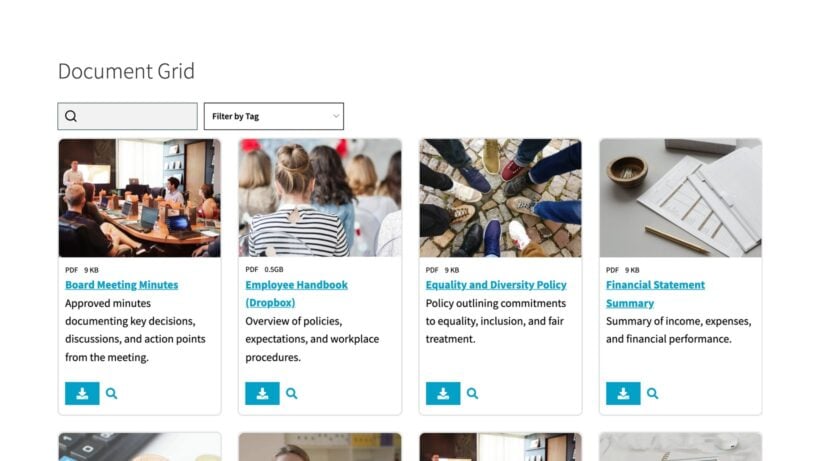
Every board generates a steady stream of documents. These include minutes, agendas, financial reports, policies, long-term plans, conflict-of-interest declarations, the bylaws themselves and the inevitable updates to them. After three or four years, most boards have hundreds of files spread across email attachments, a Google Drive that two people remember the password for, and a filing cabinet in the office.
When a new director joins, finding the documents they need to do their job becomes a multi-day archaeology project. When the auditor asks for the last three years of board minutes, you spend a week pulling them together. When a regulator queries a decision, you can't always reconstruct the record.
The fix is to give the board its own private document library on your website - one place where every governance document lives, organized by category, searchable, and only visible to people who should see it.
That's exactly the use case Document Library Pro is built for. It turns a WordPress page into a searchable, filterable document library, and you can lock individual folders to specific user roles so only board members see the board's documents. I've seen nonprofits use it to consolidate everything from sponsor packs to safeguarding policies into a single hub. The WordPress nonprofit resource library examples post walks through five real organizations using it that way.
What to put in the board's document library
- Governing documentsArticles of incorporation, bylaws, conflict-of-interest policy and any amendments. These should be the first thing a new director can find.
- Meeting recordsAgendas, board packs and signed minutes for every meeting going back at least five years. Tag each by date and committee.
- Financial reportsMonthly management accounts, annual audited accounts, the current year's budget and any major grant agreements.
- Plans and directionThe current long-term plan, the previous one for context, and any board-approved annual operational plans.
- PoliciesConflict of interest, whistleblowing, safeguarding (if you work with vulnerable people), data protection, expenses and fundraising ethics.
- Onboarding packA welcome document, board roster with bios, the rolling meeting schedule and a glossary of terms specific to the organization.
Keeping it private
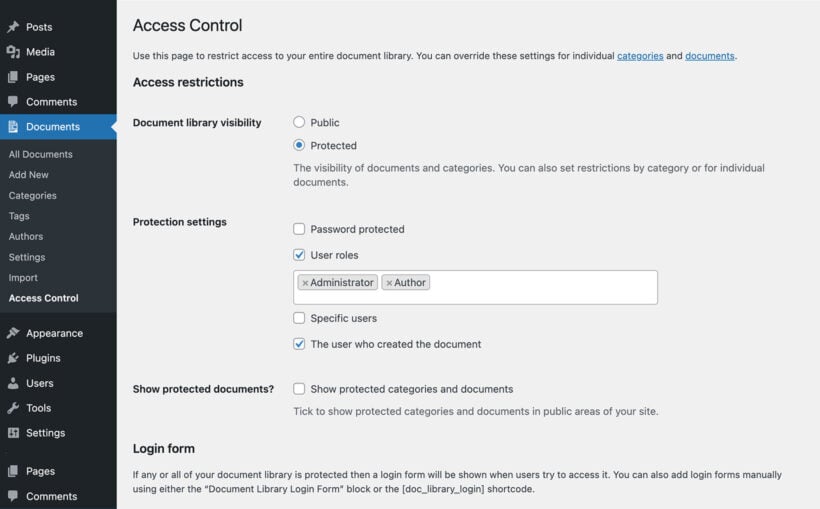
A board document library has to be private. The default option is to restrict access to logged-in users with a specific role (Board Member, for example), and to give each director their own account. Document Library Pro supports this directly through its role-based visibility settings, and pairs well with WordPress's built-in user roles for everything else. The combination means board documents stay invisible to public website visitors and to staff who shouldn't see them, while still being searchable for the people who should.
Common pitfalls to avoid
- Founder's syndromeThe founder stays on the board past the point of usefulness and resists succession planning. Term limits and a properly structured nominations process prevent this.
- Rubber-stamp boardDirectors who turn up, agree with everything and leave. Usually a recruitment failure - the board was packed with friends and donors rather than people willing to challenge management.
- Conflict-of-interest driftBoard members forget to declare changes in their personal or business circumstances. A standing item at the start of every meeting ("any new conflicts to declare?") keeps this current.
- Mission driftThe organization quietly moves into work that wasn't in the original charitable purpose. The board is responsible for catching this early.
- Information asymmetryThe executive director knows everything; the board knows what the executive director chooses to share. A well-organized board library and a culture of independent questions are the antidote.
Frequently asked questions about a nonprofit board of directors
How many people should be on a nonprofit board of directors?
Most US states require a minimum of three directors, and most successful nonprofits sit between seven and 15. Smaller than seven and you struggle to cover all the skill areas; larger than 15 and decisions slow down. Aim for the smallest board that genuinely covers the skills you need.
Are nonprofit board members paid?
In most countries and most nonprofits, no. Board members are volunteers who receive reasonable expenses (travel to meetings, accommodation if travelling far) but no salary or fees. Some large US nonprofits and most UK academy trusts can pay specific trustees if the role is genuinely full-time, but it requires regulator approval and a transparent process.
What's the difference between a board of directors and a board of trustees?
In the US the two terms are used almost interchangeably for nonprofit governance, with "directors" more common for 501(c)(3) corporations and "trustees" for foundations and some endowments. In the UK and many Commonwealth countries, charitable organizations have trustees while companies (including nonprofits structured as companies limited by guarantee) have directors. Functionally, the roles and duties are the same.
How long should board terms be?
Two- or three-year terms with a maximum of two consecutive terms is the most common structure. That gives each director enough time to get oriented and contribute meaningfully, while ensuring the board refreshes every few years.
Can a board member be removed?
Yes. The process is set out in the organization's bylaws and usually requires a vote by the remaining directors. Common grounds include missing too many meetings, breaching the conflict-of-interest policy, or acting against the organization's interests. The process should be in writing and applied consistently.
Final thoughts
A working board is built deliberately. Map the skills you need, recruit for the gaps, onboard properly, set term limits and give the board its own document hub so every member can find what they need without asking. Get those five things right and the board becomes one of the most valuable assets the organization has. Get them wrong and it's a constant source of friction that takes energy away from the actual mission.
If you're at the very start of building a board, my guide to recruiting board members for your nonprofit is the next thing to read. If you're working on the financial side of nonprofit reporting, the eight nonprofit KPIs that actually change decisions is worth a look too. And if your organization runs on WordPress, Barn2's 15% nonprofit discount applies to Document Library Pro and the rest of our plugin range.