How to recruit board members for your nonprofit


Recruiting board members for your nonprofit is more a relationship problem than a hiring problem. The best candidates are usually already in your orbit (donors, volunteers, partners) and the work is figuring out who fits and how to ask them properly.
A strong board determines almost everything else about a nonprofit's future: strategic direction, fundraising capacity, governance quality, setting and monitoring nonprofit KPI targets, the reputation you build in the community you serve. Get the recruitment right and the next five years gets easier. Get it wrong and even good programs struggle.
That makes board recruitment one of the highest-leverage things a small nonprofit can do, and one of the most commonly underdone. I've seen leaders treating each board seat as a one-off ask to recruit someone who happens to be available, rather than running a deliberate process. The deliberate version produces better boards.
In this guide, I'll cover what a nonprofit board actually does, the qualities to look for in a candidate, where to find them, how to make the ask, how to put together a candidate pack that helps people say yes and how to organize the documents that keep your board working once it's in place.
What a nonprofit board actually does
A nonprofit board of directors provides governance and leadership for the organization. In practice, that responsibility breaks down into a handful of concrete duties:
- Setting overall strategy and approving the annual plan.
- Hiring, supporting and evaluating the executive director or CEO.
- Approving the budget and overseeing financial stewardship.
- Ensuring legal and regulatory compliance, including filings, audits and reporting obligations.
- Building community relationships with donors, partners, volunteers and the people the organization serves.
- Fundraising directly and opening doors to networks that can fundraise.
The exact split varies by organization and should live in your bylaws. The point of being clear about it upfront is that potential board members will ask, "What would I actually be doing?" If you can answer that in one paragraph, recruitment gets significantly easier.
It's also worth distinguishing between two types of board seat: members who sit "by right" because of a job title or stakeholder role (less common) and members who are nominated or elected to serve (most boards). The recruitment process I'm describing here applies to the second category.
Qualities to look for in a board member
The instinct when recruiting is to look for prestige: well-known names, big titles, recognizable employers. Prestige sometimes correlates with what a board needs and can be good for marketing your nonprofit, but it's rarely the thing itself. The qualities that actually predict whether someone will be a useful board member are quieter:
Passion for the mission
A board member who deeply cares about what your nonprofit does will show up, push hard on strategy and stay engaged when the work gets difficult. Passion is harder to manufacture than skill. Look for it in how someone talks about their existing involvement with your cause, not in how impressive their CV looks.
Passion can also be broader than your specific mission. Some board members are driven by a more general commitment to the community or to giving back. That works just as well, as long as the energy is real.
Time and commitment
Enthusiasm without time is worse than honest unavailability. A board member who can't attend meetings, doesn't read the pre-reads and goes silent between quarterly meetings is a worse contributor than someone less senior who actually shows up.
Be specific about the time commitment when recruiting. "About six hours a month, plus one annual planning weekend" is more useful than "a few hours here and there". If the person you're considering can't realistically commit to the hours, they're not the right candidate for now.
Collaboration
Boards work through discussion, not unilateral decisions. A productive board member is comfortable expressing dissenting views, willing to compromise on the things that don't matter and able to read the room when a meeting needs to move on.
Look for evidence of this in how they've operated on previous boards, committees, leadership teams or community groups. People who default to working alone often struggle with the rhythm of board work.
Diverse perspectives
Boards composed entirely of people from the same industry, background or demographic make narrower decisions than they think they're making. BoardSource's research consistently finds that boards underestimate the importance of community knowledge in recruitment, and only around a quarter of boards treat demographic diversity as a recruitment priority.
The case for diversity is practical, not ideological. Varied perspectives genuinely produce better decisions, and boards reflecting the community they serve build deeper trust with that community. If your nonprofit serves a population none of your board has direct experience of, you're starting every strategic conversation a step behind.
Useful skills
Useful skills are a bonus, not a baseline. Financial literacy, legal background, marketing experience and fundraising networks are all useful, but none of them substitute for the qualities above. If a candidate has the passion, the time, the collaboration instinct and brings useful skills, that's the full package. If they have only the skills, they'll struggle to contribute on the things that matter most.
Where to find board candidates
Most boards are recruited from the same three or four pools. The mistake is reaching for unfamiliar pools (LinkedIn recruiting posts, paid services) before exhausting the ones already in front of you.
Your existing community
Your strongest donors, your most active volunteers and the people who keep turning up at events are usually the best place to start. They've already self-selected for caring about the work, they understand how the organization operates from the inside and they have a track record you can evaluate.
Run a simple audit: who has donated more than once, responded thoughtfully to donor surveys, volunteered consistently over the past year or attended multiple events? That's your first candidate list.
Existing board and staff referrals
Current board members and senior staff usually have a sense of who in their networks would be a fit. The advantage is that the referrer can speak to the candidate's strengths, weaknesses and likely fit before you make the formal ask. The disadvantage, if you over-rely on this channel, is that boards recruited entirely through referral tend to look demographically similar to the existing board.
Use referrals, but pair them with at least one channel that brings in people outside the existing network.
Professional and community networks
Local chambers of commerce, volunteer-matching services like VolunteerMatch, nonprofit-specific board services (BoardSource, BoardEffect's matching tool, or country-specific equivalents) and professional associations all offer ways to find candidates outside your existing pool. These take longer to convert into actual appointments, so start them well before you need to fill a seat.
Strategic partners
Organizations and individuals who already work alongside your nonprofit (accountants, legal advisers, communications partners, neighboring nonprofits) sometimes make excellent board members. They already understand your work, the relationship is established and the time commitment is easier to negotiate alongside existing professional ties.
How to make the ask
Asking someone to join your board is closer to a recruitment conversation than a fundraising ask. The candidate is being asked to give time, money (in many cases) and reputational support, none of which they'll commit to from a single email.
A few things that consistently make the ask land:
- Make it personal. A direct conversation (in person, video call or a properly written email) from a board chair, the executive director or a current board member who knows the candidate well. Generic outreach gets generic responses.
- Be specific about the role. "We're looking for someone with fundraising experience to chair the development committee" lands differently than "we'd love to have you on the board". The specific version tells the candidate they were chosen for a reason.
- Be honest about the commitment. Spell out time, financial expectations (if any), meeting cadence and expected term length. Candidates respect honesty about what's involved and resent finding out about a give-or-get expectation six months in.
- Anchor in the impact. What the organization is trying to do, what the board's role in that is and where this specific candidate would contribute. People say yes to causes they believe will make a difference, not to "joining a board".
- Give them an easy out. Offer to answer questions, share materials and connect them with current board members. Make it clear that "no" or "not right now" are both acceptable answers. Pressure produces reluctant yeses that turn into disengaged board members.
- Send a candidate pack. A well-organized pack of bylaws, financials, strategic plan, role description, board policies and expected time commitment often does more to convert a serious prospect than the ask conversation itself.
That last point is where most asks fall down. The pack itself is usually fine; the way it's delivered isn't.
Put together a proper candidate pack
The candidate pack is the single document set that determines how a serious candidate evaluates the opportunity. It should cover what the organization does, how it's governed, what the board's role is, what would be expected of the specific candidate and the practical materials (bylaws, recent financials, conflict-of-interest policy) they'd want to review before saying yes.
What goes in a strong candidate pack:
- A one-page "about the organization" with mission, history and current programs.
- The current strategic plan or annual plan summary.
- The most recent year's financial summary (or audited accounts, if you have them).
- Your articles of incorporation and bylaws.
- Board policies: conflict-of-interest, confidentiality, expense reimbursement.
- A board role description. It covers time commitment, meeting cadence, financial expectations, term length and committee structure.
- Brief bios of current board members and senior staff.
- A list of the past year's board minutes or summaries (redacted if needed) so candidates can see how the board actually operates.
A folder of attachments emailed back and forth gets messy fast, especially when candidates ask for specific documents at different points in the conversation. A small searchable library that prospects can access through a single link works better, both for the candidate's experience and for keeping versions controlled on your side.
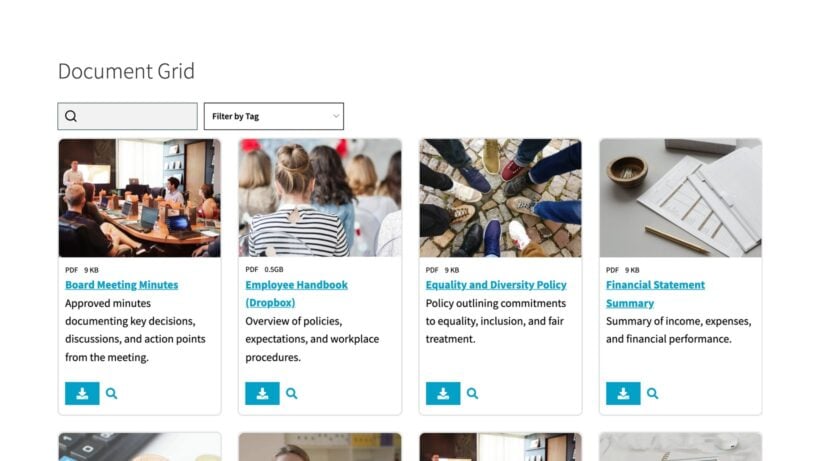
This is one of the setups I covered in my roundup of WordPress nonprofit resource library examples. Instead of attaching a stack of PDFs to an email, the organization hosts a searchable, filterable document library on its own site and shares a single link.
Document Library Pro is a popular choice for this among nonprofits. It turns your files into a sortable, searchable library with categories and access controls, so a candidate pack becomes one link instead of a folder of email attachments. You can keep it private so only invited board prospects see it, or expose specific categories publicly while restricting the rest.
It comes in two formats. On WordPress, you install the plugin and manage the library from your dashboard. If your site runs on Squarespace, a supplier's system or a private board intranet, there's an embeddable version that does the same job. You add it to your site with an embed code, or we publish it as a standalone site for you. Directors get one link to the board's documents whichever route you take.
Onboarding once they say yes
The first 60 days set the tone for a new board member's entire term. Done well, they finish onboarding feeling competent, oriented and clear on how to contribute. Done badly, they spend the first year asking for documents that should have been provided up front.
A useful 60-day onboarding cycle covers:
- Week 1. The board chair sends a welcome note, the new member signs acceptance of board policies (conflict-of-interest, confidentiality) and the executive director runs a short introductory call.
- Weeks 2-3. The new member reads the strategic plan, recent board minutes, the financial summary and the current key risks. They should leave this stage knowing what the organization does and where it is.
- Weeks 4-6. One-on-one calls with each existing board member, plus a meeting with each committee chair to understand committee work and identify where the new member will sit.
- Weeks 6-8. Attend the first board meeting, ideally without committee responsibilities yet. The aim is to absorb the rhythm before committing to specific work.
- Day 60. Check-in with the board chair to confirm committee assignments, identify any remaining gaps and set first-quarter goals.
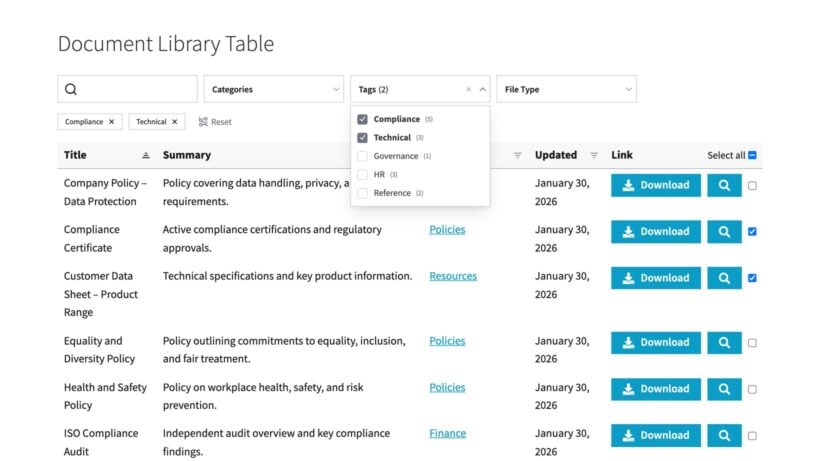
What makes the difference here, more than any specific schedule, is that the documents a new board member needs are organized and discoverable from the start. The same library you used during the candidate-pack stage covers the ongoing resource needs of the board itself. Meeting minutes, current policies, year-by-year financials, committee charters and governance updates all sit in one place. Adding documents to a single library as they're produced costs nothing extra and makes every future onboarding cycle shorter.
Some of these documents need to be publicly accessible. In the US, 501(c)(3) organizations must make Form 990 filings publicly available. In the UK and most other charity jurisdictions, registered charities have to publish annual accounts and trustee reports. A document library that handles both private (board-only) and public (anyone can view) categories from a single setup is the simplest way to meet both obligations without running two parallel systems.
For the wider WordPress setup that surrounds this (donation pages, volunteer signups, member areas), see my guide to WordPress for nonprofits, which covers the full stack a small nonprofit typically needs.
Final thoughts: recruitment is a process, not a one-off
The best-run nonprofit boards treat recruitment as an ongoing activity rather than something they do when a seat becomes vacant. They keep a running list of potential candidates, refresh it quarterly, build relationships with people in the candidate pool well before they need to ask and have a candidate pack ready to share at any moment.
Most of that work is relationship-building, which doesn't compress. Start the recruitment conversation with someone you'd love to have on the board now, even if there's no open seat. By the time one opens up, you'll know whether they're a fit and whether they're available. The deliberate version of board recruitment, done year after year, is what produces the boards that compound over time.
For more on supporting nonprofits with WordPress, see my guides to GiveWP alternatives, setting up a donation plugin and building a nonprofit resource library.